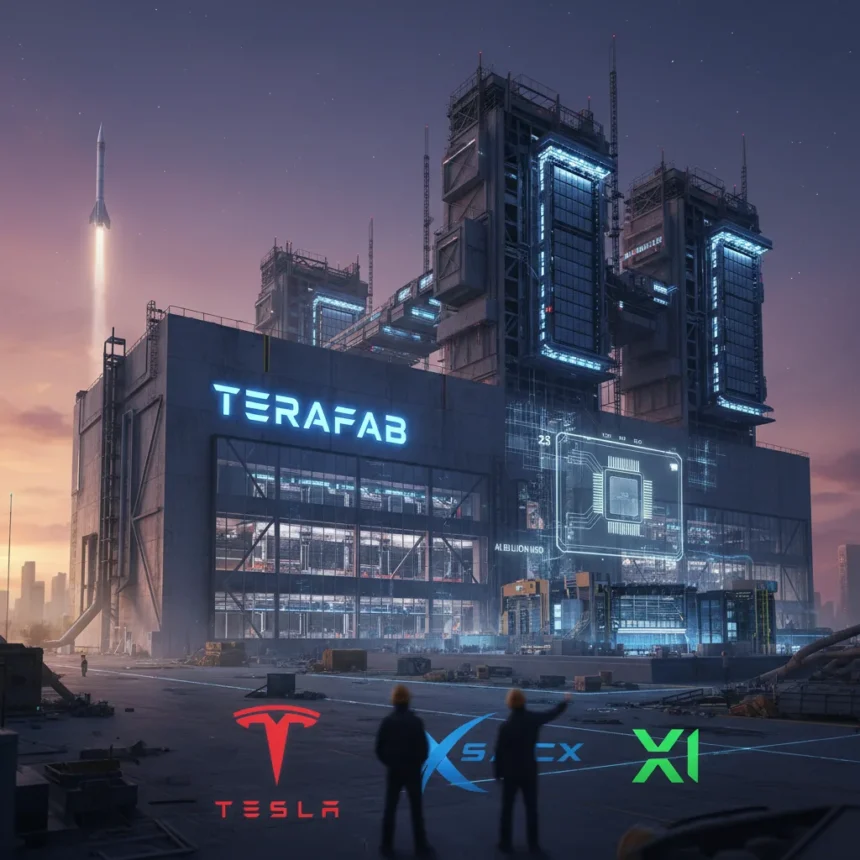
TeraFab semiconductor manufacturing represents one of the most audacious bets in tech history. Announced in March 2025, the joint venture between Tesla, SpaceX, and xAI aims to build a vertically integrated chip factory capable of producing over 1 terawatt of AI compute per year—roughly 50 times more than the entire global semiconductor industry currently outputs. At $20-25 billion, it is also one of the most expensive industrial projects ever attempted. The question is not whether it is ambitious. The question is whether it is possible.
Key Takeaways
- TeraFab will produce 1 million wafer starts per month and 100-200 billion custom AI chips annually
- The facility requires ~100 million square feet—equivalent to 15 Pentagons—and will not fit on Giga Texas
- Initial prototype fab on Giga Texas campus enables rapid chip iteration: design, mask fabrication, wafer production, and testing in days
- Project demands over 10 GW of continuous power, likely requiring dedicated solar farms and battery storage
- 80% of chips will power SpaceX orbital AI data centers deployed via Starship
- Production ramp targeted for 2027 with hiring already underway
Why TeraFab Matters Right Now
The semiconductor industry faces a critical bottleneck. Tesla needs custom AI chips for Full Self-Driving and Optimus robots. SpaceX needs radiation-hardened processors for orbital data centers. xAI needs massive compute capacity for its AI models. Currently, they depend on external suppliers like Samsung, which cannot scale fast enough. Elon Musk calls TeraFab “the final missing piece of the puzzle”—a way to control the entire supply chain from design to production to deployment. This is vertical integration at galactic scale, and it bypasses the entire foundry model that has dominated chip manufacturing for 30 years.
The timing is crucial. AI compute demand is growing exponentially, and traditional fabs cannot keep pace. By 2030, even with aggressive expansion, the industry will not produce enough capacity to meet demand. TeraFab aims to fill that gap with a single facility that dwarfs anything currently operational. Musk describes it as “the most epic chip building exercise in history by far”. That swagger masks a genuinely complex engineering and logistical challenge.
The Prototype Fab: Rapid Iteration on Giga Texas
Before building the full-scale TeraFab semiconductor manufacturing plant, Tesla is constructing an “advanced technology fab” on the Giga Texas campus in Austin. This prototype facility will enable what Musk calls a missing capability: an integrated loop where teams design a chip, fabricate lithography masks, produce silicon wafers, and test the final product—all within days. This compressed cycle allows rapid iteration on custom processors like the AI5, AI6, and D3 chips that power Tesla and SpaceX systems.



The prototype fab is not production-scale. It proves the concept works and accelerates development of next-generation architectures. Musk emphasizes that nothing like this exists anywhere in the world: “To the best of my knowledge, this doesn’t exist anywhere in the world, where you’ve got everything necessary to build logic memory and do packaging and test it, and then do the [photomasks], improve the masks, and just keep looping it”. This closed-loop design capability is the real innovation—not just building chips, but evolving them at unprecedented speed.
The Full-Scale Vision: 100 Million Square Feet
The actual TeraFab semiconductor manufacturing facility will be enormous. At approximately 100 million square feet, it is equivalent to 15 Pentagons or 3 Central Parks. It will not fit on the Giga Texas campus. Musk confirmed: “We couldn’t possibly fit the Terafab on the GigaTexas campus. It will be far bigger than everything else combined there”. The location remains unannounced, though a distributed strategy is possible—multiple fabs in different regions rather than a single monolithic complex.



The scale reveals the ambition. TeraFab aims for 1 million wafer starts per month and annual production of 100-200 billion custom AI and memory chips. To put that in perspective, the entire global semiconductor industry produces roughly 20 GW of AI compute today. TeraFab targets 100-200 GW annually, with potential to reach 1 TW per year at full capacity. This is not incremental expansion. This is a fundamental reshaping of chip supply.
Power, Land, and Logistics: The Real Challenge
Building a chip fab requires extraordinary infrastructure. TeraFab demands over 10 GW of continuous power—roughly equivalent to a large nuclear power plant. Musk’s solution involves solar farms and battery storage, but securing land, building power infrastructure, and managing environmental permitting is a formidable logistical challenge. These constraints alone could delay or reshape the project.
Water consumption is another hidden cost. Advanced chip fabs use massive quantities of ultrapure water for cooling and processing. Finding a location with adequate water supply, power, and land—while navigating zoning, environmental review, and local politics—is a multi-year undertaking. The 2027 production ramp timeline is aggressive given these constraints.
Space Chips: A Specialized Mission
One critical detail distinguishes TeraFab from conventional fabs: 80% of its output will power SpaceX orbital AI data centers deployed via Starship. These chips must survive the space environment—high radiation, extreme temperatures, and high-energy particle bombardment. Musk has emphasized the need for “a high-power chip that is designed for space that takes into account the difficult environment in space, where you’ve got high power, high energy ions, photons, you’ve got electron build up”. This is not commodity chip manufacturing. It is specialized aerospace-grade production at unprecedented scale.


This focus on space changes the calculus. While terrestrial AI data centers can use standard processors, orbital systems need radiation-hardened designs. Building a fab that masters both consumer-grade and space-grade production simultaneously adds complexity that most foundries avoid.
Is TeraFab Realistic or Science Fiction?
The skepticism is warranted. Building a fab of this scale, acquiring land, securing power, and ramping production by 2027 is an unprecedented feat. Samsung, Intel, and TSMC—the world’s largest chipmakers—each took decades to reach current scale. TeraFab aims to leapfrog them in a fraction of the time. The hiring is already underway, but recruiting thousands of specialized semiconductor engineers and managers is itself a bottleneck.
Yet Tesla and SpaceX have a track record of executing seemingly impossible projects. Giga Texas itself was built in roughly two years. Starship went from concept to orbital flight in under a decade. Neither project was easy, but both proved that extraordinary timelines are possible with sufficient capital and focus. TeraFab benefits from the same organizational intensity and the same willingness to absorb massive costs and risks.
The real question is not whether TeraFab is theoretically possible. It is whether the logistical, regulatory, and engineering challenges can be overcome on schedule. A delay of even 12 months would push production into 2028, undermining the strategic advantage of rapid vertical integration. A location dispute or power shortage could delay it further. These are not technical problems—they are practical ones, and practical problems are harder to solve than engineering challenges.
What TeraFab Means for the Chip Industry
If TeraFab succeeds, it fundamentally alters the semiconductor landscape. For 40 years, the foundry model—where specialized companies like TSMC manufacture chips designed by others—has dominated. TeraFab inverts this: Tesla and SpaceX design and manufacture their own chips in-house, eliminating the middleman and securing supply. This is vertical integration at a scale that the industry has not seen since the 1980s.
Competitors will face pressure to match this capability or risk losing strategic control over their supply chains. However, few companies have the capital, engineering talent, and manufacturing ambition to replicate TeraFab. This could entrench Tesla and SpaceX as chip powerhouses, not just car and rocket companies.
When Will TeraFab Actually Produce Chips?
The prototype fab on Giga Texas should begin iterating on custom chips within the next 1-2 years, enabling rapid design cycles for AI5, AI6, and D3 processors. Full-scale production from the main TeraFab facility is targeted for 2027, though this timeline is optimistic given land acquisition, permitting, and construction timelines. Even if delayed to 2028 or 2029, TeraFab would still represent a historic acceleration in chip manufacturing scale.
What About SpaceX’s Orbital Data Centers?
SpaceX plans to deploy orbital AI data centers powered by Starship, with 80% of TeraFab’s output destined for these systems. This is perhaps the most speculative element of the project. Orbital data centers are a nascent concept, and the technical and regulatory challenges are substantial. However, if successful, they would give SpaceX a unique competitive advantage in cloud computing and AI inference, particularly for latency-sensitive applications.
FAQ
How much will TeraFab cost?
The project is budgeted at $20-25 billion USD. This makes it one of the most expensive industrial facilities ever built, comparable to major infrastructure projects like highways or power plants. The total cost could increase if construction timelines slip or if additional capacity is added.
Where will the full TeraFab facility be located?
The location has not been publicly announced. Musk has confirmed it will not fit on Giga Texas and will require thousands of acres. A distributed strategy with multiple fabs in different regions is possible, but no details have been disclosed.
Can Tesla and SpaceX actually pull this off?
Both companies have executed extraordinary projects on compressed timelines, but TeraFab is exponentially more complex than previous ventures. Success depends on securing land, power, and talent while navigating regulatory approval. The 2027 production ramp is aggressive and carries significant execution risk.
TeraFab represents either a transformative bet on vertical integration or an ambitious overreach. The next 18 months will clarify which. If Tesla, SpaceX, and xAI can build the prototype fab and demonstrate rapid chip iteration on Giga Texas, the full-scale project becomes more credible. If delays mount, skeptics will rightfully question whether the timeline and scope are realistic. For now, TeraFab remains what it has always been: a bold gamble that could reshape the semiconductor industry or become a cautionary tale about ambition exceeding execution.
Edited by the All Things Geek team.
Source: Tom's Hardware