





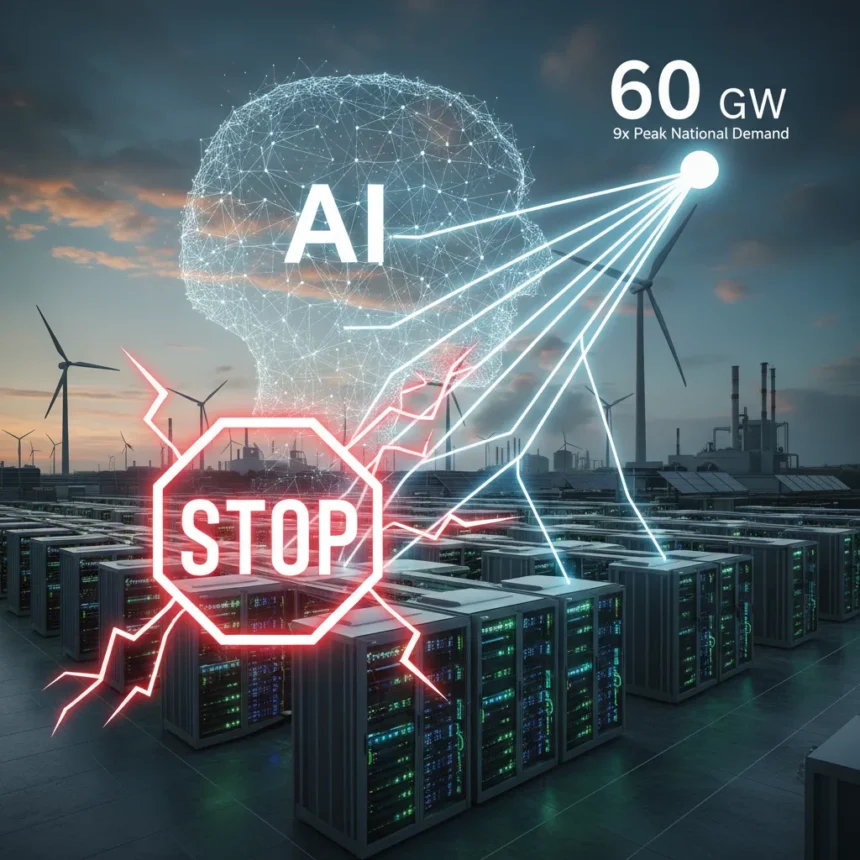
Denmark’s data center grid pause marks a turning point in how the world’s cleanest energy grids will coexist with hyperscaler AI ambitions. In March 2025, Energinet, Denmark’s state-owned grid operator, announced a moratorium on all new large-scale grid connection agreements. The pause was triggered by an extraordinary backlog: 60 gigawatts of pending project requests—nearly nine times Denmark’s entire peak electricity demand of approximately 7 GW. Data centers from Microsoft, Google, and Apple drive the majority of these requests, drawn by Denmark’s renewable energy infrastructure and cool climate.
Key Takeaways
- Energinet paused all new large-scale grid connections in March 2025 due to 60 GW in pending requests.
- The backlog is nine times Denmark’s peak electricity demand of 7 GW.
- Data centers account for nearly a quarter of the 60 GW queue.
- Denmark had 398 MW of installed data center capacity at the start of 2026, with 208 MW under construction.
- Projections estimate data center capacity reaching 1.2 GW by 2030.
Why the Data Center Grid Pause Happened Now
Denmark’s data center grid pause did not emerge from nowhere. The nation spent years cultivating itself as Europe’s AI infrastructure hub, leveraging world-leading renewable energy generation and favorable cooling conditions. That strategy worked—perhaps too well. By early 2025, the sheer volume of applications from hyperscalers overwhelmed the grid operator’s capacity to evaluate and integrate new connections. The three-month pause, initially announced in March, was designed to give Energinet time to develop new prioritization criteria for future applications. Data centers now compete directly with residential, industrial, and commercial power demands for grid access.
At the start of 2026, Denmark had 398 megawatts of installed data center capacity, with another 208 MW under construction. Projections estimate the nation will reach 1.2 GW of total data center capacity by 2030. That growth trajectory, while impressive, masks a deeper problem: the grid operator cannot physically accommodate the incoming requests without major infrastructure investment, and even that investment would take years to complete.
Data Centers and the Clean Energy Paradox
The data center grid pause exposes a paradox at the heart of renewable energy expansion. Nations that invested heavily in wind, solar, and hydroelectric generation expected to attract clean-tech industries. Instead, they are now racing to decide whether to prioritize AI infrastructure or preserve grid stability for existing residents and businesses. Denmark is the first Nordic country to confront this tension publicly, but the underlying pressure exists across Europe and beyond.


Data centers account for nearly a quarter of the 60 GW queue in Denmark. The remaining requests come from manufacturing, logistics, and other power-intensive sectors. Energinet must now weigh competing claims on finite grid capacity. Prioritizing data centers means betting on tax revenue, job creation, and foreign investment—but it also means accepting that AI infrastructure will consume an outsized share of the nation’s renewable output. Deprioritizing data centers preserves flexibility for domestic demand and other industries, but risks losing hyperscaler investment to competitors like Ireland, Sweden, or Norway.
What Comes Next for the Data Center Grid Pause
The initial three-month pause was set to expire in June 2025, at which point Energinet planned to implement new prioritization criteria. Those criteria remain undisclosed, but industry observers expect them to favor projects that align with Denmark’s energy and climate goals, or that offer grid-stabilizing services in return for access. Some applications may be rejected outright; others may face conditional approval tied to investment in grid upgrades or energy storage.



What makes Denmark’s move significant is not that it is the first nation to worry about data center power demands—it is not. But it is the first Nordic nation to formally pause new connections, and it is doing so while still maintaining world-class renewable generation. That signals that even the cleanest grids have limits. If hyperscalers cannot secure grid access in Denmark, they will pursue alternatives. Ireland, which already hosts major cloud infrastructure, may absorb some demand. Sweden and Norway, with their own abundant hydroelectric power, may position themselves as fallback options. The outcome of Denmark’s pause will ripple across European energy markets and reshape where AI infrastructure gets built over the next five years.
Is Denmark losing the AI infrastructure race?
Not necessarily. The pause is temporary and strategic, not a permanent rejection of data centers. Denmark remains attractive because of its energy profile and grid stability—assets that hyperscalers value long-term over short-term construction timelines. However, the pause does signal that Denmark will no longer rubber-stamp every application. Hyperscalers will need to negotiate harder, accept conditional terms, and potentially invest in grid infrastructure themselves. That raises the cost and complexity of building in Denmark, which may shift some new projects to less constrained markets.
Could other European nations follow Denmark’s lead?
Yes. Any nation with a limited grid facing explosive data center demand could implement a similar pause. France, Germany, and the Netherlands all face rising data center power requests. The difference is that Denmark acted first, before its grid reached a breaking point. Other nations may wait until crisis forces their hand, or they may preemptively adopt prioritization frameworks to avoid Denmark’s situation. Either way, the era of unrestricted data center expansion in Europe is ending.
Denmark’s data center grid pause is not a rejection of AI or a failure of renewable energy policy. It is a recognition that energy infrastructure cannot expand infinitely and that nations must choose how to allocate finite resources. The pause forces hyperscalers to justify their projects on merit, not just on Denmark’s clean energy brand. For readers watching AI infrastructure investment globally, this moment signals that grid capacity—not technology, not talent, not capital—is becoming the real constraint on where AI gets built. Denmark’s choice will shape European energy policy for the next decade.



Edited by the All Things Geek team.
Source: Tom's Hardware




