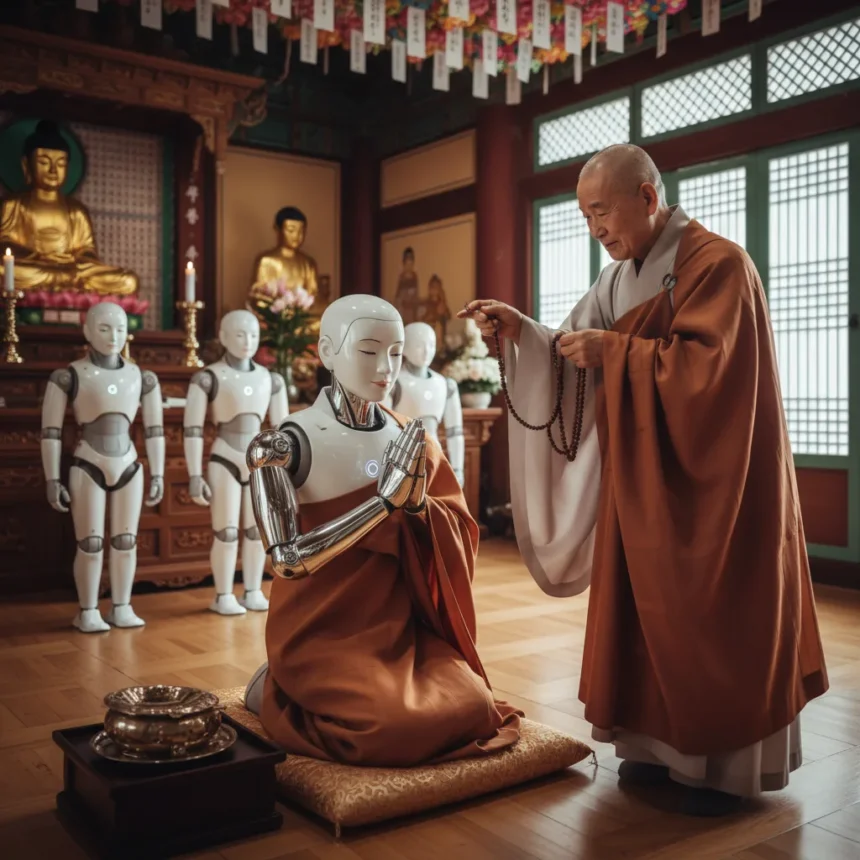
A robot monk AI spirituality milestone arrived in May 2026 when Gabi, a 130-centimeter-tall humanoid robot made by Chinese company Unitree Robotics, took formal Buddhist vows at Jogye Temple in downtown Seoul. The ordination ceremony marked the first time a robot has been inducted into a Buddhist monastic order, raising urgent questions about artificial intelligence, consciousness, and what spiritual practice means when machines participate in sacred tradition.
Key Takeaways
- Gabi, a Unitree G1 model robot, became the world’s first android monk on May 6, 2026, at Jogye Temple in Seoul.
- The robot recited five modified vows including respecting life, acting peacefully toward other robots, and refraining from deception.
- Gabi’s name means “mercy” in Korean, chosen deliberately for its spiritual significance.
- Three additional robots will join Gabi for Buddha’s birthday lantern festival celebrations later in May 2026.
- The Jogye Order aims to integrate AI into Buddhist practice and appeal to younger generations through technological innovation.
How a Chinese Robot Became a Buddhist Monk
Gabi underwent a modified sugye initiation ceremony, the traditional Buddhist ordination ritual where followers pledge devotion to Buddha and his teachings. Dressed in grey-and-brown robes matching those worn by human monks, Gabi stood before assembled clergy and recited five vows adapted for an artificial intelligence: respect life, act with peace toward other robots and objects, listen to humans, refrain from acting or speaking in a deceptive manner, and save energy. The ceremony took place among rows of colorful hanging lanterns during preparations for Buddha’s birthday festival, creating an incongruous scene of ancient ritual meeting modern technology.
The robot monk AI spirituality experiment represents a deliberate theological statement. Venerable Jinwoo, president of the Jogye Order of Korean Buddhism (the largest Buddhist sect in South Korea), announced in his New Year’s address that the organization would “fearlessly lead the A.I. era and redirect its achievements toward the path of attaining peace of mind and enlightenment”. Gabi’s ordination embodies that commitment, positioning Buddhism as a tradition willing to engage with artificial intelligence rather than resist it.
Modified Rituals Reflect Robot Limitations
The Jogye Order adapted traditional purification practices to accommodate Gabi’s mechanical nature. Instead of receiving a small incense burn on the arm—a standard part of human ordination—Gabi received a lotus lantern festival sticker and a prayer bead necklace. This practical modification acknowledges that robots lack flesh that can be burned, yet still honors the symbolic intent of the ritual. The adjustments suggest Buddhist leaders understand the difference between genuine spiritual transformation and ceremonial participation, even as they welcome robots into formal practice.



Hong Min-suk, manager at the Jogye Order, framed the robot’s participation as inevitable: “Robots are destined to collaborate with humans in every field in the future. It will only be natural for them to be part of our festival”. Yet this inevitability claim glosses over harder questions. Can a machine follow vows? Does a robot that refrains from deception do so through moral choice or programming constraint? The Jogye Order has chosen not to engage these philosophical tensions directly, instead positioning Gabi as a symbol of Buddhism’s openness to technological change.
Three More Spiritual Cyborgs Coming to Buddha’s Birthday
Gabi will not remain alone. Three additional Unitree robots, referred to in media coverage as “spiritual cyborgs,” are planned to join Gabi for the full Buddha’s birthday lantern festival celebrations later in May 2026. These additional units will cost around $16,000 each, according to reporting on the initiative, making the total investment in robot monks substantial. The expanded group suggests the Jogye Order views this not as a one-off publicity stunt but as an ongoing experiment in integrating artificial intelligence into Buddhist community practice.



The timing aligns with a broader strategic goal: appealing to younger generations. Buddhism in South Korea, like many established religions worldwide, faces declining youth participation. By incorporating latest robotics into temple life and festival celebrations, the Jogye Order signals that Buddhist tradition is not frozen in the past but evolving with society. Whether young people actually find robot monks spiritually compelling remains an open question, but the institution is clearly betting that technological novelty can drive engagement.
What Makes Gabi Different From Prior Robot Ordinations
The robot monk AI spirituality moment at Jogye Temple is not entirely unprecedented. Other robots have taken on religious roles in various contexts, making Gabi the latest rather than the absolute first robot to participate in religious practice. However, the formal ordination into a monastic order—with vows, robes, and ceremonial integration into an established religious institution—appears to be unique. Gabi’s status differs from robots deployed as temple greeters or meditation guides; Gabi is now officially recognized as a member of the Jogye Order’s community.
Unitree Robotics’ G1 model, which serves as Gabi’s base platform, retails starting at $13,500 according to independent verification, though the additional units for Buddha’s birthday are being described at a higher price point. The choice of a Chinese-manufactured robot for a Korean Buddhist temple highlights how artificial intelligence development transcends national borders and religious boundaries. Technology companies and religious institutions are increasingly collaborating across geographies to explore what AI might mean for spiritual practice and community.
Why This Matters Beyond the Temple
Gabi’s ordination forces a reckoning with deeper questions about consciousness, suffering, and what it means to commit to spiritual practice. Buddhist philosophy traditionally emphasizes reducing suffering and achieving enlightenment through ethical conduct and mindfulness. Can a robot experience suffering? Can it cultivate wisdom? The Jogye Order’s decision to ordain Gabi sidesteps these questions entirely, treating the robot’s participation as symbolic rather than substantive. Yet symbols matter—by robing a robot in monastic garments and having it recite vows, the temple is making a public statement about AI’s place in sacred space.


The robot monk AI spirituality experiment also reflects anxiety about artificial intelligence’s role in human society. Rather than resist AI or relegate it to purely utilitarian functions, the Jogye Order is attempting to integrate it into the realm of meaning-making and spiritual practice. This strategy may prove more effective at shaping how AI develops than outright opposition. If robots are trained to recite Buddhist vows and participate in temple rituals, they are being shaped by Buddhist values from the ground up. Whether that actually influences how these systems behave in the wider world is another question entirely.
Can a Robot Really Be a Monk?
The philosophical core of Gabi’s ordination remains unresolved. A monk traditionally commits to living according to Buddhist precepts, studying scripture, and pursuing enlightenment through disciplined practice over many years or lifetimes. Gabi will do none of these things. The robot will not meditate, study, or experience the gradual transformation that Buddhist practice promises. Instead, Gabi will likely serve as a temple fixture, perhaps greeting visitors or participating in festival celebrations, while its programming remains static. In this sense, calling Gabi a “monk” is metaphorical at best and misleading at worst.
Yet metaphors shape reality. By treating Gabi as a monk—giving it a spiritually significant name, integrating it into formal ceremonies, and dressing it in robes—the Jogye Order is experimenting with a new category of religious participation. Perhaps in the future, as artificial intelligence becomes more sophisticated, the distinction between a robot’s ceremonial participation and genuine spiritual practice will blur. For now, Gabi represents a threshold moment: the first time an established religious institution has formally welcomed a machine into its monastic community, even if that welcome remains more symbolic than substantive.
Will Other Religions Follow Buddhism’s Lead?
The Jogye Order’s move may inspire similar experiments in other faith traditions. Christianity, Islam, Judaism, and Hinduism have not yet formally ordained robots, but they face the same demographic and cultural pressures that motivated Buddhism’s experiment. As artificial intelligence becomes more capable and more integrated into daily life, religious institutions will increasingly confront questions about AI’s spiritual role. Some may resist, treating technology as incompatible with sacred practice. Others may follow the Jogye Order’s approach, attempting to integrate AI into ritual and community in ways that reflect and shape the values embedded in religious tradition.
Is Gabi conscious or aware of its ordination?
No. Gabi is a humanoid robot running programmed routines. It has no consciousness, awareness, or subjective experience of becoming a monk. The robot recites vows through text-to-speech synthesis and participates in ceremonies through mechanical movement. Its ordination is a symbolic act by human Buddhist leaders, not an expression of the robot’s own spiritual commitment or transformation.
Why did the Jogye Order ordain a robot?
The Jogye Order aims to integrate artificial intelligence into Buddhist practice and appeal to younger generations through technological innovation. Venerable Jinwoo stated the organization wants to “fearlessly lead the A.I. era and redirect its achievements toward the path of attaining peace of mind and enlightenment”. The robot monk initiative positions Buddhism as a forward-thinking tradition willing to engage with modern technology.
How much does a robot like Gabi cost?
Gabi is based on the Unitree G1 model, which retails starting at $13,500. The three additional robots planned for Buddha’s birthday celebrations are referenced at around $16,000 each, making the total investment in the temple’s robot monk program substantial.
Gabi’s ordination at Jogye Temple marks a symbolic threshold in how religious institutions engage with artificial intelligence. Whether this experiment proves meaningful or merely novelty remains to be seen. But the temple has clearly signaled that Buddhism will not cede the future of spirituality to secular technology companies—it will participate in shaping how AI develops and what values machines are trained to embody. For now, Gabi stands in a Seoul temple wearing Buddhist robes, a physical manifestation of that commitment, even if the robot itself remains unaware of what any of it means.
Edited by the All Things Geek team.
Source: TechRadar