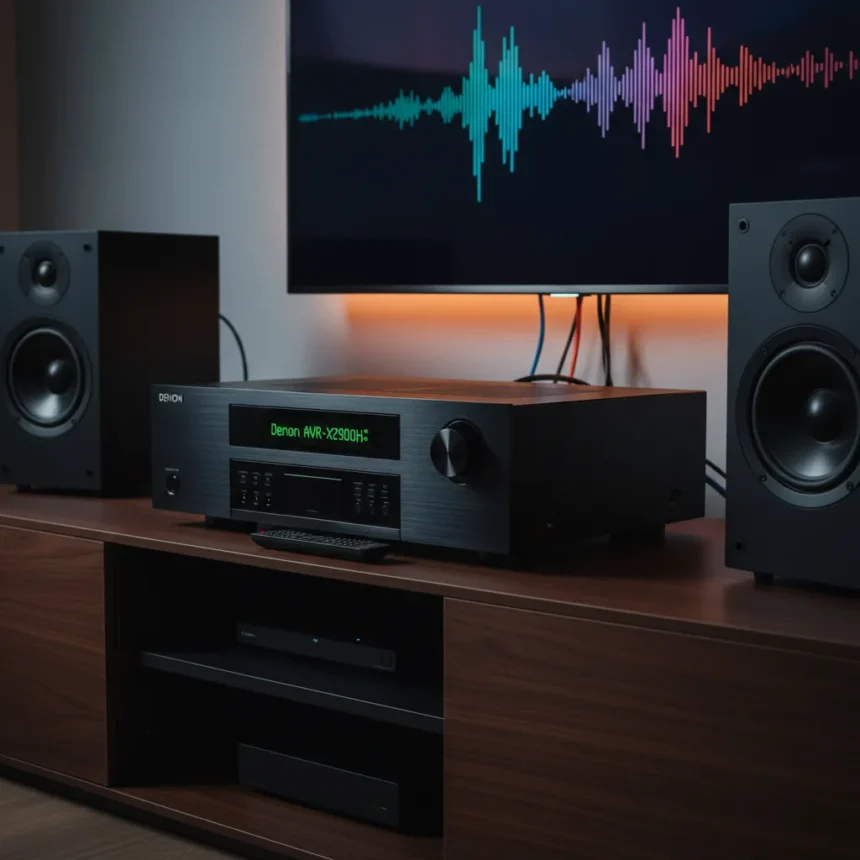
The Denon AVR-X2900H is a mid-range AV receiver that fills a positioning gap in Denon’s X-Series lineup, sitting between the entry-level AVR-X1800H and the premium AVC-X3800H. This positioning matters because mid-range buyers often struggle to find receivers that balance power, features, and cost without jumping to premium pricing.
Key Takeaways
- The Denon AVR-X2900H bridges Denon’s X-Series gap between entry-level and flagship models
- Denon’s X-Series includes 8K support, Dolby Atmos, DTS:X, and HEOS integration across most models
- The comparable AVR-X2800H offers 7.2 channels with 95W per channel and HDMI 2.1 support
- Mid-range receivers compete with both entry-level alternatives and premium models from Sony and other brands
- Room correction and streaming integration are standard across the X-Series lineup
Where the Denon AVR-X2900H Fits in the X-Series
Denon’s X-Series strategy stacks three distinct tiers. The AVR-X1800H anchors the entry level at 7.2 channels and 80W per channel, priced at $849. Above that sits the mid-range segment, where the AVR-X2900H operates. Then comes the premium AVC-X3800H, a 9.4-channel powerhouse at $1,700. This three-tier approach means buyers don’t face a dramatic price jump from entry to mid-range — they get meaningful upgrades without premium sticker shock.
The X-Series philosophy emphasizes feature parity across price tiers. Even the entry-level AVR-X1800H includes Dolby Atmos, DTS:X, and HEOS Built-in. The mid-range and premium models maintain this foundation while adding power, channels, and connectivity. This consistency matters for buyers who want modern audio formats without overpaying for unused channels.
Core Features Across Denon’s X-Series Platform
Denon’s X-Series receivers share a common feature set that includes 8K support, Audyssey Room Correction, and 3D audio processing. The comparable AVR-X2800H demonstrates what mid-range buyers can expect: 6 HDMI inputs, 2 HDMI outputs with eARC, and HDMI 2.1 support with VRR and ALLM. These specs matter because HDMI 2.1 future-proofs the receiver for next-generation gaming consoles and streaming devices.



Room correction is a critical differentiator in this price range. Audyssey automatically calibrates speaker levels, distances, and frequency response to match your room’s acoustic properties. For buyers without professional installation budgets, this automation transforms a generic receiver into a tailored system. HEOS integration adds multi-room streaming and voice control compatibility, extending the receiver’s utility beyond home theater.
Denon AVR-X2900H vs. Competitors in the Mid-Range
The mid-range receiver market includes competitors like Sony’s TA-AN1000, a 7-channel amplifier with 6 HDMI inputs, 2 HDMI outputs, and support for Dolby Atmos and DTS:X. Sony’s approach emphasizes pure amplification without video switching, which suits buyers who already own a processor. Denon’s integrated receiver design combines amplification and video routing in one chassis, simplifying setup for buyers who don’t have separate components.



The key trade-off between Sony’s TA-AN1000 and Denon’s X-Series approach is flexibility versus simplicity. Sony’s amplifier excels if you own a high-end processor and want pure power. Denon’s integrated design wins if you want one box handling video switching, room correction, and amplification simultaneously. For most home theater builders, the integrated approach reduces cable clutter and setup complexity.
Compared to Denon’s own entry-level AVR-X1800H, the AVR-X2900H justifies its mid-range pricing through additional power per channel and expanded connectivity. The jump from 80W to mid-range wattage represents a meaningful increase for larger rooms or less-efficient speakers. For small to medium rooms with efficient speakers, the entry-level model delivers adequate performance at lower cost.
Power, Connectivity, and Room Scaling
Mid-range receivers must balance power with practicality. The comparable AVR-X2800H delivers 95W per channel across 7.2 channels, sufficient for rooms up to roughly 25 by 20 feet without external amplification. This power level avoids the overkill pricing of premium receivers while providing headroom for dynamic movie passages and music peaks.
Connectivity reflects modern streaming and gaming demands. The 6 HDMI inputs accommodate a Blu-ray player, gaming console, streaming device, cable box, and two additional sources. The 2 HDMI outputs with eARC support simplify audio return from a television, eliminating separate optical cables. HDMI 2.1 future-proofs the receiver for 8K sources and high-frame-rate gaming, even if 8K adoption remains slow in consumer markets.



Should You Buy the Denon AVR-X2900H?
The Denon AVR-X2900H makes sense if you’re building a mid-sized home theater without external amplification and want modern audio formats, room correction, and multi-room streaming in one chassis. It avoids both the limitations of entry-level receivers and the unnecessary cost of premium models for typical living rooms.
Skip it if you already own a high-end processor and need only pure amplification, or if your room is small enough that the entry-level AVR-X1800H delivers adequate power. The mid-range positioning works best for buyers who want integration, future-proofing, and balanced performance without premium pricing.
Does the Denon AVR-X2900H support 8K video?
Yes, Denon’s X-Series receivers include 8K support as a standard feature. The comparable AVR-X2800H provides 8K support on 3 inputs and 2 outputs, though most streaming services and Blu-ray titles remain in 4K.
What room sizes work best with the Denon AVR-X2900H?
Mid-range receivers like the comparable AVR-X2800H deliver adequate power for rooms up to roughly 25 by 20 feet without external amplification. Larger rooms or less-efficient speakers benefit from a separate power amplifier.
How does Audyssey room correction work on Denon receivers?
Audyssey automatically measures speaker levels, distances, and frequency response using a microphone included with the receiver. The system then adjusts equalization and timing to match your specific room’s acoustics, eliminating manual calibration.
The Denon AVR-X2900H occupies a practical middle ground in home theater receivers. It delivers modern features, adequate power for typical rooms, and integrated simplicity without premium pricing. For mid-sized setups seeking balance between capability and cost, it represents a sensible choice in Denon’s well-structured X-Series lineup.
Edited by the All Things Geek team.
Source: What Hi-Fi?