





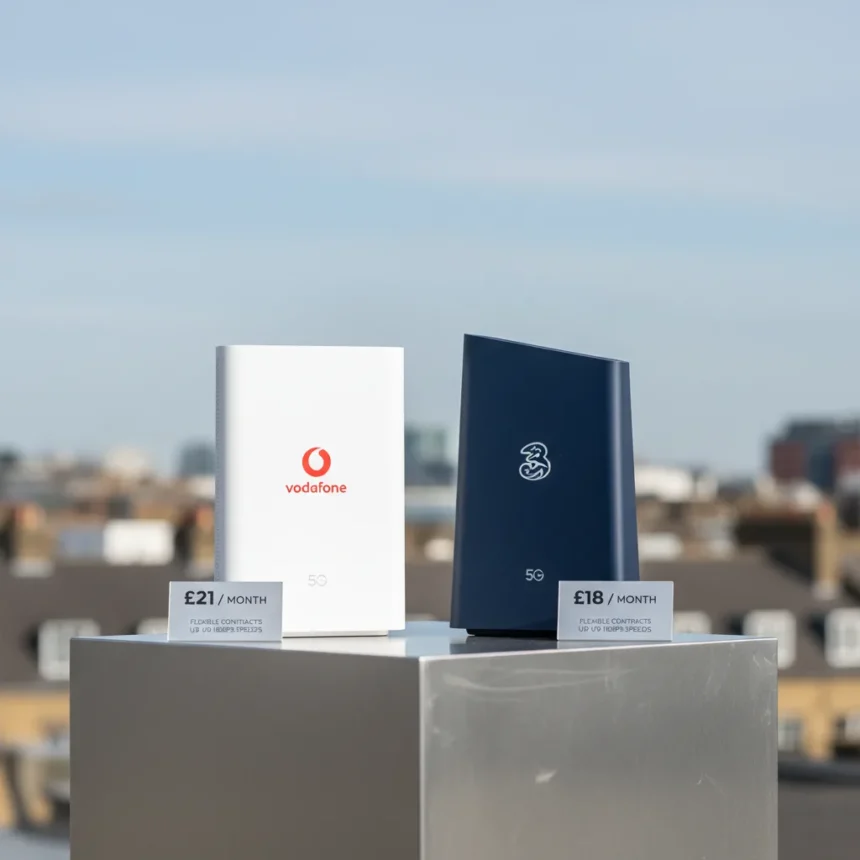
Vodafone 5G Broadband is a fixed wireless access home broadband service using Vodafone’s 5G network to deliver speeds up to 150Mbps, launched across the UK to reach 3.7 million homes without full fibre access. The service starts at £21 per month on a 24-month contract for speeds up to 50Mbps, or £30–£32 monthly on flexible 30-day rolling plans. Yet Three UK offers a nearly identical 5G home broadband service for just £18 per month—raising an uncomfortable question about value in a merged network landscape.
Key Takeaways
- Vodafone 5G Broadband delivers up to 150Mbps average speeds, 3x faster than typical part-fibre connections at 80Mbps.
- Entry price is £21/month (24-month contract) or £30/month (rolling 30-day), with unlimited data and self-installation included.
- Three’s competing 5G home broadband undercuts Vodafone at £18/month for similar speeds, creating pricing tension post-merger.
- Targets 3.7 million UK homes lacking full fibre, expanding full-fibre-like coverage to over 26 million homes nationwide.
- Self-install 5G Power Hub router requires no engineer visit, landline, or upfront costs; next-day delivery available.
Vodafone 5G Broadband Pricing Explained
Vodafone’s entry-level offer sits at £21 per month for a 24-month contract, promising speeds up to 50Mbps with unlimited data and no setup fees. Existing Vodafone mobile customers save £2 monthly via the Together bundle, bringing the effective cost to £19—still above Three’s headline £18 rate. For those avoiding long-term commitment, rolling 30-day contracts start at £30 per month (50Mbps tier) or £32 monthly (up to 150Mbps), offering flexibility renters and students value but at a premium over the contract option.
The pricing structure reflects Vodafone’s positioning as the UK’s largest full-fibre network operator, now expanded through the VodafoneThree merger with access to combined infrastructure reaching over 26 million homes. Yet that merger advantage has not translated into lower consumer pricing—a strategic choice that invites comparison with Three’s more aggressive entry point.
Why Vodafone Costs More Than Three’s 5G Offer
The £3 monthly gap between Vodafone (£21) and Three (£18) for comparable fixed wireless access service remains unexplained in Vodafone’s public messaging, creating friction in the post-merger narrative. Both services use 5G networks to bypass fibre infrastructure gaps; both offer self-installation and flexibility. Vodafone’s larger full-fibre footprint and claim to reach more homes with full-fibre-like speeds may justify premium positioning, but consumers see nearly identical technology at different price points.


This pricing discrepancy highlights integration challenges within the VodafoneThree merger, where two competing 5G home broadband products now coexist under one corporate umbrella. Vodafone may be banking on brand loyalty, bundle discounts for mobile customers, and its broader network reach to justify the higher entry cost, but the value proposition requires clearer articulation than current messaging provides.
Speed Performance and Real-World Expectations
Vodafone 5G Broadband advertises average speeds of 150–200Mbps in optimal conditions, with theoretical maximums reaching 1Gbps on 5G Ultra deployments. In practice, speeds fluctuate based on signal strength, distance from the nearest mast, and network congestion—a reality Vodafone acknowledges but does not emphasize. The service delivers roughly 3x faster speeds than part-fibre connections capped at 80Mbps, making it genuinely competitive for households streaming 4K video or gaming online.



The 5G Ultra rollout, now live in London, Manchester, Glasgow, and Cardiff, promises enhanced coverage and up to 25% better battery life on connected phones, though these benefits apply to limited geographic areas. For the broader 3.7 million homes Vodafone targets, standard 5G performance will be the norm—fast enough for most use cases but variable by location.
Setup, Installation, and User Experience
Vodafone 5G Broadband requires only self-installation: plug in the 5G Power Hub router (Wi-Fi 6 compatible), position it near a window for optimal signal, and connect devices. No engineer visit, no landline requirement, no upfront costs. Next-day delivery is available for orders placed before 10pm, making the service genuinely convenient for renters, students, and households avoiding engineer appointments.
This friction-free setup contrasts sharply with full fibre installations, which often require engineer visits and longer wait times. For busy households or those in rental properties facing landlord resistance to permanent installations, the self-install advantage is real—though it does not justify higher pricing than Three’s identical self-install model.
Target Market and Competitive Positioning
Vodafone positions 5G Broadband for renters, students, rural households, busy families, and anyone seeking flexibility without engineer visits. The 30-day rolling contract option directly addresses renters and short-term residents; the 24-month plan targets stability-seeking households willing to commit. Yet Three’s lower price undercuts this positioning, especially for price-sensitive renters and students.



A postcode checker on Vodafone’s website recommends the fastest available option—full fibre or 5G Broadband—based on address availability, helping customers make informed choices. This transparency is valuable but does not resolve the pricing question: why should a student in a postcode where both services work choose Vodafone at £21 over Three at £18?
Is Vodafone 5G Broadband worth the premium over Three?
The answer depends on whether Vodafone’s larger full-fibre footprint, Together bundle discounts, or perceived network reliability justify the £3 monthly premium. For existing Vodafone mobile customers, the £2 discount narrows the gap to £19—closer to Three’s £18 but still above parity. For new customers without Vodafone mobile service, the pricing advantage swings entirely to Three.
Can you get Vodafone 5G Broadband without a long-term contract?
Yes. Rolling 30-day contracts start at £30 per month for up to 50Mbps and £32 monthly for up to 150Mbps, with no cancellation penalties. This flexibility comes at a premium—£9–£11 more monthly than the 24-month contract option—but suits renters and those unwilling to commit.
What speeds should you realistically expect from Vodafone 5G Broadband?
Real-world speeds depend on signal strength, distance from the mast, and network load. Vodafone claims 5G is roughly 10x faster than 4G (which averages 23–35Mbps), but the advertised 150Mbps average requires optimal conditions. Most users will experience somewhere between 80–150Mbps, making the service suitable for streaming, gaming, and video calls but not guaranteed to hit maximum figures consistently.
Vodafone 5G Broadband solves a genuine problem—delivering fast, flexible broadband to millions of UK homes locked out of full fibre networks. But the pricing strategy raises questions about post-merger integration and customer value. At £21 per month, Vodafone is betting that network scale, bundle discounts, and brand trust outweigh Three’s more aggressive £18 offer. For most consumers, Three’s identical technology at a lower price will prove the more compelling choice unless Vodafone clarifies what extra value justifies the premium.
Edited by the All Things Geek team.
Source: TechRadar




