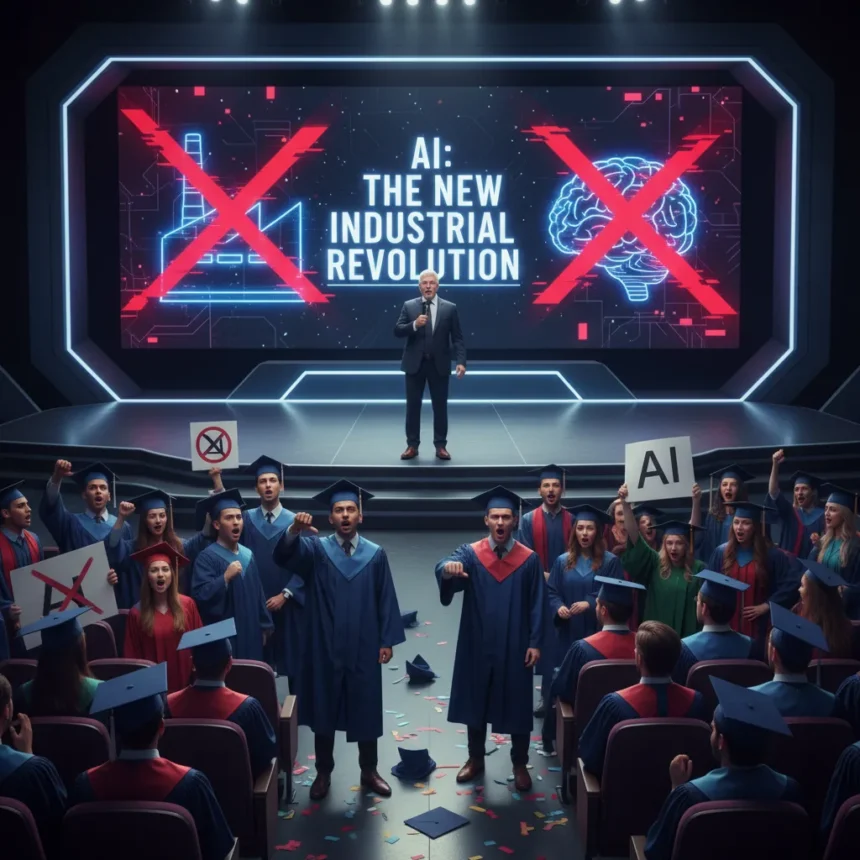
Gen Z AI skepticism just became impossible to ignore. At a recent graduation ceremony, a speaker was booed when she declared that artificial intelligence represents the next industrial revolution—a statement that would have drawn applause at a tech conference just years ago. The moment captures a fundamental shift in how young adults view AI, one that contradicts the breathless enthusiasm dominating Silicon Valley boardrooms and tech media.
Key Takeaways
- A graduation speaker faced boos for calling AI the next industrial revolution
- Gen Z shows measurable skepticism toward AI hype and automation narratives
- Young adults express nostalgia for a pre-AI world and worry about job displacement
- The generational divide on AI adoption is widening, not narrowing
- Tech industry messaging about AI may be fundamentally misaligned with Gen Z values
Why Gen Z rejects industrial revolution framing
Gen Z AI skepticism stems from lived experience, not abstract fear. Unlike millennials who grew up alongside the internet boom, Gen Z has watched AI’s rise coincide with housing unaffordability, climate anxiety, and persistent economic precarity. When a speaker frames AI as transformative progress, graduates hear a threat to their already uncertain futures. The boos were not anti-technology—they were anti-hype, anti-inevitability, and deeply skeptical of who benefits from AI’s rollout.
The industrial revolution comparison itself triggered the backlash. Historical industrial revolutions displaced workers, concentrated wealth, and created generations of instability before producing broad prosperity—if they ever did. Framing AI through that lens is not reassuring to people entering a job market already fragmented by gig work and automation. A speaker invoking the industrial revolution essentially told graduates: buckle up for disruption. They responded by booing.
This is not a fringe position among Gen Z. Surveys and cultural commentary consistently show young adults expressing ambivalence or outright concern about AI’s trajectory, particularly around job security and the concentration of AI power among a handful of companies. The graduation ceremony moment is simply the first time this skepticism found a public, visible outlet.



Gen Z AI skepticism versus millennial tech optimism
The generational divide on AI is stark and widening. Millennials, shaped by the internet’s early promise and the startup culture of the 2000s, tend to see AI as another inevitable wave of technological progress—disruptive, yes, but ultimately beneficial. Gen Z, who came of age during the reckoning with social media’s harms, platform monopolies, and the climate crisis, approaches AI with inherited skepticism. They have watched technology companies make promises before, fail to deliver, and escape accountability.
This shift matters because Gen Z will shape AI adoption, regulation, and cultural acceptance over the next decade. If a generation enters the workforce fundamentally skeptical of AI’s promises, that skepticism will influence hiring decisions, consumer behavior, and political pressure on regulation. A speaker at a graduation ceremony is not just addressing one audience—she is signaling to the tech industry what pitch will and will not land with the next generation of workers and voters.



The boos also reflect something deeper: a desire to preserve human connection and analog experience in a world moving toward automation. When Gen Z cheers for a time before AI, they are not rejecting progress—they are rejecting the premise that more AI is automatically progress. They want choice, not inevitability. They want to know who profits and who pays.
What the graduation ceremony moment reveals about AI messaging
The speaker’s framing—AI as industrial revolution—is standard rhetoric in tech leadership circles. It appears in earnings calls, keynotes, and venture capital pitches. It is designed to convey scale, inevitability, and historical importance. But at a graduation ceremony, surrounded by young people who will live with AI’s consequences, the same rhetoric sounds tone-deaf or even threatening.
Tech companies and their spokespeople have largely failed to address Gen Z’s specific concerns: job displacement without a safety net, algorithmic bias, data privacy, and wealth concentration. Instead, they offer grand narratives about human flourishing and technological progress. Gen Z hears these narratives as marketing, not reassurance. The boos were an audience rejecting a sales pitch dressed up as prophecy.
This messaging gap is not accidental. The tech industry benefits from framing AI as inevitable and beneficial, because that framing reduces pressure to regulate, distribute benefits fairly, or slow deployment. Gen Z AI skepticism threatens that narrative. The graduation ceremony moment is a preview of the friction that will emerge as young adults gain power—as voters, workers, and eventually, leaders—to shape AI’s trajectory.



Is Gen Z right to be skeptical about AI?
Skepticism about transformative technology is historically justified. The internet promised to democratize information and empower individuals; instead, it concentrated power in a few platforms and created new forms of surveillance. Social media promised connection; it delivered addiction and mental health crises. AI promises productivity and convenience; early evidence suggests it may also deliver job losses, environmental costs, and deepened inequality. Gen Z is not being irrational—it is being cautious based on pattern recognition.
That said, blanket rejection of AI is neither realistic nor necessarily wise. AI tools can solve real problems: medical diagnosis, scientific research, accessibility for people with disabilities. The question is not whether AI should exist, but who controls it, who benefits, and who bears the cost. Gen Z’s skepticism is most valuable when it pushes for those conversations rather than simply rejecting the technology outright.
FAQ
Why did graduates boo the speaker’s AI comment?
Graduates booed because the speaker framed AI as inevitable progress—the industrial revolution comparison—without acknowledging job displacement, wealth concentration, or other concerns specific to Gen Z’s economic situation. For young people facing uncertain futures, the framing sounded like a threat, not a promise.
Is Gen Z AI skepticism widespread or just a viral moment?
Gen Z AI skepticism is documented across surveys, social media, and cultural commentary. The graduation ceremony moment is one visible expression of a broader generational unease with AI hype, not an isolated incident. Young adults consistently express more caution about AI than older generations.
What should tech companies do differently when addressing Gen Z?
Tech companies should acknowledge concrete concerns—job displacement, data privacy, algorithmic bias—rather than dismissing them with grand narratives about progress. They should explain who benefits from AI, who might be harmed, and what safeguards exist. Honesty about trade-offs will land better with Gen Z than inevitability framing.
The graduation ceremony boos signal a reckoning. For years, the tech industry has shaped the AI narrative without meaningful input from the people who will live with its consequences. Gen Z AI skepticism is not anti-progress—it is pro-accountability. The industry can adapt its messaging and its practices, or it can expect more friction as this generation gains influence. The choice is not actually about AI at all. It is about whether tech leaders will listen to legitimate concerns or double down on hype.
Edited by the All Things Geek team.
Source: TechRadar