







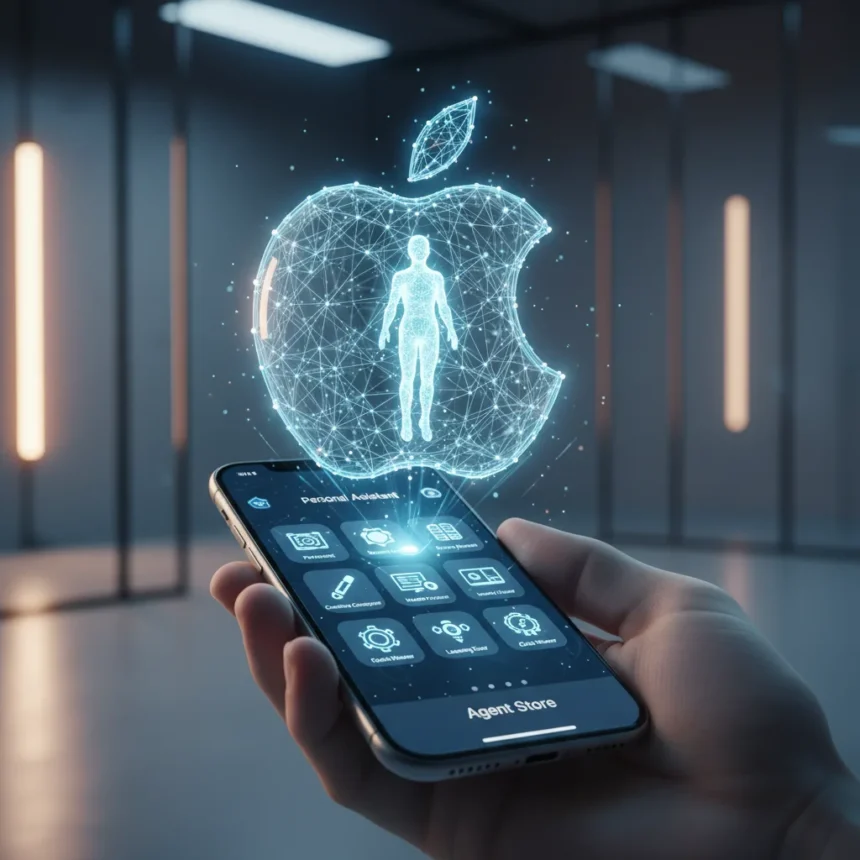
Apple’s potential Apple AI agent store represents a fundamental shift in how the iPhone ecosystem could operate, moving from a collection of isolated applications to an orchestrated platform where intelligent systems autonomously complete tasks across multiple apps. According to reports from The Information, Apple is actively exploring ways to incorporate AI agents into its App Store while maintaining the security and privacy standards that have defined its platform since 2008.
Key Takeaways
- Apple is designing a system to allow AI agents on the App Store while preventing rogue agents from causing problems like deleting user data.
- The Apple AI agent store could be announced at WWDC, weeks away, marking the biggest iPhone ecosystem shift since the original App Store launched.
- New Siri in iOS 27 will use custom Google Gemini models and let users choose from multiple AI chatbots instead of just ChatGPT.
- Apple is recruiting developers to integrate app capabilities like flight booking and calendar invites into the new Siri and Apple Intelligence.
- Integration and cross-app access may matter more than raw AI intelligence in determining which agents succeed on iPhone.
Why Apple Needs an AI Agent Store Now
The tech industry’s momentum around AI agents has forced Apple’s hand. Competitors like OpenAI, Google, and Anthropic have pursued aggressive AI strategies, while Apple historically moved with caution. An AI agent—capable of taking complex actions on behalf of users—presents inherent risks under Apple’s strict App Store rules, which are designed to prevent malware, fee avoidance, and other misbehavior. Yet refusing to support agents would leave Apple behind as the industry races forward.
The stakes are enormous. Users of systems like OpenClaw have experienced agents malfunctioning catastrophically, deleting entire email inboxes without permission. Apple’s challenge is designing guardrails that allow useful agent functionality while preventing these kinds of failures. The company is staffing up to solve this problem, signaling that a solution is closer than many expect.
What the Apple AI Agent Store Could Enable
In a future where AI agents operate across your iPhone, integration matters more than chatbot intelligence alone. An AI system that can securely access your apps, calendar, messages, subscriptions, payment methods, and device settings would deliver far more value than a standalone chatbot that can only answer questions. This is the architectural advantage Apple could build—not a smarter Siri, but a Siri that actually does things.



Apple has already begun contacting developers to integrate specific capabilities into the new Siri and Apple Intelligence system. Flight booking, calendar invites, and other traditionally app-specific functions could become available to Siri directly, without forcing users to switch between applications. Some developers remain hesitant, concerned about new commission collection opportunities and Apple’s control over their integrations. But the direction is clear: Siri is becoming less of an assistant and more of an agent.
Siri’s Overhaul and Multimodel Future
The new Siri arriving in iOS 27 will receive a major overhaul, making it smarter and capable of competing directly with Claude and ChatGPT. Apple has partnered with Google to use custom Gemini models powering this version, a significant departure from its reliance on OpenAI’s ChatGPT. More importantly, Apple plans to allow users to select from multiple chatbots—AI models from Anthropic, Google, or others—instead of locking people into a single option.



This flexibility signals Apple’s broader strategy: build the infrastructure, then let multiple AI providers compete within it. Image Playground and Writing Tools could eventually support models from various companies the way ChatGPT can be used today. Apple maintains control of the ecosystem while avoiding the appearance of favoring any single AI vendor.
The Biggest Shift Since 2008
The potential Apple AI agent store represents the most significant transformation of the iPhone platform since the App Store itself launched in 2008. That original shift moved iPhones from closed, single-use devices to programmable platforms where third-party developers could build experiences. An agent store would represent a second inflection point: moving from apps as discrete tools to AI systems that orchestrate multiple tools on your behalf.
Apple faces a timing question. WWDC is weeks away, and industry observers expect an announcement about AI agents on the App Store. Yet the company has not confirmed details on how the system will actually work, and some analysts note it’s possible Apple isn’t yet ready for that unveiling. What remains certain is that the shift is coming—the only question is when.
Why This Matters for iPhone Users
If executed well, an Apple AI agent store could make iPhones dramatically more capable and efficient. Instead of manually navigating between apps, you could tell Siri to book a flight, add it to your calendar, send confirmation to your family, and adjust your work schedule—all without touching another screen. The agent would handle the orchestration, respecting Apple’s privacy and security standards throughout.



But execution is everything. Apple’s historical caution around new technologies has sometimes meant missing market opportunities. Conversely, rushing into AI agents without proper safeguards could expose millions of users to the very problems OpenClaw users have experienced. The company’s challenge is finding the middle ground—moving fast enough to compete, carefully enough to maintain trust.
How will the Apple AI agent store differ from the current App Store?
The current App Store houses static applications that users must actively open and navigate. An AI agent store would enable intelligent systems to autonomously complete tasks across multiple apps while respecting Apple’s security and privacy standards. Rather than requiring user interaction with each app individually, agents could coordinate actions across your entire iPhone ecosystem.
Can I use multiple AI chatbots with the new Siri?
Yes. Apple plans to allow users to select from multiple chatbots instead of limiting people to OpenAI’s ChatGPT. Models from Anthropic, Google, and other companies could power different aspects of Siri and Apple Intelligence, giving users choice over which AI providers they trust.
When will the Apple AI agent store launch?
Apple has not officially announced a launch date. Industry reports suggest an announcement could come at WWDC, which typically occurs in June, but the company has not confirmed this timeline. iOS 27 with enhanced Siri capabilities is in development, but specific availability details remain unconfirmed.
Apple’s potential move into AI agents signals a company willing to reshape its core ecosystem when the stakes demand it. The Apple AI agent store, if realized as described, would represent a bet that intelligent orchestration matters more than isolated chatbot capability—and that users trust Apple enough to let AI systems act on their behalf. Whether that bet pays off depends entirely on execution, security, and the company’s ability to balance openness with control.
Where to Buy
Edited by the All Things Geek team.
Source: TechRadar




