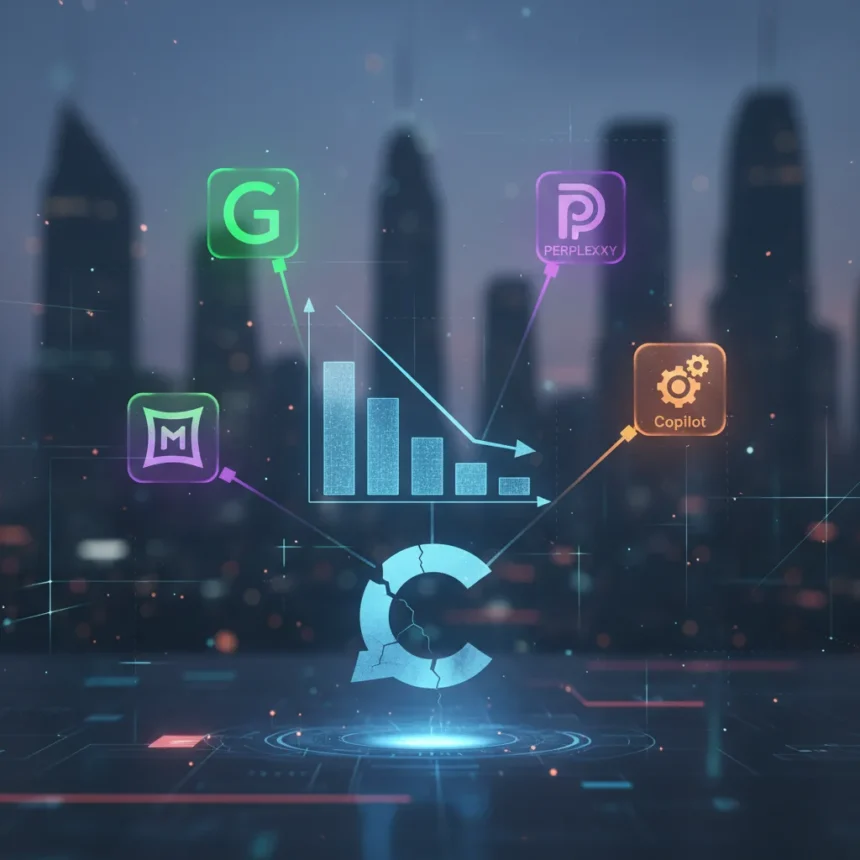
ChatGPT usage decline has reached an inflection point. New data shows OpenAI’s flagship chatbot is losing referral dominance while competing AI platforms—Gemini, Perplexity, Claude, and Copilot—steadily capture user attention and market share across the sector.
Key Takeaways
- ChatGPT’s referral share fell to 76.85% in April 2026, marking continued erosion of dominance.
- Google Gemini’s share rose to approximately 9% as users diversify their AI chatbot usage.
- Claude and Perplexity both gained material traction in recent months, signaling user appetite for alternatives.
- A “QuitGPT” movement has emerged as one factor behind declining popularity.
- The shift reflects broader user frustration and the maturation of the AI chatbot market.
ChatGPT usage decline accelerates across platforms
ChatGPT usage decline is no longer a minor dip—it is a structural shift. According to referral data tracking web traffic to AI chatbot platforms, ChatGPT’s share of incoming traffic slipped to 76.85% in April 2026, down from higher levels earlier in the year. While still commanding three-quarters of the market, the trajectory reveals a chatbot landscape no longer dominated by a single player. The decline matters because referral share directly reflects user behavior: fewer people are arriving at ChatGPT’s website, and more are exploring competitors.
This erosion accelerated after years of ChatGPT’s near-monopoly on consumer AI attention. The platform launched in November 2022 and quickly became synonymous with generative AI itself. Users treated it as the default choice, the way people once defaulted to Google for search. That assumption no longer holds. Today’s AI chatbot user is more likely to compare options, try multiple platforms, or switch based on specific use cases—a maturation that OpenAI did not anticipate when it dominated the early market.
Competitors gain material ground in ChatGPT usage decline
While ChatGPT usage decline accelerates, its rivals are not standing still. Google Gemini captured approximately 9% of referral share in the same April 2026 period, a meaningful gain for a product that faced early criticism for overly cautious responses and inconsistent quality. Claude, Anthropic’s chatbot, also gained material traction in recent months, though exact share figures vary by source. Perplexity, the AI search engine that combines chatbot functionality with web search, has emerged as a dark horse, appealing to users seeking real-time information without ChatGPT’s knowledge cutoffs.



Microsoft’s Copilot rounds out the competitive set, integrated into Windows, Edge, and Office—giving it distribution advantages that pure-play chatbots lack. Unlike standalone competitors, Copilot reaches users through existing workflows, reducing friction for adoption. This ecosystem advantage matters more as ChatGPT usage decline continues, because users already embedded in Microsoft’s suite face lower switching costs to Copilot than to an unfamiliar platform.
The diversity of competitors reflects a maturing market. Early AI adoption favored the first-mover. Today’s market rewards specialization: Claude for nuanced reasoning, Perplexity for current information, Gemini for ecosystem integration, Copilot for productivity workflows. ChatGPT usage decline stems partly from this fragmentation—no single chatbot now dominates every use case.



The “QuitGPT” movement and user frustration
A grassroots “QuitGPT” movement has emerged as a visible symptom of ChatGPT usage decline. While not a formal organization, the movement reflects real user frustration: pricing increases on premium tiers, perceived slowdowns in response quality, and a sense that OpenAI prioritizes enterprise customers over individual users. The movement gained visibility on social media as users shared their reasons for switching to competitors, turning ChatGPT usage decline into a cultural narrative, not just a data point.
User frustration alone does not explain the shift—markets move on capability and pricing, not sentiment. But the “QuitGPT” framing matters because it signals that ChatGPT no longer enjoys the goodwill of early adopters. Those users felt they were part of an AI revolution when they first tried ChatGPT. Today, many feel taken for granted. That emotional shift accelerates ChatGPT usage decline by making competitors feel like fresh alternatives rather than inferior knockoffs.
What ChatGPT usage decline means for the AI market
ChatGPT usage decline does not mean OpenAI is failing—it means the AI chatbot market is normalizing. When one product owns 95% of a category, any decline looks dramatic. At 76.85% share, ChatGPT remains the category leader by a wide margin. But the trajectory matters more than the snapshot. If ChatGPT usage decline continues at its current rate, the platform could fall below 70% within months, crossing a psychological threshold where it is no longer the obvious default choice.
This shift has implications for OpenAI’s business model. ChatGPT’s free tier drove adoption and habit formation; converting those users to paid subscriptions proved harder than expected. As ChatGPT usage decline accelerates, the free tier becomes less valuable as a funnel if users are already exploring paid alternatives like Claude Pro or Perplexity Pro. OpenAI may need to rethink its monetization strategy—either by improving the free tier experience to compete with rivals, or by doubling down on enterprise customers where it holds stronger advantages.


For the broader AI industry, ChatGPT usage decline signals that the market is healthy and competitive. Monopolies stifle innovation; competition drives it. Gemini, Claude, and Perplexity are forcing OpenAI to justify its pricing and quality in ways it did not need to a year ago. That pressure benefits users, who now have real alternatives and genuine choice in the AI chatbot space.
Is ChatGPT still the best AI chatbot?
ChatGPT remains the most widely used AI chatbot, despite the usage decline, but “best” depends on use case. For general conversation and writing, ChatGPT is still competitive. For current information, Perplexity excels. For nuanced reasoning and long-form analysis, Claude has earned a strong reputation. No single chatbot dominates every category anymore, which is precisely why ChatGPT usage decline is accelerating—users are matching tools to tasks rather than defaulting to one platform.
Why is ChatGPT usage declining if it is still popular?
ChatGPT usage decline reflects market maturation, not absolute decline in users. More people use ChatGPT than ever, but a smaller percentage of all AI chatbot traffic goes to ChatGPT because competitors have launched and improved. It is like Netflix losing streaming market share as Disney+, Amazon Prime, and others entered the market—Netflix did not fail; the market simply diversified. ChatGPT usage decline is a sign of a healthy, competitive AI market.
What is the “QuitGPT” movement?
The “QuitGPT” movement is a grassroots effort by users to publicly switch away from ChatGPT to competing platforms like Claude, Gemini, or Perplexity. Participants cite pricing increases, perceived quality drops, and frustration with OpenAI’s direction as reasons for leaving. While not formally organized, the movement has gained visibility on social media and reflects real sentiment among early ChatGPT adopters who feel the product no longer serves their needs as well as competitors do.
The shift in the AI chatbot market is real, measurable, and accelerating. ChatGPT usage decline is not a crisis for OpenAI—yet. But it is a wake-up call. The era of unchallenged dominance is over. OpenAI must now compete on product quality, pricing, and user experience in ways it never had to before. For users, that competition is a win: real choice, genuine alternatives, and pressure on all players to improve. The AI chatbot market is finally growing up.
Edited by the All Things Geek team.
Source: TechRadar