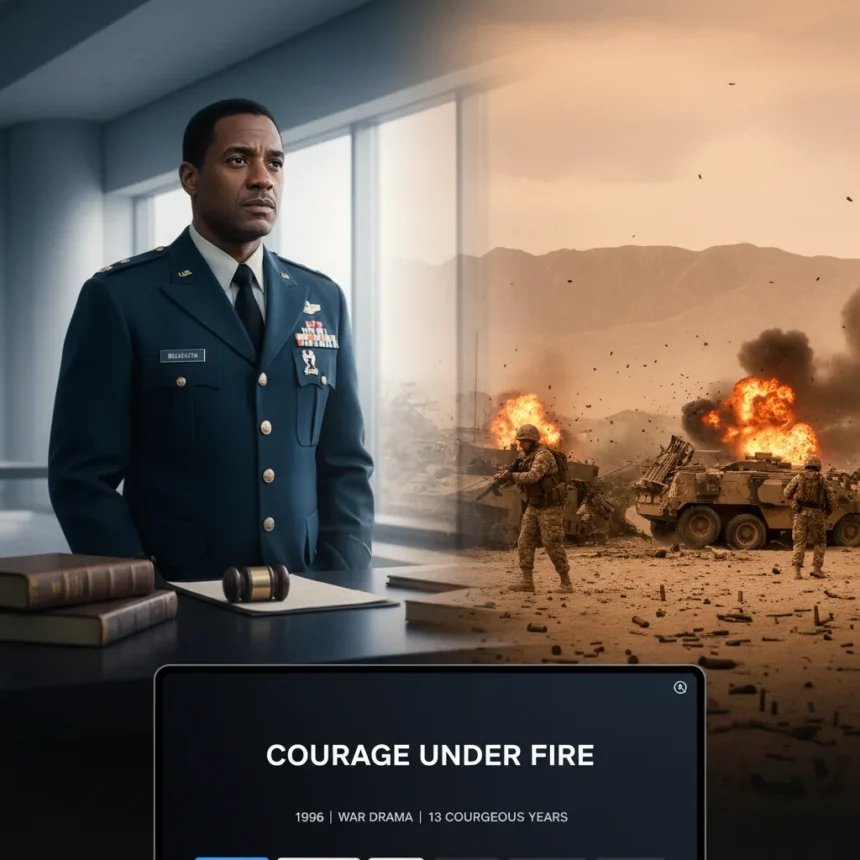
Courage Under Fire is a 1996 war drama directed by Edward Zwick that investigates the moral cost of combat through the eyes of a fractured soldier seeking truth. Nearly thirty years after its July 12, 1996 release, the film remains a compelling examination of guilt, heroism, and the gap between official narratives and battlefield reality.
Key Takeaways
- Denzel Washington plays Lieutenant Colonel Nathaniel Serling, haunted by a friendly-fire incident he caused during the 1991 Gulf War.
- The film combines investigative drama (à la A Few Good Men) with visceral war sequences that rival Saving Private Ryan’s intensity.
- Serling uncovers inconsistencies in the accounts of those involved in Captain Karen Walden’s death, a Medevac unit commander posthumously nominated for the Medal of Honor.
- Critical reception has remained strong, with Rotten Tomatoes showing an 86% critic score.
- Runtime is 1 hour 56 minutes, making it a tight, focused narrative without excess.
Courage Under Fire: Investigation Meets Combat Reality
The core tension of Courage Under Fire comes from its refusal to offer easy answers. Serling, a lieutenant colonel wracked by guilt over a friendly-fire incident on February 25, 1991, is assigned to investigate the circumstances surrounding Captain Karen Walden’s death during a Medevac rescue mission. Walden is being posthumously considered for the Medal of Honor—the first woman to receive it for combat heroism—but Serling’s interviews with her crew reveal a story that does not hold together. The official version crumbles under scrutiny, forcing Serling to confront not just Walden’s truth, but his own complicity in a system that prioritizes narrative control over accountability.
This investigative framework gives the film its A Few Good Men DNA: a determined officer peeling back layers of institutional deception. But where A Few Good Men culminates in a courtroom confrontation, Courage Under Fire operates in murkier territory. There is no clear villain to expose, no satisfying legal resolution. Instead, Serling discovers that heroism and cowardice are far more complicated than military medals suggest, and that the people we lionize may have been terrified, and the people we condemn may have acted with unexpected courage.
Why Courage Under Fire Endures as War Cinema
The film’s staying power lies in its refusal to sentimentalize war. Zwick balances the investigative narrative with flashback sequences that capture the chaos and confusion of actual combat—the Saving Private Ryan comparison is apt, though Courage Under Fire uses those sequences more sparingly and strategically. The 1991 Gulf War setting adds historical weight without overwhelming the personal story. Serling’s unraveling marriage and descent into alcoholism are not subplots; they are the emotional core. His guilt over his own mistake—killing his best friend in a moment of battlefield confusion—mirrors the larger moral ambiguity surrounding Walden’s mission.

Meg Ryan’s performance as the deceased Walden, revealed through crew interviews and flashbacks, presents a woman caught between duty and survival. One crew member describes her as someone who grew calmer under pressure, while another calls her a coward. The contradiction is the point. Courage Under Fire argues that war strips away the narratives we construct about ourselves and forces us to confront what we actually are in moments of extremity. That message has not aged.
The Performances That Hold the Film Together
Washington carries the entire film on his shoulders, and his portrayal of a man trying to maintain professional composure while falling apart internally is understated and devastating. He does not play Serling as a hero seeking redemption; he plays him as someone broken, trying to do his job while the ground shifts beneath him. The supporting cast, including Lou Diamond Phillips and Matt Damon in smaller roles, grounds the investigation in specific human voices rather than military archetypes. Each crew member’s recollection of Walden reveals as much about the person speaking as it does about the subject being investigated.



Frequently Asked Questions
Is Courage Under Fire worth watching today?
Yes. The film’s exploration of institutional truth-telling, moral ambiguity, and the psychological aftermath of combat remains relevant. It does not offer comfortable answers, which is precisely why it endures. The 86% critic score on Rotten Tomatoes reflects a film that respects its audience’s intelligence.
How does Courage Under Fire compare to other 1990s war films?
While Saving Private Ryan delivers visceral combat sequences and A Few Good Men offers legal drama, Courage Under Fire sits at the intersection—it is neither pure action nor pure procedural. It is interested in what happens after the battle, in the moral accounting that follows. That makes it a distinct entry in the war-film canon.
What is the film’s central conflict about?
Serling’s investigation into Walden’s death forces him to confront the gap between the official story and the truth. But the deeper conflict is internal: Serling must reconcile his own guilt with his duty to uncover what actually happened. The film argues that these two struggles are inseparable.
Courage Under Fire deserves to be rediscovered by viewers who have moved past the 1990s without catching it, and rewatched by those who remember it. It is a film about the cost of truth-telling in institutions that prefer comfortable lies, and about the way war leaves its marks not just on bodies but on consciences. Nearly thirty years later, that message only grows more urgent.



Where to Buy
Buy or rent "Courage Under Fire" from Amazon
Edited by the All Things Geek team.
Source: Tom's Guide