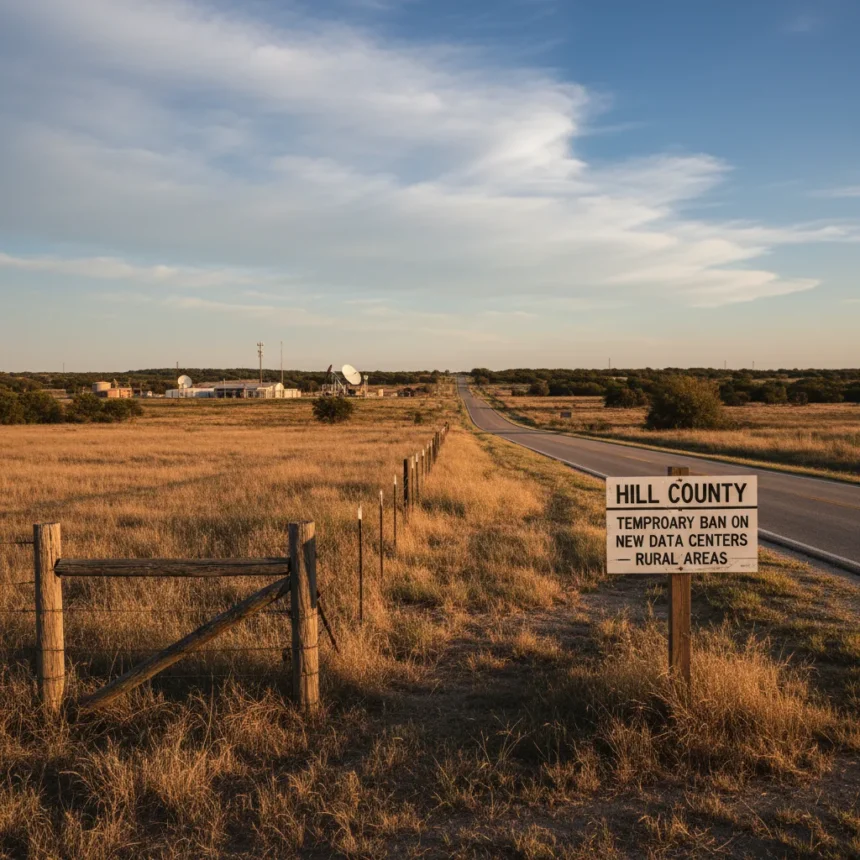
Hill County, Texas, a rural county roughly 55 miles south of Fort Worth, approved a one-year data center moratorium in unincorporated areas this week, marking what appears to be the first such ban by a Texas county. The 3-2 vote by county commissioners reflects escalating tension between rural communities and the AI infrastructure boom spreading across Texas, even as legal experts warn the county’s authority to impose such restrictions remains uncertain.
Key Takeaways
- Hill County commissioners voted 3-2 to pause new data center construction in unincorporated areas for one year
- The moratorium applies to rural zones with minimal zoning oversight, where large projects like Provident Data Centers’ 300-acre proposal have sparked community backlash
- Residents raised concerns about noise pollution, water consumption, electricity use, and environmental contamination
- County Attorney David Holmes warned commissioners they risk lawsuits, saying “You’re damned if you and damned if you don’t”
- Legal authority for county data center bans remains untested, with a state senator challenging whether counties can impose these restrictions
Why Hill County Voted to Pause Data Center Growth
After hours of public comment from dozens of residents, Hill County commissioners decided to hit pause on a sector moving fast and furious into rural Texas. The data center moratorium applies specifically to new construction in unincorporated areas, where projects can advance with little zoning oversight. County leaders framed the one-year pause as necessary time to study the impacts on public health, public safety, and community infrastructure.
The decision was not abstract. A Dallas-based company called Provident Data Centers proposed a 300-acre development in north Hillsboro that galvanized local opposition. Residents worried about noise pollution, light pollution, industrial waste, water depletion, and electricity grid strain. Some feared that if data centers were abandoned after construction and proper paperwork was not filed, the county could be left holding the liability. These concerns reflect a broader pattern: residents in neighboring counties have raised similar objections, saying projects are moving faster than public understanding or meaningful oversight.
The moratorium is temporary by design. County commissioners explicitly stated they need the year to assess potential risks and develop policy. This framing matters legally. University of Texas at Austin professor Robert Paterson told the Texas Tribune that Hill County is on “good grounds” because the moratorium has an end date and officials cited public health and safety as the rationale. Without that structure, the ban might face stronger legal challenges.


The Legal Threat Hanging Over the Ban
Here is the catch: Texas may not have the legal authority to enforce this ban at all. County Attorney David Holmes warned commissioners before the vote that they risk being sued. The state of Texas does not have what Paterson calls “a good test case” to clarify whether counties possess the power to regulate data center construction. That ambiguity is the real problem. A state senator is reportedly challenging the legality of data center moratoriums, and the uncertainty could invite litigation from developers or the state itself.
The data center moratorium Texas counties are attempting sits in a gray zone. Texas law does not explicitly grant counties authority to ban industrial projects like data centers in unincorporated areas, nor does it explicitly forbid it. Paterson’s assessment is cautiously optimistic for Hill County—the one-year sunset clause and the stated public health rationale provide legal cover—but no court has tested this yet. The next county to pass a similar ban, or a developer who challenges Hill County’s, could force a ruling that either emboldens rural resistance or strips counties of their power entirely.



Hill County’s Move Reflects Statewide Tension Over AI Infrastructure
Hill County’s vote is not an isolated protest. The action comes as part of a statewide battle over Texas’ data center boom, especially in rural counties where land is cheap and power is abundant. Other local governments have paused similar projects. Residents across neighboring counties have raised identical concerns—noise, water use, electricity consumption, and environmental risks—suggesting this is not a Hill County problem but a Texas problem.
The contrast is stark. Data center companies see rural Texas as ideal: low cost, available power, minimal zoning restrictions. Rural communities see the same thing and worry. A one-year moratorium does not stop the industry; it buys time. Whether that time results in meaningful regulation or simply delays the inevitable expansion depends partly on whether Hill County’s legal gamble pays off and partly on whether other counties follow suit. If the data center moratorium Texas counties are attempting gets struck down, rural communities will have lost their primary tool for slowing or studying these projects before they arrive.
What Happens After the Year Ends?
The moratorium expires in one year. Between now and then, Hill County officials must decide whether to allow data center construction to resume, impose permanent restrictions, or develop a regulatory framework that permits projects while addressing community concerns. That decision will likely depend on what the county learns during the study period and whether the legal challenges materialize.
If developers or the state sue before the year is up, the outcome could determine not just Hill County’s future but the future of data center regulation across rural Texas. If no lawsuit comes, other counties may follow Hill County’s example, creating a patchwork of local restrictions. Either way, the data center boom is not slowing. The moratorium is a speed bump, not a stop sign.



Is the data center moratorium Texas counties can impose legally enforceable?
No court has ruled definitively. Professor Robert Paterson said Hill County has “good grounds” because the moratorium has an end date and officials cited public health rationale, but Texas lacks a precedent case to establish county authority. A legal challenge could overturn the ban or clarify county power—the outcome is uncertain.
Why did Hill County target unincorporated areas specifically?
Unincorporated areas have minimal zoning oversight, allowing large industrial projects to move forward with few restrictions. By focusing the moratorium there, the county addressed the zone where data center development faces the fewest barriers and where community concerns were most acute.
What are residents most concerned about with data centers?
Residents cited noise pollution, light pollution, water consumption, electricity use, environmental contamination, and industrial waste. Some also worried that abandoned facilities could create long-term liability for the county if proper paperwork was not maintained.
Hill County’s one-year data center moratorium is a rare moment of local pushback against a national infrastructure trend. Whether it succeeds legally, whether it inspires other counties, and whether it actually changes policy after the year expires all remain open questions. What is certain is that rural Texas communities are no longer passive. They are asking questions about data centers before the bulldozers arrive—and they are willing to vote to buy time to get answers.
Edited by the All Things Geek team.
Source: Tom's Hardware