







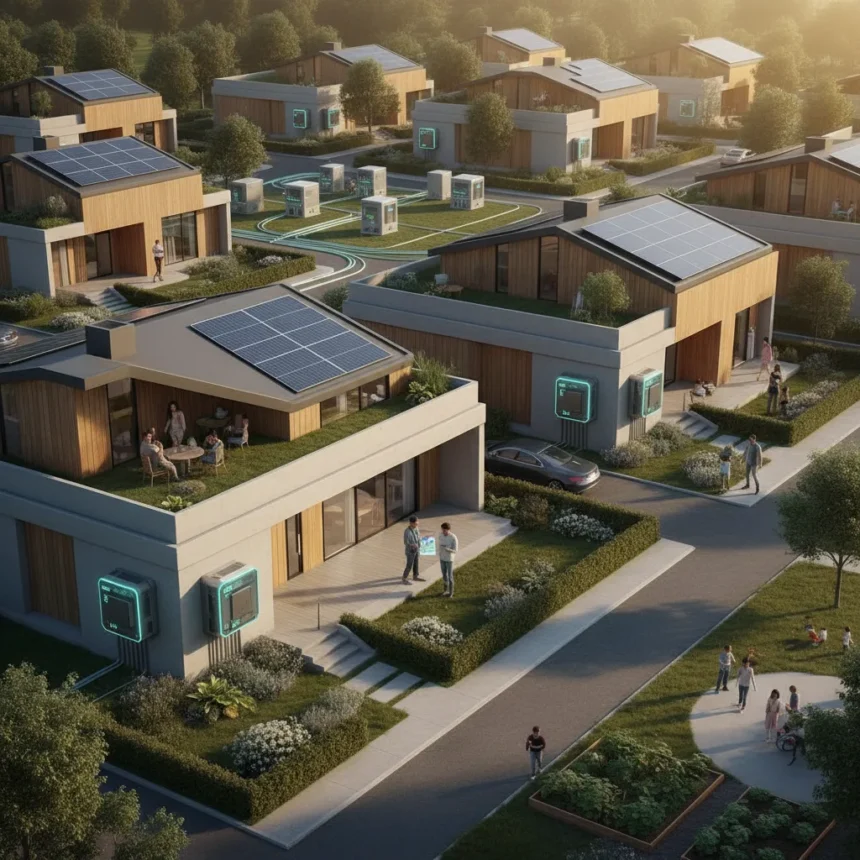
Residential AI data centers represent a fundamentally different approach to powering the AI boom—one that moves compute infrastructure from massive warehouse facilities into the backyards of individual homes. Span, a California-based startup known for smart electrical panels, is partnering with Nvidia to test this model by installing compact computing nodes called XFRA nodes on the exterior walls of homes in select communities.
Key Takeaways
- Span’s XFRA nodes are compact units installed outside homes, roughly the size of standard HVAC condenser units.
- The trial involves PulteGroup and additional homebuilder partners in a handful of communities under construction.
- Homeowners receive compensation, with Span previously citing an example of 150 per month, though some cases may have no fee.
- Span claims 8,000 XFRA units can be installed six times faster and at five times lower cost than a typical centralized 100 megawatt data center.
- The model exploits unused electrical transmission capacity already available in many residential neighborhoods.
Why Distributed Residential AI Data Centers Matter Now
The AI industry faces a crushing infrastructure bottleneck. Training and running large language models demands enormous amounts of electricity and cooling capacity, driving a race to build massive data centers. But constructing these facilities takes years, costs billions, and faces fierce local opposition from communities worried about grid strain and environmental impact. Span’s distributed approach sidesteps these problems by leveraging existing neighborhood infrastructure and spreading the computational load across thousands of homes instead of concentrating it in one location.
The timing is critical. Nvidia’s involvement signals that the AI chipmaker sees real potential in this model, not just as a fringe experiment but as a viable path to scale compute capacity faster than traditional methods. By embedding AI infrastructure into residential construction projects through PulteGroup and other homebuilders, Span avoids the permitting delays and community resistance that plague centralized data center expansion.
How Residential AI Data Centers Actually Work
Span’s XFRA nodes are white boxes installed near standard exterior utilities—air conditioning units, electrical panels—making them visually unobtrusive. Each unit contains Nvidia GPUs and AMD CPUs alongside cooling systems, designed to operate independently while remaining networked as part of a larger distributed computing grid. The key insight: most homes use only about 42% of the electricity allocated to them, and rarely reach peak usage. Span’s smart electrical panels detect this spare capacity and use it to power the compute nodes without disrupting household power availability.



This is fundamentally different from centralized data centers, which must be purpose-built with dedicated infrastructure, massive cooling systems, and redundant power supplies. Residential nodes piggyback on existing grid infrastructure, reducing deployment time and capital costs. Span claims it can install 8,000 XFRA units approximately six times faster and at roughly five times lower cost than constructing a typical centralized 100 megawatt data center of equivalent capacity.
The Homeowner Economics and What Still Remains Unclear
Span previously shared an example payment of 150 per month to homeowners hosting nodes—roughly half of what average Americans spend on electricity and broadband combined. In some cases, there may be no upfront fee at all; instead, Span covers a substantial portion of the homeowner’s electricity and internet bills in exchange for hosting the equipment. This model transforms homeowners into infrastructure participants, turning their spare electrical capacity into a revenue stream.



What remains murky: the trial is limited to new construction communities partnered with PulteGroup and other homebuilders, not existing homes. This means the model has not yet been tested at scale in established neighborhoods where retrofitting would be more complex. The article does not specify whether Span plans to expand beyond these controlled trial environments or what timeline might apply to broader rollout. The units are designed to blend in with home exteriors, but independent verification of their visual impact and noise levels is absent from available reporting.
Distributed Computing vs. The Centralized Data Center Status Quo
Traditional data centers concentrate computing power in single locations, optimizing for efficiency through massive scale but sacrificing deployment speed and community acceptance. Residential AI data centers flip the trade-off: they sacrifice some efficiency gains from centralization but gain speed, lower upfront costs, and distributed risk. If one node fails, the network continues. If one community resists expansion, the model simply deploys elsewhere.
The comparison matters because it reveals why this approach could accelerate AI development. Every month of delay in data center construction costs AI companies millions in lost training time and competitive position. A model that cuts deployment time by six-fold while reducing costs by 80% is not just incremental—it could reshape how the industry plans infrastructure for the next decade.
What Could Go Wrong With Residential AI Data Centers
The biggest unknowns surround long-term reliability and homeowner satisfaction. Cooling systems, even compact ones, generate heat. Power-hungry GPUs create electromagnetic interference. What happens when a node fails and needs replacement? Does the homeowner have to grant access to technicians? If the node malfunctions, who bears the cost of repairs? The trial will answer these questions, but until then, residential AI data centers remain an elegant theory rather than a proven model.



There is also the question of scalability beyond new construction. Installing nodes in homes under construction is far easier than retrofitting existing homes with electrical and cooling upgrades. If Span wants to deploy millions of nodes, it will eventually need to move beyond the PulteGroup partnership into the existing housing stock—a much harder problem.
Will residential AI data centers actually stay quiet?
Span claims the units are designed to blend in and operate without disrupting homeowners, roughly the size of standard HVAC condensers. However, the research brief does not provide independent verification of noise levels, heat output, or long-term neighbor relations. Real-world experience from the trial will determine whether these units truly are as unobtrusive as promised.
How much can homeowners actually earn from hosting a node?
Span has cited an example payment of 150 per month, though the actual amount varies by location and arrangement. In some cases, instead of a flat fee, Span covers a significant portion of the homeowner’s electricity and broadband bills. The exact financial terms remain negotiable and dependent on local electricity costs and grid conditions.
When will residential AI data centers become available to existing homes?
The current trial is limited to new construction communities partnered with PulteGroup and other homebuilders. No public timeline has been announced for expanding to existing homes or rolling out beyond trial communities. The model remains experimental and its broader deployment depends on the success of early installations.
Residential AI data centers could reshape infrastructure deployment, but they are still unproven at scale. Span’s partnership with Nvidia and PulteGroup suggests serious backing, yet the real test comes when these nodes move from controlled trial environments into real homes with real homeowners managing expectations over years. If the model works, it could accelerate AI development by years. If it stumbles on reliability, noise, or neighbor relations, it becomes a cautionary tale about infrastructure shortcuts. The industry is watching closely.
Edited by the All Things Geek team.
Source: TechRadar


