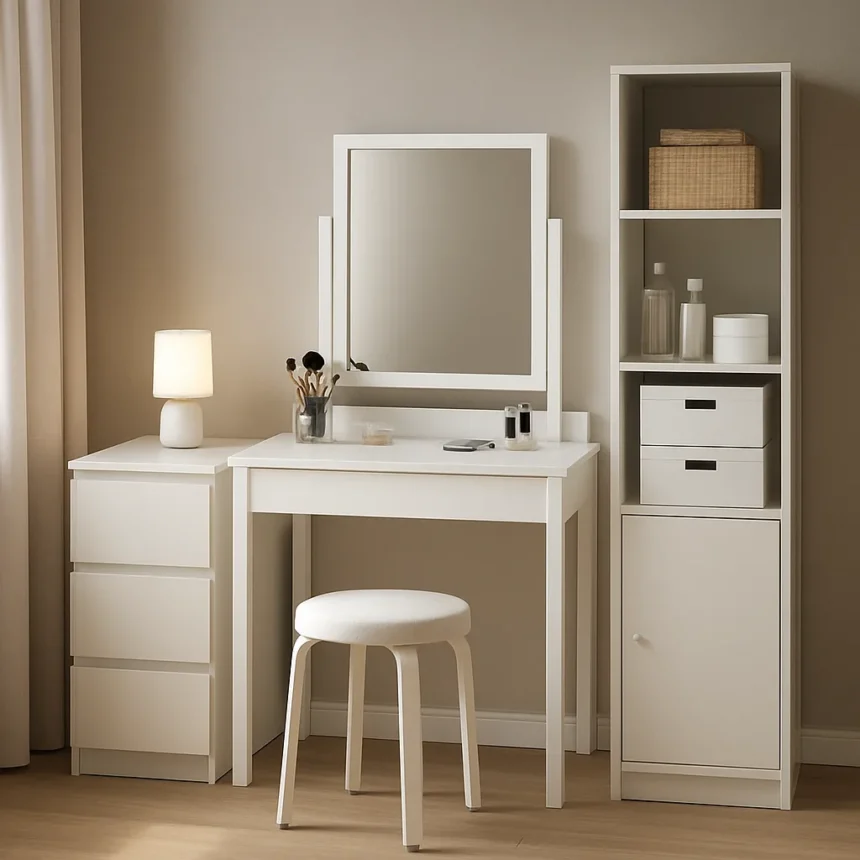
IKEA vanity products offer a flexible, affordable way to create a dedicated beauty station in your home. Rather than investing in a single expensive vanity unit, many people find that combining multiple IKEA pieces delivers better functionality, customization, and value.
Key Takeaways
- IKEA vanity products can be mixed and matched to create custom setups ranging from simple to elaborate.
- Combining separate pieces often costs less than buying a pre-built vanity unit.
- Modular IKEA products allow you to scale your vanity from a single item to a full hidden beauty station.
- Strategic product combinations maximize storage and mirror placement for better daily use.
- The modular approach lets you upgrade individual components without replacing the entire setup.
Why IKEA vanity products work better than single-unit alternatives
A complete vanity setup requires multiple functional elements: a work surface, storage, lighting, and a mirror. Single pre-built vanity units often compromise on one or more of these elements to fit a fixed footprint. IKEA vanity products solve this by letting you choose each component independently. You pick a desk or table that fits your space, add drawers or shelving for storage, position a mirror at eye level, and incorporate lighting exactly where you need it. This modular approach means no wasted space and no sacrificing functionality for aesthetics.
The cost difference is significant. A high-quality standalone vanity desk from a furniture retailer can exceed what you’d spend assembling three or four IKEA pieces into a superior setup. Because IKEA manufactures at scale and keeps designs simple, individual components stay affordable while maintaining durability for daily use.
Building a vanity setup progression with IKEA products
IKEA vanity products work best when you think about them as a progression rather than a single purchase. You might start with a simple standalone desk or table, which serves as your foundation. This gives you a flat work surface for makeup application, skincare routines, and daily grooming tasks. It’s the bare minimum for a functional vanity, and many people find this sufficient for their needs.

From there, you can expand by adding storage components. Drawers, shelving units, or wall-mounted organizers stack around your base surface, keeping brushes, palettes, and skincare products within arm’s reach. This second layer transforms a basic table into an organized station where everything has a designated spot. You spend less time hunting for items and more time actually using your vanity.
The final evolution is the hidden beauty station—a complete setup where mirrors, lighting, and storage integrate so smoothly that the entire vanity can close or tuck away when not in use. Some people achieve this by pairing a desk with a mirror cabinet, while others use wall-mounted shelving with integrated lighting and a fold-down work surface. IKEA’s range of products makes each of these configurations possible without custom fabrication or expensive carpentry.



Key design principles for IKEA vanity combinations
Successful IKEA vanity setups follow a few consistent principles. First, ensure your work surface height matches standard desk height—around 28 to 30 inches—so you’re not straining your neck or arms during makeup application or skincare routines. IKEA desks and tables are designed with this in mind, making them reliable starting points.
Second, prioritize mirror placement. A large, well-positioned mirror is non-negotiable for a functional vanity. Wall-mounted mirrors give you flexibility to position them at the ideal height and angle, and they don’t consume precious desk surface area. Some people combine a large wall mirror with a smaller tabletop mirror for detail work.
Third, lighting transforms the entire experience. Natural light is ideal, but if your vanity sits away from windows, IKEA offers affordable lighting solutions that mount above or beside mirrors. Proper lighting prevents makeup application mistakes and makes skincare routines more effective. Without it, even the most beautiful vanity setup falls short functionally.
Comparing IKEA vanity setups to custom or high-end alternatives
Custom vanity furniture from specialty retailers or interior designers offers tailored aesthetics and premium materials, but at a cost that often reaches thousands of dollars. High-end vanities also lock you into a fixed design—if your needs change or you want to relocate, you’re stuck with the original configuration. IKEA vanity products, by contrast, are designed to be reconfigured, relocated, or upgraded piece by piece. If you move to a smaller space, you can sell or donate individual components and keep others. If you want to refresh your setup, you can swap out one element without overhauling everything.



The trade-off is assembly and customization work. IKEA products require you to assemble them and plan the layout yourself, which demands time and attention to detail. For people who enjoy a hands-on approach or have a clear vision for their space, this is an advantage. For those who prefer turnkey solutions, it’s a drawback.
Does an IKEA vanity setup actually look polished?
Yes, when designed intentionally. The perception that IKEA products look cheap or temporary comes from poor styling or haphazard assembly. A thoughtfully arranged IKEA vanity—with coordinated finishes, proper lighting, organized storage, and a large mirror—looks intentional and curated. Pairing IKEA pieces with quality mirrors, lighting fixtures, or decorative accessories elevates the entire aesthetic without requiring expensive furniture.
Many interior designers and home organizers use IKEA products as the foundation for vanity setups precisely because the modular system allows for professional-looking results without the price tag. The key is treating it as a cohesive design project, not just throwing together whatever fits.
How much should you expect to spend on an IKEA vanity setup?
A basic single-item vanity (just a desk or table) might cost as little as $50 to $150. Adding storage, a mirror, and lighting could bring the total to $300 to $600 for a complete, functional setup. A more elaborate hidden beauty station with premium finishes and integrated components might reach $800 to $1,200. These ranges depend on which specific IKEA products you choose and how much you’re willing to invest in supporting elements like mirrors and lighting. Even at the higher end, you’re typically spending significantly less than a comparable pre-built vanity from a furniture retailer.
Can you really hide an IKEA vanity setup?
Yes. A hidden beauty station is an IKEA vanity setup designed to close, fold, or tuck away when not in use. This works particularly well in small bedrooms or shared spaces where you want a dedicated vanity without it dominating the room. Some people use a desk with a fold-down surface, a cabinet with a built-in mirror, or shelving that slides behind a door. The modular nature of IKEA products makes these configurations achievable with standard components and basic DIY skills.
What’s the main advantage of combining IKEA products instead of buying one vanity unit?
Flexibility. A single vanity unit is fixed in design, dimensions, and functionality. IKEA vanity products let you customize every aspect—height, width, depth, storage type, mirror size, and lighting placement. You can adjust your setup as your needs evolve, move components to a new home, or upgrade individual pieces without replacing everything. This flexibility, combined with lower cost and easier assembly, is why many people prefer the IKEA approach to vanity design.
Building an IKEA vanity setup rewards intentional planning and attention to detail, but the payoff is a functional, affordable, and uniquely personalized beauty station that works exactly the way you need it to.
Edited by the All Things Geek team.
Source: TechRadar