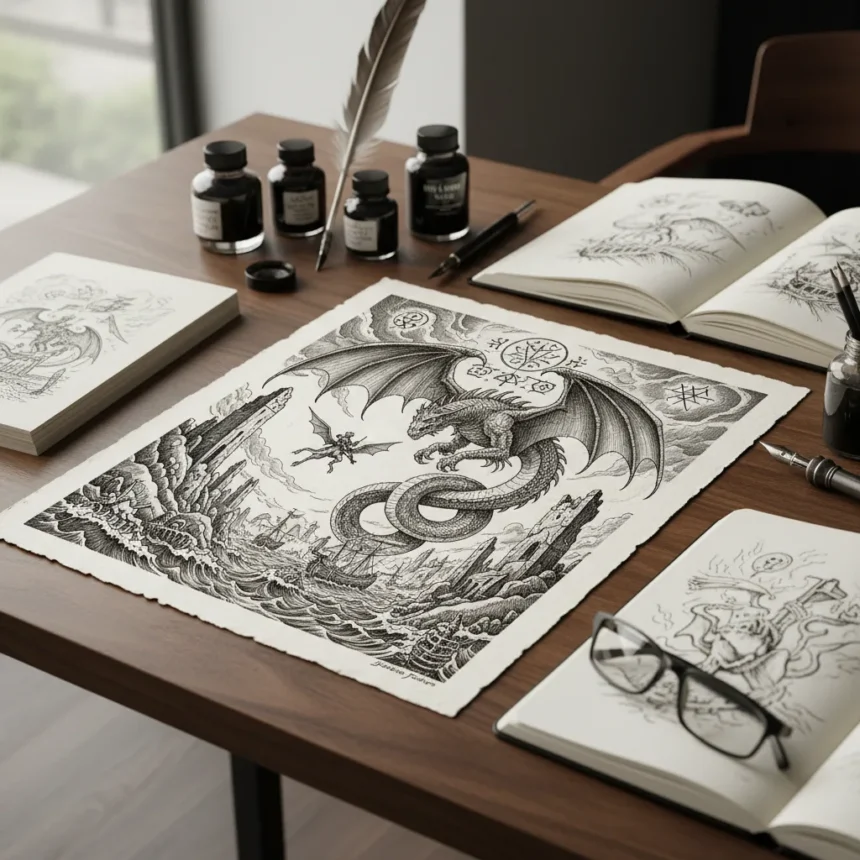
Joshua Striker is a contemporary artist known for using ink to recreate the look of 19th-century engravings while exploring dark fantasy worlds of overwhelming scale. His work bridges historical printmaking aesthetics with modern imaginative storytelling, creating a distinctive visual language that feels both antiquated and urgently contemporary.
Key Takeaways
- Joshua Striker uses ink techniques to emulate 19th-century engraving aesthetics in his artwork.
- His subject matter centers on dark fantasy worlds rendered at massive, immersive scales.
- The artist merges historical visual traditions with contemporary dark fantasy narratives.
- His approach contrasts the meticulous detail of old-master printmaking with surreal, imaginative worldbuilding.
- The work demonstrates how traditional artistic techniques remain relevant for modern storytelling.
How Ink Recreates 19th-Century Engraving Aesthetics
The technical foundation of Striker’s practice lies in using ink to capture the precise linework, cross-hatching, and tonal depth characteristic of 19th-century engravings. Rather than employing the mechanical methods of historical engravers—who carved into metal or wood plates—Striker achieves this visual language through hand-applied ink, translating the labor-intensive print tradition into a contemporary drawing medium. This approach allows him to preserve the aesthetic qualities readers recognize from historical printmaking: the intricate line patterns, the sense of painstaking craftsmanship, and the dramatic contrast between inked and white space.
The appeal of this method lies partly in nostalgia and partly in technical challenge. Nineteenth-century engravings carried an authority and gravitas that modern digital art or loose illustration styles cannot easily replicate. By choosing ink as his medium, Striker commits to the same deliberate, irreversible process that historical engravers faced. A mistake cannot be erased; each line contributes to the final image. This constraint becomes a strength, forcing compositional discipline and rewarding viewers with a sense of authentic craftsmanship rather than algorithmic precision.
Dark Fantasy Worlds at Overwhelming Scale
Where Striker’s work diverges sharply from historical precedent is in subject matter. While 19th-century engravings often documented landscapes, historical events, anatomical studies, or literary scenes grounded in recognizable reality, Striker deploys his engraving-inspired technique to render dark fantasy worlds—imaginative realms filled with impossible architecture, fantastical creatures, and landscapes designed to overwhelm the viewer with their scale. A single composition might depict towering structures dwarfing human figures, vast caverns swallowing entire armies, or surreal geological formations that defy natural law.

This pairing of historical technique with fantastical content creates productive tension. The engraving aesthetic carries connotations of documentary truth and scientific observation, yet Striker uses it to depict worlds that cannot exist. Viewers encounter a visual paradox: the meticulous realism of the linework and the authoritative tone of the medium suggest factual representation, while the subject matter screams impossible imagination. This cognitive dissonance is precisely what makes the work memorable and distinctive.
The Contemporary Relevance of Historical Techniques
Striker’s practice speaks to a broader pattern in contemporary art: the strategic revival of traditional media not as nostalgic retreat but as deliberate aesthetic choice. In an era when digital tools dominate visual culture and AI-generated imagery floods online platforms, hand-drawn ink work carries cultural weight precisely because it is labor-intensive, irreproducible, and unmistakably human. The 19th-century engraving aesthetic, with its associations of craft mastery and historical depth, offers resistance to algorithmic homogenization.



The work also demonstrates that historical artistic traditions remain generative resources for new storytelling. Striker does not simply imitate 19th-century engravings; he appropriates their visual language as a vehicle for contemporary dark fantasy narratives. This is appropriation in the artistic sense—taking existing forms and redirecting them toward new expressive ends. The result is neither purely historical nor purely modern, but a hybrid that asks viewers to reconcile past and present, realism and fantasy, precision and imagination.
Why Dark Fantasy Demands Overwhelming Scale
The emphasis on overwhelming scale in Striker’s dark fantasy worlds serves a specific narrative function. Scale operates as a tool for communicating awe, dread, and human insignificance. When a viewer confronts an engraving depicting a cavern so vast that entire civilizations appear as specks, or a structure so towering that its summit vanishes beyond the frame, the emotional response is visceral. The meticulous linework of the engraving technique amplifies this effect—each tiny line contributes to a sense of infinite detail and inexhaustible depth. The viewer’s eye can wander across the composition indefinitely, always discovering new details, always reminded of the vast scale of the imagined world.
This approach contrasts sharply with much contemporary fantasy illustration, which often prioritizes character portraiture, dramatic action, or saturated color. Striker’s ink-based worlds are monochromatic or near-monochromatic, emphasizing structure and composition over decorative surface. The absence of color forces the viewer to engage with form, line, and spatial relationships. In doing so, it harks back to the educational function of 19th-century engravings, which were often valued for their ability to communicate complex spatial information through pure linework.
Is Joshua Striker’s work available to view online?
The artist’s work can be discovered through art publications and platforms that feature traditional illustration and dark fantasy art. Creative Bloq, which published the featured article, regularly showcases contemporary artists working with traditional media, making it a natural venue for Striker’s practice to reach a broader audience interested in the intersection of historical technique and modern storytelling.



What materials does Striker use to create his ink engravings?
While the verified details confirm that Striker uses ink to recreate the 19th-century engraving aesthetic, the specific materials, tools, and surface types employed in his process are not detailed in the available source material. The focus remains on the visual result—ink applied to create the look of historical engravings—rather than the mechanical specifics of production.
How does dark fantasy art differ from traditional fantasy illustration?
Dark fantasy emphasizes atmospheric dread, impossible scales, and surreal or nightmarish imagery rather than heroic adventure or magical wonder. Striker’s approach, using the austere precision of engraving-style ink work, intensifies this darkness by stripping away color and relying on shadow, line density, and compositional tension to generate emotional impact. The historical engraving aesthetic lends an air of grim authority to fantastical subject matter, suggesting these dark worlds are documented rather than imagined.
Joshua Striker’s work represents a compelling model for how traditional artistic techniques can serve contemporary storytelling. By choosing ink to recreate 19th-century engraving aesthetics, he does not retreat into nostalgia but instead weaponizes historical form for modern emotional and narrative ends. The overwhelming scale of his dark fantasy worlds, rendered in painstaking linework, forces viewers to confront both the grandeur and the alienation of imagined realms. In an age of digital saturation and algorithmic image generation, this commitment to hand-drawn precision and historical technique feels not antiquated but urgently necessary.
Where to Buy
27% OFFSakuraPigma Micron Black Ink Multi-Tip Set$21.82$29.99shop now | 12% OFFYasutomoBokuju Liquid Ink$19.99$22.64shop now | PentelArts Pocket Brush Pen£3.54shop now | 10% OFFPentelColor Brush Pen$8.36$9.33shop now
Edited by the All Things Geek team.
Source: Creativebloq