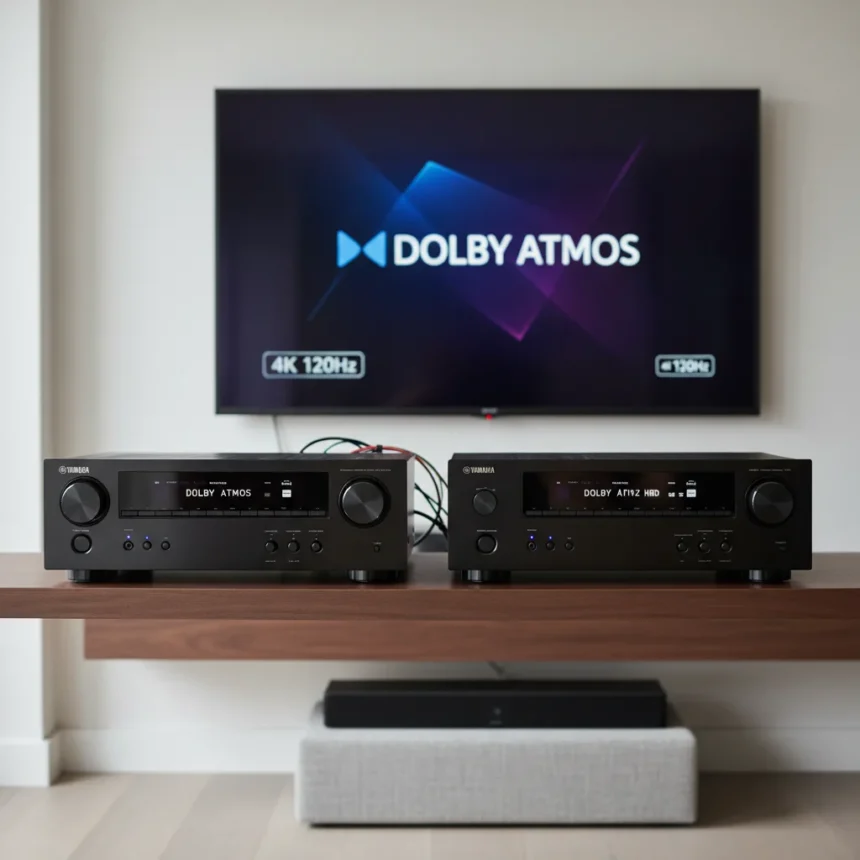
Yamaha’s new budget AV receivers—the RX300A and RX500A—prove that real home theater no longer requires a five-figure investment. For years, anyone serious about surround sound and immersive audio had to choose: spend big on a receiver or settle for a soundbar. These budget AV receivers collapse that false choice, delivering Dolby Atmos, HDMI 2.1, and 4K 120Hz passthrough at prices that undercut most premium soundbar systems.
Key Takeaways
- The RX300A starts at $399 with 5.2-channel amplification and Dolby Atmos support.
- The RX500A costs $599 and adds 7.2-channel amplification plus DTS:X immersive audio.
- Both models support 4K 120Hz and 8K video passthrough via HDMI 2.1.
- Yamaha is bundling the RX500A with a complete 5.1 surround speaker setup.
- These are Yamaha’s first new entry-level receivers in years, replacing the long-running RX-V385.
Why This Matters Right Now
The home theater market has bifurcated. High-end receivers cost thousands, while budget options meant compromising on features that gamers and film fans actually want. Yamaha’s budget AV receivers close that gap by including HDMI 2.1 connectivity and Dolby Atmos support—features once reserved for midrange and premium models. According to Yamaha’s marketing director, these receivers “include all the essential tech you need to build a modern home theater with phenomenal sound at an accessible price point”. That’s not marketing speak; it’s accurate. A $599 receiver with 7.2-channel amplification, Dolby Atmos, and 4K 120Hz passthrough genuinely outperforms a $1,200 soundbar system in every meaningful way.
The timing is deliberate. Console gamers upgrading from built-in TV speakers now have a real alternative. Film enthusiasts can build a proper surround setup without financing it. And streamers finally have a path to immersive audio that doesn’t involve replacing their entire entertainment stack.
The RX300A: Entry-Level Done Right
The RX300A is the successor to Yamaha’s ancient RX-V385, and the generational leap is substantial. It’s a 5.2-channel receiver, meaning it can drive five main speakers plus two subwoofers—enough for a proper surround setup in most living rooms. At $399, it undercuts premium soundbars by hundreds of dollars while offering genuine surround sound. The redesigned chassis is slimmer than older Yamaha entry models, making it easier to fit into tight AV racks. Both the RX300A and RX500A support Bluetooth Multipoint, which lets you connect two devices simultaneously and switch between them without re-pairing. That’s a feature Yamaha usually reserves for higher tiers.



The RX300A supports all modern HDR formats—Dolby Vision, HDR10+, and Hybrid Log-Gamma—so your 4K streaming content looks as good as the receiver can make it. HDMI 2.1 means 4K at 120Hz passthrough, which matters if you’re gaming on PS5 or Xbox Series X and want frame rates beyond 60fps without sacrificing resolution.
The RX500A: The Real Value Play
Step up $200 to the RX500A and you get 7.2-channel amplification instead of 5.2, which opens up more flexible speaker configurations. Seven channels means you can add surround back speakers for a more enveloping sound field, or use the extra channels for height speakers to unlock more of Dolby Atmos’s spatial benefits. The RX500A also adds DTS:X, Dolby’s competing immersive audio format, giving you access to more movie soundtracks. It includes Wi-Fi and Ethernet connectivity, plus support for network music services including AirPlay 2, Google Cast, Spotify Connect, Qobuz Connect, and TIDAL Connect. If you care about music as much as movies, the RX500A is the stronger choice.



Yamaha is bundling the RX500A with a complete 5.1 surround speaker setup, which is the real story here. You’re not just getting a receiver; you’re getting a path to a finished home theater system. That bundle positioning directly challenges soundbar bundles, which typically offer a subwoofer and satellite speakers but lack the receiver’s flexibility and upgrade potential.
How Budget AV Receivers Stack Against Soundbars
A soundbar is a closed system. You buy it, you’re done. A receiver is a platform. You start with the RX300A and two speakers, then add surrounds next year, height speakers the year after. That’s why comparing a $599 receiver to a $599 soundbar is misleading—the receiver is an investment in a system, not a finished product. Soundbars also compress all channels into a single box, relying on psychoacoustic tricks to simulate surround sound. Real surround speakers, driven by a dedicated amplifier, create actual sound fields. The difference is noticeable the moment you watch a film with overhead sounds or side surrounds.
The other advantage: upgrade flexibility. If your soundbar‘s processor becomes outdated, you replace the entire unit. With a receiver, you swap the processor module or upgrade speakers independently. A $399 receiver bought today can still drive new speakers bought in five years. That longevity matters for budget buyers who can’t afford to replace their entire setup every three years.
Specs That Actually Deliver
Output power on both models is rated at 70W per channel into 8 ohms at 20Hz–20kHz with 0.09% THD (two channels driven), or 145W per channel into 6 ohms at 1kHz with 10% THD (one channel driven). Those numbers are modest compared to high-end receivers, but they’re sufficient to drive passive speakers in most home theater setups. The RX300A has five speaker outputs (for a 5.2 configuration), while the RX500A has seven (for 7.2 or 5.1.2 with height channels). Both include two subwoofer pre-outs, so you can run dual subs if you want deeper bass. The RX500A’s extra speaker outputs matter if you plan to add surround back or height speakers later.



HDMI connectivity is generous: four inputs and one output on both models, with eARC support for sending audio from your TV back to the receiver. That means you can use the TV’s built-in apps (Netflix, Prime Video, etc.) and still hear surround sound through the receiver. Analog inputs include RCA, optical, and coaxial, covering older devices and streaming devices that don’t support HDMI.
The Bundle Play
Yamaha’s decision to bundle the RX500A with a 5.1 surround speaker setup is the strongest evidence that the company understands what budget buyers actually need. They don’t want to hunt for compatible speakers or piece together a system from multiple brands. They want a complete solution they can unbox and install. This bundle directly counters the soundbar narrative and gives first-time AV receiver buyers a clear path to success.
Are budget AV receivers actually better than soundbars?
For surround sound and immersive audio, yes. A receiver-based system with five or seven speakers creates genuine surround fields that soundbars simulate. If you only care about TV dialogue and occasional movies, a soundbar is simpler. If you watch films, game, or listen to music seriously, a receiver is the better long-term investment.
Can you upgrade the RX300A later if you want more channels?
No, the RX300A is fixed at 5.2 channels. If you think you’ll want surround back or height speakers eventually, the RX500A’s 7.2 configuration offers more flexibility. However, you can always add a second subwoofer or better speakers to either model without replacing the receiver.
Do these receivers work with wireless speakers?
Both models support Bluetooth Multipoint for streaming audio from phones and tablets, but the main surround speakers must be passive speakers connected via speaker cable to the receiver’s binding posts. Wireless surround speakers would require additional amplification or active speakers, which adds cost and complexity.
Yamaha’s budget AV receivers prove that the soundbar era is ending. For the price of a premium soundbar, you now get a real receiver with genuine surround sound, immersive audio, and a clear upgrade path. That’s not just a product refresh—it’s a market shift. Buyers who want better home theater no longer have to choose between soundbars and expensive receivers. These budget AV receivers offer a third way, and it’s compelling enough to matter.
Edited by the All Things Geek team.
Source: TechRadar