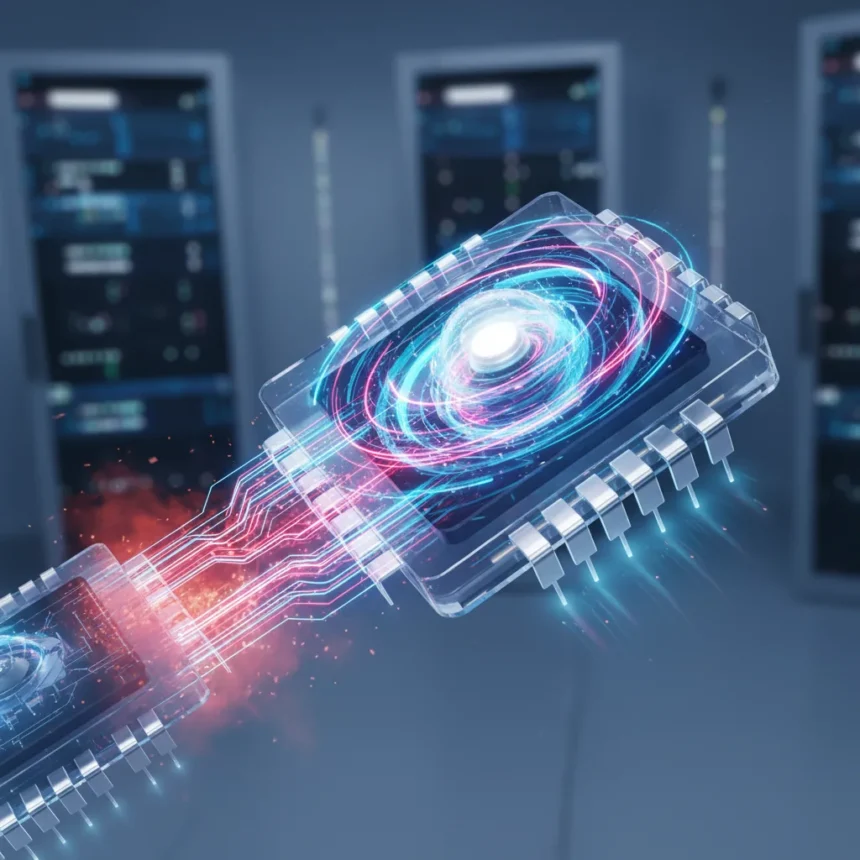
Magnetic chip switching has just become far more interesting. Researchers at the University of Tokyo have demonstrated a way to flip magnetic states in antiferromagnetic materials with minimal heat generation, potentially enabling processors that run 1000 times faster without burning through extra power. This is not a consumer product yet—availability is years away—but the implications for next-generation computing hardware are substantial.
Key Takeaways
- Magnetic chip switching in antiferromagnets can achieve 1000x speed increases without proportional heat generation
- The breakthrough uses manganese-tin (Mn₃Sn), an antiferromagnetic material where spin alignments cancel out
- Two switching pathways exist: one heat-driven under strong current, one low-heat under weaker current
- Commercial devices remain several years away despite the research success
- The work targets future spintronic logic and memory devices, not today’s conventional chips
How Magnetic Chip Switching Differs From Current Technology
Today’s processors rely on electronic switching—moving charge through silicon to flip bits. This generates heat as an unavoidable side effect. Magnetic switching takes a different path. Instead of moving electrons, it flips the orientation of magnetic spins within a material. In antiferromagnets like manganese-tin, these spins are arranged so their magnetic moments cancel each other out, which is why the material appears magnetically neutral despite its internal magnetic structure. This cancellation is key: it means the switching can occur without the electromagnetic noise and heat dissipation that plague conventional electronics.
The University of Tokyo team identified two distinct switching mechanisms in their antiferromagnetic material. One pathway requires strong electrical current and generates significant heat—similar to conventional approaches. The second pathway operates under weaker current and produces minimal heating. That low-heat pathway is the breakthrough. By understanding which conditions trigger which mechanism, researchers can now design systems that preferentially use the efficient route, sidestepping the thermal penalty that has long limited processor speeds.
Why This Matters for Future Chip Design
Heat is the enemy of modern computing. As processors get faster, they generate more thermal energy, which then forces designers to throttle performance to avoid damage. This creates a hard ceiling on speed improvements. Magnetic chip switching offers a way to break that ceiling. If you can increase processing speed without adding heat, you remove the primary constraint on performance scaling. That opens the door to dramatically faster devices without requiring exotic cooling solutions or accepting reduced reliability.


The research points toward spintronic devices—processors and memory that use magnetic properties instead of purely electronic charge flow. These are not theoretical concepts; spintronics is an active field with real applications in magnetic sensors and some memory technologies. What the University of Tokyo work adds is a path to spintronic logic gates that operate at speeds competitive with or exceeding today’s silicon, while staying cool enough to run reliably. That combination has eluded the industry for years.
The Realism Check: Years Away From Devices
The headline claim of 1000x speed increase is striking, but context matters. This is a laboratory demonstration of a fundamental switching mechanism, not a finished processor. The research shows what is theoretically possible in a pure material under controlled conditions. Translating that into a practical chip requires solving numerous engineering challenges: integrating the material into a functional device architecture, controlling switching precision at scale, interfacing with conventional electronics, and manufacturing it reliably at volume. Each step introduces new constraints and delays.



The TechRadar report notes that consumer devices incorporating this technology will not arrive for several years at minimum. That timeline is realistic. Breakthrough physics to commercial product typically spans five to ten years in semiconductor research, even when the core science is solid. Storage companies, server manufacturers, and smartphone makers will likely see prototype systems first. Consumer laptops and phones will follow later, if the technology proves manufacturable and cost-effective at scale.
Magnetic Chip Switching vs. Today’s Alternatives
Current high-performance chips use silicon CMOS technology, which has dominated for decades and continues to improve through smaller transistors and better architecture. However, CMOS faces a fundamental thermal wall: as transistors shrink, heat density increases, and cooling becomes harder. Researchers have explored alternatives—quantum computing, photonic processors, analog chips—but none have yet delivered the combination of speed, reliability, and manufacturability that CMOS provides. Magnetic chip switching is positioned as a potential successor, not a replacement for niche applications, because it addresses the heat problem directly while maintaining the logical flexibility of conventional processors.
The advantage over other experimental approaches is specificity. Quantum computers excel at certain problem types but cannot run general software. Photonic processors are fast but face integration challenges. Magnetic switching, by contrast, could in theory run the same software stack as today’s computers while operating at lower temperatures. That compatibility is crucial for adoption.
What Happens Next in the Research
The immediate next steps involve scaling and refinement. The University of Tokyo team has demonstrated the principle in a laboratory material. Future work will focus on optimizing the material composition, improving switching speed and reliability, and integrating the approach with other components into a functional circuit. Collaborations with semiconductor manufacturers and device companies will likely follow, as the path from university research to industry-ready technology requires both scientific advances and manufacturing expertise.



The broader research community is also watching closely. If the antiferromagnetic switching approach proves scalable, other groups will pursue similar directions with different materials or architectures. Competition and parallel development typically accelerate the timeline from breakthrough to practical deployment. Still, even with rapid progress, five years is a reasonable estimate before prototype systems appear in research labs, and another few years before commercial availability.
Is magnetic chip switching ready for consumer devices?
No. The research is a laboratory demonstration of a fundamental switching mechanism, not a finished technology. Consumer devices will not appear for several years at minimum, and widespread adoption will take longer still. The work shows what is theoretically possible, but translating that into reliable, manufacturable, cost-effective chips requires significant additional engineering.
How does magnetic chip switching reduce heat compared to conventional processors?
Conventional processors generate heat because moving charge through silicon dissipates energy. Magnetic switching flips spin orientations instead, and in antiferromagnetic materials, the internal magnetic structure is balanced in a way that allows switching with minimal electromagnetic noise and thermal loss. One switching pathway in the University of Tokyo material operates under weak current and produces negligible heat, whereas the conventional strong-current pathway generates significant heat.
What is manganese-tin and why does it matter for this research?
Manganese-tin (Mn₃Sn) is an antiferromagnetic material where internal magnetic spins cancel each other out, making the material magnetically neutral overall. This property allows efficient switching without the magnetic interference that plagues conventional magnetic devices. The University of Tokyo team used this material to demonstrate their breakthrough in low-heat magnetic switching.
The magnetic chip switching breakthrough represents a rare moment in semiconductor research: a fundamental advance that could reshape how processors work. The 1000x speed claim is eye-catching, but the real story is subtler and more important. By decoupling speed from heat, researchers have identified a path forward when conventional silicon is hitting its limits. Whether that path leads to practical devices depends on years of engineering work ahead, but the science is solid and the potential is genuine. For now, the technology remains a research milestone—impressive, important, and still years away from your next computer.
Edited by the All Things Geek team.
Source: TechRadar