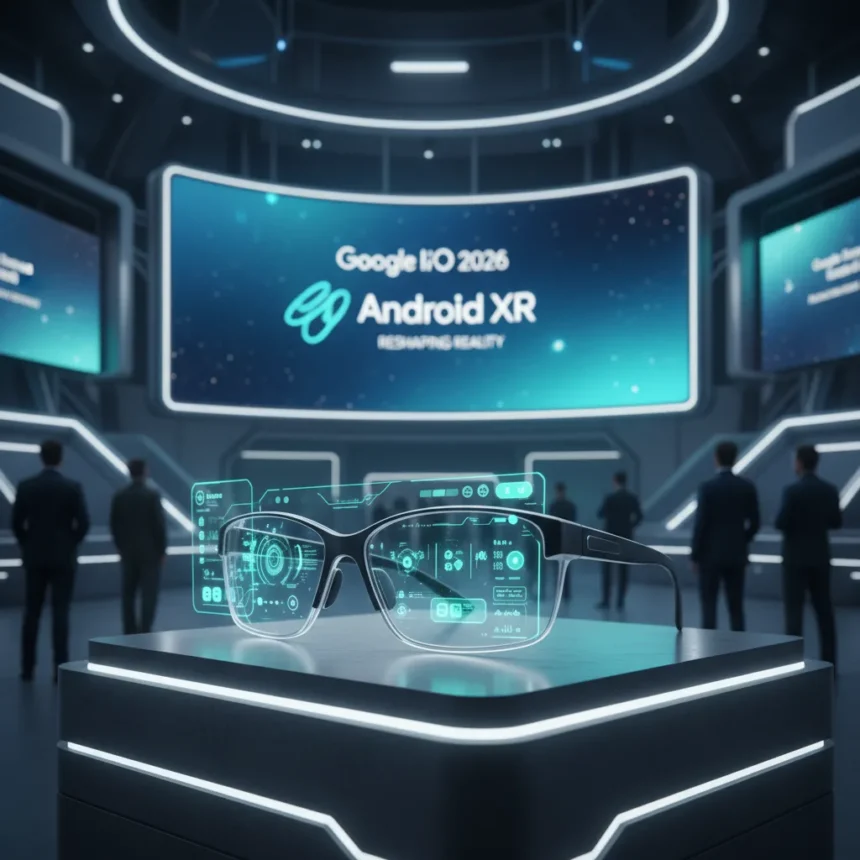
Android XR smart glasses represent Google’s most direct challenge to Meta’s Ray-Ban glasses dominance, and Google I/O 2026 in May could be the moment the company finally commits to the category. After showing Android XR prototypes to select audiences, Google faces a critical choice: make a serious consumer pitch or fade into the background while Meta and Apple dominate wearable AR. The company needs three specific announcements to prove it is not just experimenting.
Key Takeaways
- Google I/O 2026 is shaping up as a major showcase for Android XR smart glasses and the broader ecosystem.
- Android XR smart glasses have already been demonstrated in prototype form to journalists and developers.
- Meta Ray-Ban glasses currently lead the consumer smart glasses market, setting the competitive benchmark.
- Samsung and other hardware partners are positioned to build Android XR devices alongside Google.
- Three specific announcements could signal whether Google is ready for a consumer launch or still in exploration mode.
A Clear Consumer Product Identity for Android XR Smart Glasses
Google has been coy about the actual product—whether it is launching its own Android XR smart glasses or positioning the platform for partners like Samsung to lead. At I/O 2026, Google needs to settle this question with a definitive announcement. Either Google releases its own branded Android XR smart glasses with a clear name, price window, and availability timeline, or it formally positions Samsung as the primary hardware partner and commits to that strategy publicly. Ambiguity kills momentum. Meta did not hesitate to put Ray-Ban branding front and center. Google cannot win by hiding behind vague partnership language.
The announcement does not require a full commercial launch. A pre-order window, a developer edition, or a limited regional rollout would suffice. What matters is that Google stops treating Android XR smart glasses as a prototype and starts treating them as a product. Developers, retailers, and consumers need to know whether they are waiting for something real or chasing vapor.
Concrete Hardware Capabilities and Real-World Use Cases
So far, Android XR smart glasses have been shown in controlled demos, but Google has not painted a compelling picture of what they actually do in daily life. At I/O 2026, Google should demonstrate Android XR smart glasses solving specific problems: navigation without a phone, contextual information overlays in real-time, hands-free communication, or AI-powered visual search. These features exist in prototype form, but Google has kept them locked behind closed doors.


The key is showing, not telling. A five-minute on-stage demo of Android XR smart glasses handling a real task—ordering coffee, finding a product in a store, translating a foreign menu—would instantly communicate what these glasses are for. Meta Ray-Ban glasses already do this with voice commands and camera integration. Google’s Android XR smart glasses need to show they can do something equally practical and preferably something Meta cannot.
Hardware details matter too. Display brightness, field of view, battery life, weight, and form factor all determine whether Android XR smart glasses feel like the future or a clunky prototype. Google should commit to specific specs and show how they compare to competitors, rather than letting speculation fill the void.



A Credible Developer Ecosystem and AI Integration Plan
Android XR smart glasses will fail without apps. Google needs to announce a developer program with real incentives, early access for partners, and a clear path for third-party apps to run on Android XR. The platform should support major services—maps, messaging, productivity, fitness—from day one. Developers will not build for a platform that feels experimental or abandoned.
AI integration is non-negotiable. Google’s Gemini AI should be baked into Android XR smart glasses as a core feature, not a bonus. Voice commands powered by Gemini, visual recognition, real-time translation, and contextual suggestions should feel native to the experience. Google has the AI advantage over Meta; it should lean into it. Announcing specific AI features—what Gemini can do through these glasses that it cannot do on a phone—would give developers and consumers a concrete reason to care.
The ecosystem announcement should also address the Warby Parker question. If Warby Parker is building Android XR smart glasses, Google should confirm this and outline how it works with the broader platform. If not, Google should explain its distribution strategy for getting Android XR smart glasses into consumer hands.
Why This Matters Now
Smart glasses are no longer a niche category. Meta Ray-Ban glasses are selling, Apple is rumored to be working on AR glasses, and Samsung has been publicly exploring the space. Google cannot afford to let Android XR smart glasses become a forgotten prototype. I/O 2026 is the moment to move from research to reality. Three clear announcements—a product identity, real hardware capabilities, and a credible developer ecosystem—would signal that Google is serious. Without them, Android XR smart glasses risk becoming another abandoned Google moonshot.



Will Google announce its own Android XR smart glasses brand at I/O 2026?
Google has not confirmed whether it will launch its own branded glasses or position partners like Samsung as the primary manufacturers. An I/O 2026 announcement clarifying this strategy is essential for market clarity and developer confidence.
What features could Android XR smart glasses offer that Meta Ray-Ban glasses cannot?
Google’s Gemini AI integration, deeper Android ecosystem support, and potential features like real-time visual search and advanced translation could differentiate Android XR smart glasses from Meta’s offering. The key is demonstrating these in a compelling way at I/O 2026.
When will Android XR smart glasses actually launch to consumers?
No consumer launch date has been confirmed. Google I/O 2026 is the next major opportunity for the company to announce a timeline, whether that is 2026, 2027, or beyond.
Google I/O 2026 will reveal whether Android XR smart glasses are a serious bet or a research project. The company has the technology, the AI, and the ecosystem to compete. What it needs now is the confidence to commit publicly and the clarity to help developers and consumers understand what Android XR smart glasses are for. Three announcements—identity, capability, and ecosystem—would be enough to shift the conversation from skepticism to anticipation.
Edited by the All Things Geek team.
Source: TechRadar