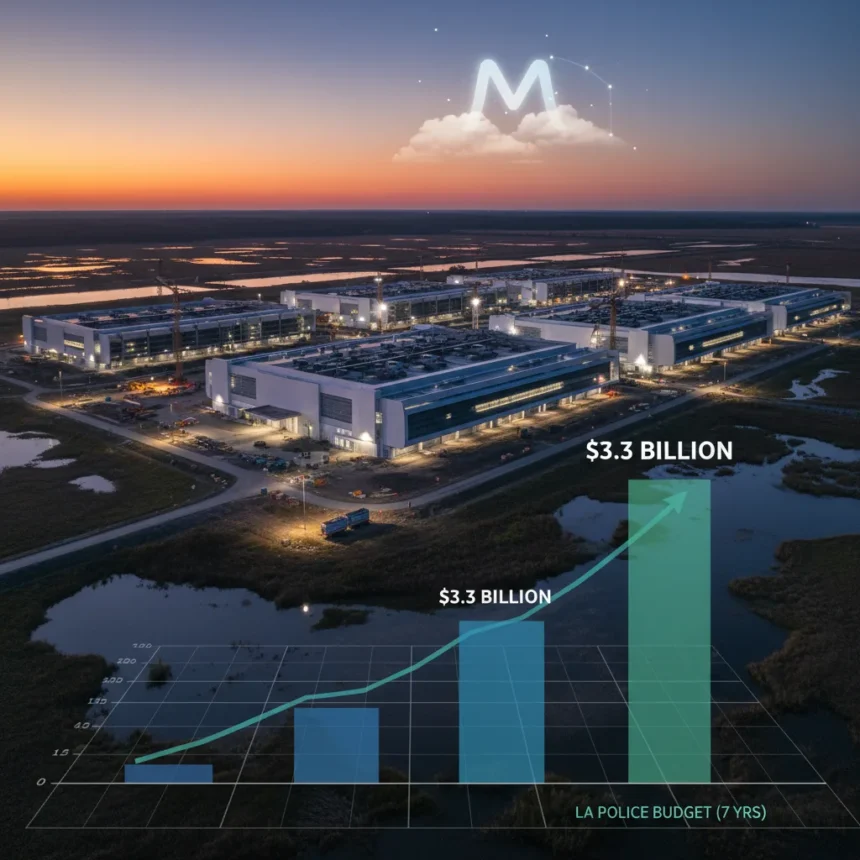
Data center tax breaks have become one of the most contested tools in the AI infrastructure race, and Louisiana just handed out one of the biggest on record. Meta’s Hyperion facility in Richland Parish, Louisiana, is set to benefit from an estimated $3.3 billion in tax exemptions over the life of the deal — a figure that dwarfs the state’s annual police budget by more than seven times. The incentive flows through Laidley LLC, a Delaware-registered Meta affiliate, under Louisiana’s Act 730, which exempts eligible data center equipment and software purchases from state and local sales tax.
Key Takeaways
- Meta’s Hyperion data center in Richland Parish, Louisiana, spans 2,250 acres and is currently under construction.
- The estimated tax break totals $3.3 billion, based on roughly $35 billion in projected GPU spending at a 9.56% combined sales tax rate.
- The exemption covers equipment and software, including GPUs used to train AI models, for 20 years with an optional 10-year renewal.
- Richland Parish commissioners approved the deal in July 2024; Louisiana’s Act 730 covers eligible purchases made on or after that date.
- To qualify, the project must create at least 50 permanent in-state jobs and invest a minimum of $200 million in new Louisiana capital by July 1, 2029.
What are data center tax breaks and how does this deal work?
Data center tax breaks typically exempt large technology facilities from sales tax on equipment purchases — servers, networking gear, and increasingly, the GPUs that power AI workloads. Louisiana’s Act 730 does exactly that, shielding eligible purchases made on or after July 1, 2024, from the state’s combined 9.56% sales and use tax rate. Apply that rate to a projected $35 billion in GPU spending and you arrive at the $3.3 billion estimate.
The exemption runs for 20 years, with an option to renew for a further 10 years — meaning the arrangement could cover three decades of equipment procurement at the Hyperion site. That’s not a one-off break; it’s a structural reshaping of how Meta’s AI hardware costs are taxed in Louisiana. The deal was reportedly contingent on receiving the exemption: Meta is said to have told state officials the project would not proceed without a sales tax carve-out on servers and equipment.
Why Louisiana changed its laws to land the Hyperion deal
Before this deal, Louisiana had no equivalent data center tax exemption. Other southern states had already moved: Alabama, Arkansas, Mississippi, and Texas all offer similar incentives to attract large facilities. Texas, for instance, exempts data centers from state sales tax provided they meet size thresholds and create at least 200 jobs. Louisiana was playing catch-up, and the Hyperion project appears to have been the catalyst for closing that gap.


State officials moved quickly. Louisiana’s legislature passed the bill enabling the major tax break, and Richland Parish commissioners approved the local component in July 2024. The speed of that process reflects how aggressively states are competing for AI infrastructure investment — and how much leverage a company like Meta holds when it can credibly threaten to site a 2,250-acre facility elsewhere.
How big is the Meta data center tax break relative to public spending?
The $3.3 billion figure is an estimate, not a guaranteed final cost — it depends on actual GPU spending hitting roughly $35 billion over the exemption period. But even as an estimate, the comparison to Louisiana’s police budget is striking. The tax break is described as equivalent to more than seven years of that budget. That framing matters because it makes the opportunity cost concrete: every dollar of sales tax exempted is a dollar that does not flow into state and local coffers.



Whether that trade-off is worth it depends on what Hyperion actually delivers. The minimum thresholds written into Act 730 are relatively modest: 50 direct, permanent new in-state jobs and $200 million in new capital investment by July 1, 2029. For a facility of this scale, those floors look low. The state is betting that construction employment, supply-chain activity, and long-term economic spillovers will justify the foregone tax revenue — a bet that is genuinely difficult to evaluate before the facility is operational.
Is the GPU exemption the most significant part of this deal?
The inclusion of GPUs in the exemption is what makes this deal particularly relevant to the current AI buildout. GPUs are the single most expensive line item in any large AI training facility, and exempting them from a nearly 10% sales tax rate on tens of billions of dollars of purchases is where the bulk of the $3.3 billion figure originates. This isn’t a standard server-rack subsidy — it’s a direct financial contribution to Meta’s AI model training economics.
That distinction matters for how other states read this deal. If Louisiana is willing to exempt GPU purchases at this scale, it raises the floor for what competing states may need to offer to attract the next major AI campus. The data center tax breaks race just got more expensive for everyone.
Is the $3.3 billion tax break figure confirmed?
No. The $3.3 billion is an estimate derived from projecting roughly $35 billion in GPU and equipment spending against Louisiana’s 9.56% combined sales tax rate. Actual exemptions will depend on real purchasing volumes, eligibility certification by Louisiana Economic Development, and compliance with Act 730’s requirements over the 20-year term. Treat it as an analytical upper-bound, not a signed check.



What does Meta have to deliver in return for the tax exemption?
Under Act 730, the project must create at least 50 direct, permanent new in-state jobs and commit a minimum of $200 million in new capital investment in Louisiana by July 1, 2029. The facility must be certified by Louisiana Economic Development to access the exemption. Beyond those thresholds, the state’s return depends on broader economic activity generated by the Hyperion construction and operation.
How does Louisiana’s deal compare to other states’ data center incentives?
Louisiana previously had no dedicated data center sales tax exemption, putting it behind Alabama, Arkansas, Mississippi, and Texas, all of which already offered comparable incentives. Texas requires data centers to meet a minimum size and create at least 200 jobs — a higher jobs bar than Louisiana’s 50-job threshold. Louisiana’s willingness to set a lower employment floor suggests it prioritised landing the investment over maximising job-creation commitments.
The Hyperion deal is a case study in what happens when AI infrastructure demand collides with interstate tax competition. Louisiana got the facility, but it gave up a generation of tax revenue to do it. Whether that exchange looks smart in 2035 depends almost entirely on how many jobs, contracts, and downstream businesses Hyperion actually generates — and right now, the state is taking that largely on faith.
Edited by the All Things Geek team.
Source: TechRadar