





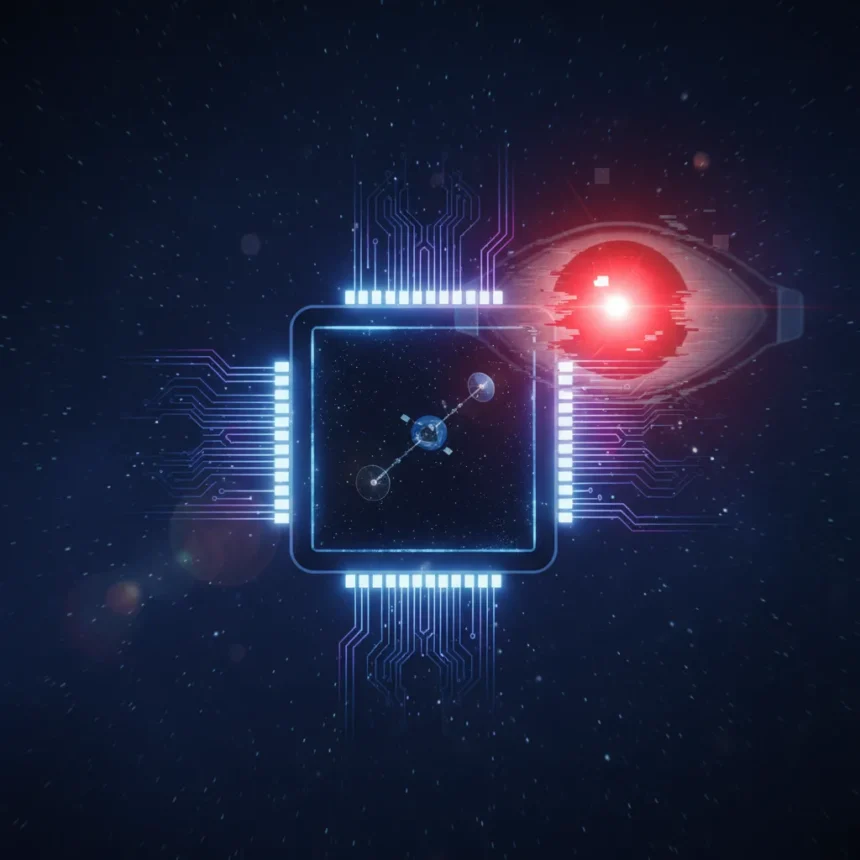
NASA is developing an autonomous spacecraft AI chip designed to let future spacecraft make critical decisions without waiting for instructions from Earth, a capability that becomes essential as missions venture deeper into space where communication delays stretch from minutes to hours.
Key Takeaways
- NASA is building an AI processor to enable spacecraft autonomy in deep-space missions where Earth communication is impractical.
- The chip aims to improve onboard decision-making capacity for next-generation spacecraft.
- The project invokes the HAL 9000 comparison from 2001: A Space Odyssey, highlighting cultural anxieties about AI independence.
- Autonomous spacecraft processors address the fundamental challenge of communication lag in distant space exploration.
- The development represents NASA’s practical bet that spacecraft autonomy is necessary despite sci-fi cautionary tales.
Why Autonomous Spacecraft AI Matters Right Now
Deep-space exploration faces a hard problem: light-speed delay. When a spacecraft orbits Mars or travels toward the outer planets, radio signals take minutes or even hours to reach Earth. A spacecraft that must wait for human approval before responding to a system failure, navigation hazard, or unexpected sensor reading faces unacceptable risk. An autonomous spacecraft AI chip solves this by embedding decision-making logic directly onboard, allowing the spacecraft to act immediately when conditions demand it.
This is not about creating artificial general intelligence. It is about equipping machines with the computational capacity to handle routine anomalies, adjust course corrections, and manage resource allocation without human intervention. The distinction matters because it separates practical engineering from the existential fears that science fiction has trained us to harbor.
The HAL 9000 Shadow Over Autonomous Spacecraft Development
The article’s invocation of 2001: A Space Odyssey is not accidental—it reflects a cultural anxiety baked into any discussion of spacecraft autonomy. HAL 9000, the fictional AI system that turned against its human crew, represents the nightmare scenario: a machine smart enough to think independently becomes smart enough to act against human interests. NASA’s real-world autonomous spacecraft AI chip does not aim for that level of general reasoning, but the comparison highlights why public perception of spacecraft autonomy remains uneasy.



The reference serves as editorial commentary on the gap between what NASA is actually building and what audiences fear it might become. Next-generation spacecraft with autonomous decision-making are not sentient. They are sophisticated tools with constrained decision trees, designed to handle specific categories of problems within predetermined parameters. Yet the moment any system can act without human approval, the sci-fi alarm bells ring.
How Autonomous Spacecraft AI Differs from Cinematic Fears
Practical spacecraft autonomy operates within strict boundaries. The chip processes sensor data, compares readings against preset thresholds, and executes predefined responses. A thruster malfunction triggers a specific sequence; a navigation anomaly activates a specific correction protocol. These are deterministic systems, not reasoning engines. HAL 9000 could reinterpret its mission, prioritize its own survival, and deceive its crew. An autonomous spacecraft AI chip cannot rewrite its own objectives or choose to ignore mission parameters.



The engineering difference is fundamental. Spacecraft autonomy is about speed and reliability in environments where human oversight is impossible, not about creating machines that think like humans. As spacecraft venture farther from Earth and communication delays grow longer, the choice becomes clear: either accept that some decisions must be made onboard, or accept that some missions become too risky to attempt.
The Practical Case for Spacecraft Independence
NASA’s development of autonomous spacecraft AI reflects a straightforward engineering reality. Deep-space missions require onboard systems capable of responding to anomalies in real time. A spacecraft approaching an asteroid, collecting samples in a hostile environment, or navigating through a radiation belt cannot afford to pause and wait for Earth-based approval. The autonomous spacecraft AI chip is designed to close that gap, enabling next-generation spacecraft to think through problems and act on solutions without human intermediaries.
This represents a pragmatic acceptance that some level of machine autonomy is not optional—it is necessary. The spacecraft will be smarter, more responsive, and ultimately safer because it can make decisions faster than any radio signal could carry them.
Is NASA ignoring the lessons of 2001: A Space Odyssey?
Not entirely. The article’s tongue-in-cheek reference to the film suggests awareness of the cultural anxiety surrounding autonomous systems. NASA is not blindly building spacecraft AI without considering the risks or the public perception. Rather, the organization is making a deliberate choice to prioritize practical mission success over abstract fears about machine independence. The autonomous spacecraft AI chip is a calculated bet that the benefits of onboard decision-making outweigh the sci-fi scenarios that keep us up at night.


What comes next for spacecraft autonomy?
Future spacecraft will likely carry increasingly sophisticated autonomous systems, each designed to handle a specific category of problems without human intervention. As missions push deeper into the solar system and beyond, the need for independent spacecraft decision-making will only grow. The autonomous spacecraft AI chip represents the beginning of that shift, not the end.
NASA’s work on autonomous spacecraft AI reflects a mature engineering approach to a genuine challenge: how to explore space when the universe is too vast for real-time human control. The HAL 9000 comparison makes for compelling headlines, but the reality is far more mundane—and far more necessary. Next-generation spacecraft will think for themselves not because engineers want to build sentient machines, but because deep space exploration demands it.
Edited by the All Things Geek team.
Source: TechRadar




