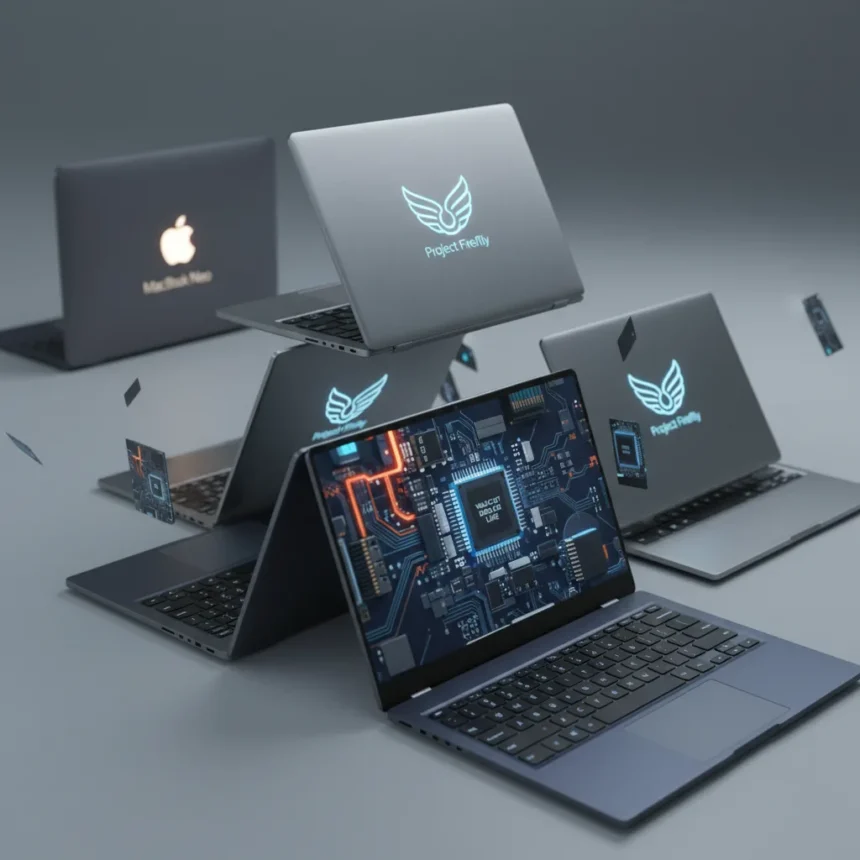
Intel Wildcat Lake laptops are at the center of Project Firefly, Intel China’s ambitious push to create affordable systems priced under $600 that directly challenge Apple’s MacBook Neo. Rather than relying on traditional PC notebook design fragmentation, Intel is adopting a standardized blueprint approach inspired by China’s smartphone manufacturing supply chain to streamline production and slash costs.
Key Takeaways
- Intel Wildcat Lake laptops target sub-$600 pricing through standardized design, not custom OEM variants.
- Project Firefly borrows smartphone manufacturing strategies to reduce production complexity and cost.
- The initiative positions budget Windows systems against Apple’s value-oriented MacBook Neo.
- Unified design reduces the number of distinct laptop configurations partners must produce.
- Aluminum chassis and fanless operation modes feature in reference designs.
How Intel Wildcat Lake Laptops Challenge Apple’s Strategy
Apple’s MacBook Neo represents a shift toward efficiency and lower price points in the premium laptop market. Intel Wildcat Lake laptops take a different approach: deliver genuine affordability without sacrificing modern processor performance. Where MacBook Neo targets users willing to pay for the Apple ecosystem, Intel Wildcat Lake systems aim at cost-conscious buyers who prioritize value over brand prestige. The sub-$600 target directly undercuts Apple’s positioning and forces a choice based on price rather than ecosystem lock-in.
Project Firefly’s key innovation is not the processor itself, but how Intel manufactures and distributes Wildcat Lake systems. By standardizing the reference design, Intel reduces the engineering overhead for OEM partners. Instead of each manufacturer creating unique chassis, thermal solutions, and component layouts, partners follow a unified blueprint. This mirrors how smartphone makers in China optimize supply chains across thousands of devices by standardizing internal architecture while allowing minor cosmetic variation. The result is faster time-to-market and lower per-unit costs that trickle down to retail pricing.
Standardized Design vs. Customization: Why It Matters
Traditional PC notebook manufacturing allows tremendous customization. Each OEM designs its own thermal management, chassis geometry, and component integration. This flexibility drives innovation but also inflates development costs and inventory complexity. Intel Wildcat Lake laptops reverse this logic. A unified design means partners can order components in bulk, negotiate better pricing with suppliers, and reduce manufacturing complexity. The tradeoff is less differentiation between brands—but at sub-$600, buyers prioritize affordability over uniqueness.


The aluminum chassis and fanless operation modes visible in reference designs signal Intel’s commitment to quality despite the budget price point. Fanless operation—achieved through efficient thermal design—eliminates mechanical failures and reduces manufacturing costs. An aluminum chassis conveys durability without the premium price tag of ultrabook-class materials. These choices reflect Intel’s understanding that budget buyers still expect reliability and decent build quality; they simply cannot afford $1,200+ premiums.
Intel Wildcat Lake Laptops and the Smartphone Manufacturing Playbook
China’s smartphone industry perfected the art of scaling production without sacrificing margins. Manufacturers like Xiaomi and Oppo achieve high volumes by standardizing internal architecture, leveraging shared component suppliers, and optimizing logistics. Intel is applying the same playbook to notebooks. Instead of dozens of unique designs competing for shelf space, Project Firefly creates a single reference platform that all partners build around. This reduces the number of supply chain variants, improves supplier relationships, and enables faster component procurement.



The smartphone analogy extends to software and firmware. Just as Android provides a standardized OS layer across thousands of phone designs, Intel Wildcat Lake laptops run Windows on standardized hardware, reducing driver fragmentation and quality-assurance overhead. Partners focus on minor cosmetic or feature differentiation rather than fundamental engineering reinvention. For Intel, this means better control over the user experience and fewer support headaches downstream.
Can Sub-$600 Wildcat Lake Systems Compete with MacBook Neo?
Apple’s MacBook Neo targets a specific buyer: someone who values ecosystem integration, software polish, and long-term support over raw specs. Intel Wildcat Lake laptops cannot match the MacBook’s software experience or hardware-software integration. What they offer instead is price. At sub-$600, a Wildcat Lake system costs roughly half as much as a comparable MacBook Neo configuration. For students, developing-world buyers, and cost-conscious professionals, that gap is decisive.
The real competition is not head-to-head feature parity but market segmentation. MacBook Neo owns the premium-affordable segment. Intel Wildcat Lake laptops target the true budget tier—the segment that cannot justify $1,000+ spending. By standardizing design and manufacturing, Intel can maintain quality and margins at lower price points than traditional custom OEM designs allow. Whether partners actually deliver compelling products at these prices remains to be seen, but the manufacturing strategy itself is sound.
What Specs Can You Expect from Intel Wildcat Lake Laptops?
The research brief does not specify exact RAM, storage, display size, or battery capacity for Wildcat Lake systems. Intel has published reference designs featuring aluminum chassis and fanless operation modes, but final retail configurations will vary by partner and market. Expect the Wildcat Lake platform to emphasize efficiency—fanless designs and low-power operation align with the budget-conscious positioning. Storage and memory will likely start at modest levels (256GB SSD, 8GB RAM) to hit the sub-$600 target, with upgrade options available.



When Will Intel Wildcat Lake Laptops Launch?
Project Firefly is already moving toward retail. Reference designs have been shown, and aluminum-chassis prototypes are in development. Exact launch timing and regional availability are not specified in current reporting, but the initiative appears to be in the latter stages of engineering. Expect announcements from partner manufacturers throughout 2025 as they finalize their own Wildcat Lake configurations.
How Does Project Firefly Change Intel’s Laptop Strategy?
Traditionally, Intel provided processors and reference designs, but OEMs maintained design autonomy. Project Firefly represents a shift toward tighter control and standardization. Intel is not just selling chips; it is selling a complete manufacturing blueprint. This requires stronger partnerships with OEMs who are willing to follow Intel’s design direction rather than pursuing their own vision. For Intel, the payoff is predictability and scale. For OEMs, the tradeoff is reduced engineering flexibility in exchange for lower costs and faster time-to-market.
Will Intel Wildcat Lake laptops actually stay under $600?
The sub-$600 target is a stated goal, not a guarantee. Retail pricing depends on component costs, partner margins, and regional market conditions. However, the standardized manufacturing approach and smartphone-inspired supply chain optimization make aggressive pricing more feasible than with traditional custom designs. Partners have strong incentives to hit the target—undercutting MacBook Neo is the entire value proposition.
What makes Intel Wildcat Lake different from previous budget laptop platforms?
Previous Intel budget platforms allowed significant customization, resulting in dozens of distinct designs across the market. Wildcat Lake enforces a unified blueprint, reducing variant count and manufacturing complexity. This is a more aggressive standardization strategy than Intel has pursued in consumer notebooks, borrowed directly from smartphone industry practices.
Intel’s Project Firefly represents a calculated bet that standardization and supply-chain efficiency can deliver affordable Wildcat Lake laptops without sacrificing build quality or performance. Whether the initiative succeeds depends on partner execution and market reception—but the manufacturing strategy itself addresses a real problem in PC notebooks: cost complexity. By forcing design unity, Intel aims to prove that budget Windows laptops can compete on price without looking cheap.
Edited by the All Things Geek team.
Source: Tom's Hardware