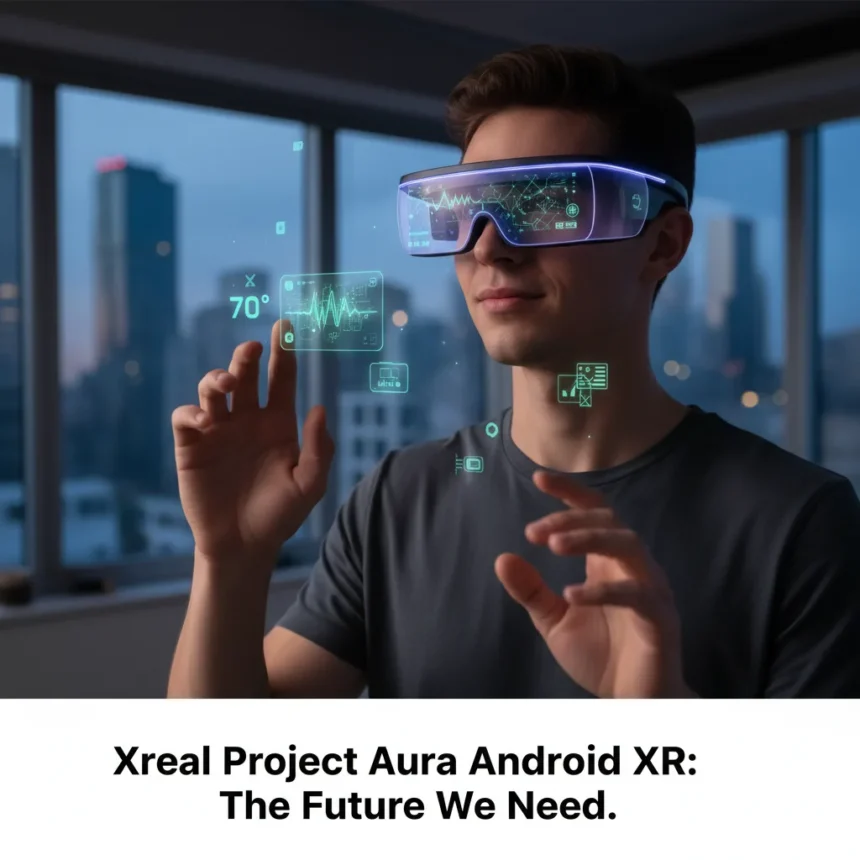
Xreal Project Aura Android XR glasses represent a meaningful step toward the smart glasses future—one that feels tangible rather than hype-driven. At Google I/O, Xreal unveiled a lightweight optical see-through prototype that combines a 70-degree field of view, Gemini AI integration, and a tethered compute puck to deliver spatial computing that actually works in everyday contexts.
Key Takeaways
- Xreal Project Aura Android XR glasses feature a 70-degree field of view, a major leap for AR glasses form factors.
- The device uses micro-OLED displays described as astonishingly sharp and colorful.
- A tethered compute puck powered by Snapdragon XR2+ Gen 2 provides processing power with up to four hours of battery life.
- Gemini AI integration enables real-time translation, contextual object information, and spatial navigation overlays.
- The glasses remain in prototype stage with no confirmed launch date or pricing.
What Makes the 70-Degree Field of View a Game Changer
The Xreal Project Aura Android XR glasses’ 70-degree field of view is the headline spec for good reason. For context, this is substantially wider than most AR glasses on the market and represents a genuine breakthrough in how much of your visual field can display digital information without feeling cramped or tunnel-like. Samsung’s Project Moohan pushes further with a 100-degree field of view, but Xreal’s approach trades absolute width for a more practical balance between immersion and optical clarity. The wider the FOV, the heavier and bulkier the optics typically become—Xreal appears to have found a sweeter spot.
The micro-OLED displays themselves are astonishingly sharp and colorful, according to hands-on testing at Google I/O. This matters because earlier AR glasses often delivered washed-out, dim visuals. When you’re overlaying Google Maps directions onto a city street or reading real-time translation of a foreign-language sign, display quality determines whether the experience feels futuristic or frustrating.
The Tethered Puck Trade-Off: Power Over Portability
Here’s the honest part: Xreal Project Aura Android XR glasses are not fully untethered. They connect via cable to a compute puck—a small rectangular device powered by Qualcomm’s Snapdragon XR2+ Gen 2 processor. The puck clips to your pants and lasts up to four hours on a single charge. This is a deliberate engineering choice that prioritizes processing power and thermal management over the freedom of truly wireless glasses.


Why does this matter? Because running Gemini AI, spatial mapping, and real-time translation simultaneously demands serious computational horsepower. Untethered glasses would require either a battery that bulges awkwardly or thermal throttling that cripples performance. Xreal’s tethered approach acknowledges this reality and optimizes for capability instead. For someone using smart glasses as a productivity tool—following step-by-step visual guides, getting directions, translating text—the cable is a reasonable compromise.
Gemini Integration and Spatial Computing in Action
The Xreal Project Aura Android XR glasses are deeply integrated with Google’s Gemini AI, which is the real differentiator here. At Google I/O, the demo showed what this means in practice: you can ask Gemini to retrieve information about objects in your environment, get navigation overlays from Google Maps, receive real-time translations, or follow visual guides for tasks like cooking or repair work. A YouTube how-to video can float in the corner of your field of view while you work with your hands free.



This is spatial computing that solves actual problems. It is not just a gimmick or a novelty—it is a tool. The glasses ran a demo of Demeo, a tabletop game, which showed entertainment potential, but the real value lies in practical applications where having information overlaid on reality beats pulling out a phone.
How Xreal Project Aura Stacks Against Competitors
Xreal Project Aura Android XR glasses occupy a distinct position in the emerging smart glasses landscape. Meta’s Project Orion pushes toward a fully untethered experience but remains further from consumer availability. Samsung’s Project Moohan offers a wider 100-degree field of view but has not yet demonstrated the same level of Gemini integration. Meanwhile, Xreal’s previous device, the Xreal One, used the X1 chip—the new glasses step up to the X1S, a refreshed spatial processor that handles the heavier AI workload.
The Android XR platform itself is the key differentiator. Xreal Project Aura Android XR glasses are the second official Android XR device announced after Samsung, which means developers can begin building for this ecosystem now. That matters because ecosystem depth determines long-term viability. A device with the best optics but no apps is a paperweight.
Prototype Reality: No Price, No Date, No Guarantees
It is important to state clearly: Xreal Project Aura Android XR glasses are a prototype shown at Google I/O. There is no confirmed launch date, no pricing, and no guarantee the final product will match what was demonstrated. Prototypes often look better than production hardware—thermal constraints, manufacturing costs, and supply chain realities can force compromises.



More details were expected at Augmented World Expo in early June, according to the original hands-on review. Until then, treat Project Aura as a proof of concept rather than a preorder candidate. The glasses represent Xreal’s vision for the future, not a commitment to a specific timeline or price point.
Is the tethered design a dealbreaker?
Not necessarily. The four-hour battery life on the compute puck covers a full workday. The cable connection is annoying but manageable if you clip the puck to your belt or pocket. For someone using smart glasses as a tool rather than an all-day fashion statement, the trade-off is reasonable. Fully untethered glasses would require either larger batteries or lower performance—neither is appealing.
What does Gemini integration actually enable?
Gemini integration means the Xreal Project Aura Android XR glasses can understand context from your environment and provide relevant information without you typing or speaking a command. Point at an object, and Gemini can identify it and provide details. Ask for directions, and maps appear overlaid on your surroundings. This is spatial computing that feels natural rather than forced.
When will Xreal Project Aura Android XR glasses launch?
No launch date has been confirmed. The prototype was shown at Google I/O as a hands-on demo, and more details were expected at Augmented World Expo in early June. Xreal has not announced pricing or availability, so treating this as a 2025 or later product is reasonable.
Xreal Project Aura Android XR glasses represent the smart glasses future worth waiting for—one built on practical spatial computing rather than hype. The 70-degree field of view, Gemini integration, and tethered-puck design strike a balance between capability and realism. This is not the perfect glasses yet, but it is a genuine step toward the everyday smart glasses that will eventually replace smartphones for navigation, information, and communication. Whether Xreal executes on the promise remains to be seen, but the prototype deserves serious attention.
Edited by the All Things Geek team.
Source: Tom's Guide