





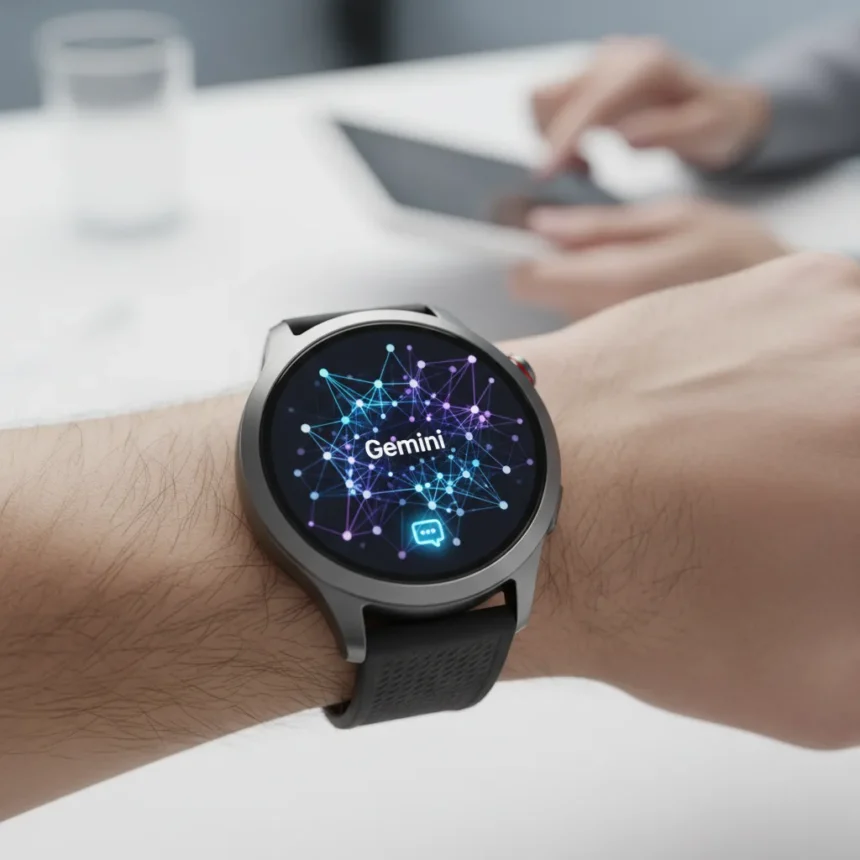
Gemini on Wear OS is rolling out starting today to smartwatches running Wear OS 4 and newer, marking a quiet but significant shift in how Google wants you to use AI on your wrist. While Google I/O may have overshadowed this announcement with broader platform talk, the real story is that your watch is about to become substantially smarter—and more independent from your phone.
Key Takeaways
- Gemini on Wear OS launches July 9, 2025, across Google, Samsung, OPPO, OnePlus, and Xiaomi watches.
- Works on Wear OS 4 and newer; future Wear OS 6 upgrades will also include support.
- Handles multi-step, app-aware tasks directly from your wrist without pulling out your phone.
- Activation options: say “Hey Google,” press and hold the side button, or tap the Gemini app icon.
- Uses the same advanced AI models as Gemini on Android phones for consistent performance.
What Gemini on Wear OS Actually Does
Gemini on Wear OS is not just a cosmetic refresh of the old Google Assistant. This is a fundamentally more capable AI experience designed to understand natural speech patterns and deliver fast, concise responses optimized for a tiny screen. The key difference: Gemini can handle multi-step tasks that previously forced you to dig out your phone. Summarize your last email from a coworker before a meeting. Create a playlist for a 10-minute-mile run without breaking stride. Send a message apologizing for running late without stopping your workout. These are tasks that feel trivial on a phone but genuinely useful on a wrist.
Google says Gemini works across apps to get things done more efficiently. That means the AI can pull data from your email, music, messaging, and fitness apps in sequence—something the older assistant struggled with. Ask “Do I need an umbrella today?” and Gemini checks the weather without making you navigate three menus. It sounds simple, but on a smartwatch where every tap matters, that efficiency compounds.
Which Watches Get Gemini on Wear OS
The rollout includes smartwatches from five major manufacturers: Google, Samsung, OPPO, OnePlus, and Xiaomi. If you own a Pixel Watch, Galaxy Watch, or any recent Wear OS device from these brands, you’re in the window. The requirement is straightforward—Wear OS 4 or newer. Google is also committing to bring Gemini to watches that upgrade to Wear OS 6, so even older devices won’t be permanently left behind.


The multi-brand support matters. This is not a Pixel Watch exclusive or even a Google-only announcement. Samsung’s Galaxy Watch lineup, which dominates the Android smartwatch market, gets Gemini support. That breadth signals Google is serious about making Wear OS competitive again, not just optimizing for its own hardware.
How to Start Using Gemini on Wear OS
Three ways to wake Gemini on your watch. Say “Hey Google” and the assistant responds. Press and hold the side button for a more tactile trigger. Or tap the Gemini app icon directly on your watch screen. Once activated, speak naturally. Gemini understands conversational phrasing better than the older assistant, so you do not need to speak in clipped commands.



The rollout begins July 9, 2025, and continues over the coming weeks. If you do not see Gemini immediately on your watch, it is coming—Google is staggering the deployment rather than flipping a switch everywhere at once. Check your watch’s app store or settings to confirm the update once it arrives in your region.
Why This Matters More Than You Think
Smartwatches have always suffered from a core problem: they are too limited to be useful for complex tasks, so you end up pulling out your phone anyway. Gemini on Wear OS is Google’s attempt to shrink that gap. By putting a genuinely capable AI assistant on your wrist, Google is betting that you will reach for your phone less often—or at least later in your day.
For fitness enthusiasts, the ability to create a playlist or send a message without stopping a workout is genuinely valuable. For busy professionals, summarizing emails before meetings saves mental load. For anyone, asking whether you need an umbrella without unlocking your phone is just easier. None of these tasks are revolutionary individually, but together they reframe what a smartwatch can do. You are no longer just checking notifications and glancing at time. You are actively delegating decisions and tasks to an AI that understands context.
The comparison to the older Google Assistant is stark. The previous experience was reactive—you asked simple questions, got simple answers. Gemini on Wear OS is proactive and contextual. It understands that “summarize my last email” requires cross-app knowledge. It knows that a playlist for a 10-minute-mile run is different from a playlist for a casual walk. That sophistication is what separates a useful assistant from a gimmick.



Does Every Wear OS Watch Get Gemini?
No. The rollout covers Wear OS 4 and newer, which includes most smartwatches released in the last two years. Older devices running Wear OS 3 or earlier will not receive Gemini support. If your watch is three or more years old, you are likely out of luck unless you upgrade. That is a reasonable trade-off for Google—supporting ancient hardware fragments the experience and slows development.
Will Gemini on Wear OS Replace Google Assistant Completely?
Google positions Gemini as the new assistant experience, but the brief does not clarify whether the older Assistant is being fully deprecated or if both will coexist. What is clear is that Gemini is the forward-facing product. New features, improvements, and capabilities will land in Gemini first. If you want the latest AI experience on your watch, Gemini is where it lives.
How Is Gemini on Wear OS Different From Gemini on Your Phone?
Both use the same advanced AI models, so the underlying intelligence is identical. The difference is presentation and optimization. Gemini on your phone can show you long-form answers, images, and web results. Gemini on your watch delivers concise, spoken responses because a 1.4-inch screen cannot display a research paper. The AI has been tuned to understand that wrist-based queries are usually quick questions or urgent commands, not deep research sessions. It prioritizes speed and brevity over comprehensiveness.
This is Google’s quiet win. While competitors scramble to add AI to wearables as a checkbox feature, Google is building an assistant that actually understands the constraints of a smartwatch and works within them. That thoughtfulness is what separates a useful tool from vaporware. Gemini on Wear OS launches July 9, 2025, and it is worth paying attention to.
Where to Buy
Edited by the All Things Geek team.
Source: TechRadar