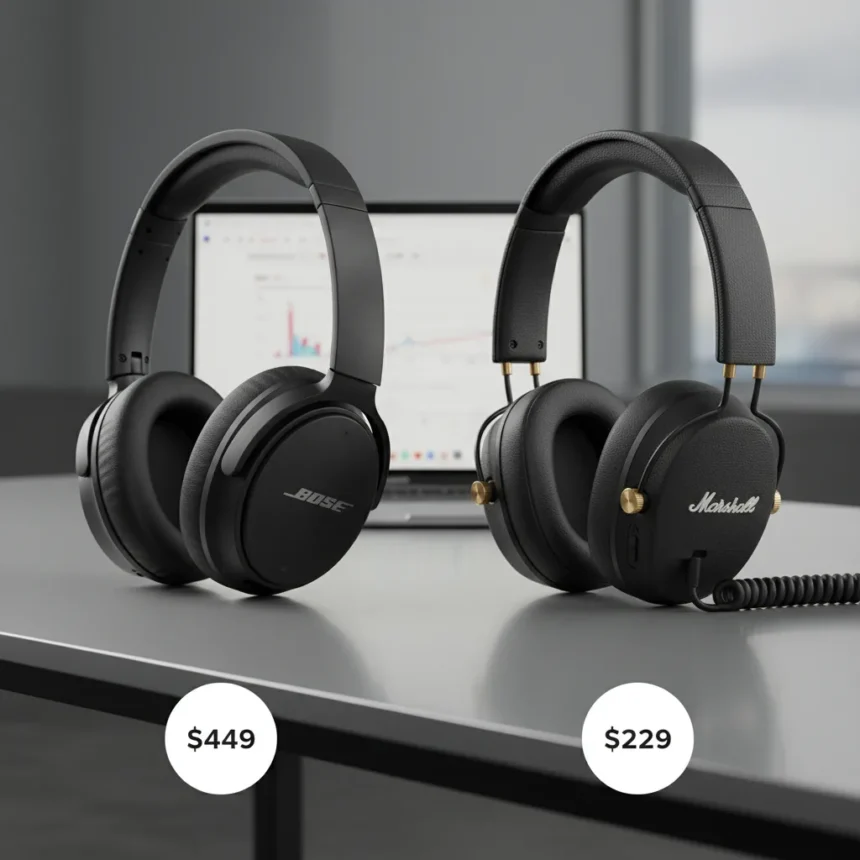
The Bose QuietComfort Ultra 2nd Gen has long set the standard for premium noise-canceling headphones, commanding a $449 price tag that puts them firmly in flagship territory. But what happens when a challenger emerges at less than half the cost? The Marshall Milton ANC arrives at $229, asking a direct question: does the price gap reflect a real performance gap, or are you paying for the Bose name?
Key Takeaways
- Bose QuietComfort Ultra 2nd Gen costs $449; Marshall Milton ANC costs $229—a $220 difference
- Direct testing reveals whether Marshall’s cheaper model can match Bose’s ANC performance
- The comparison targets buyers deciding whether premium pricing equals premium noise cancellation
- Both are over-ear, ANC-focused headphones designed for travel and daily use
- Value proposition hinges on whether the Marshall delivers surprising performance at half the price
The Price-to-Performance Question
The Bose QuietComfort Ultra 2nd Gen commands premium pricing because Bose has spent decades building a reputation for world-class active noise cancellation. At $449, these headphones represent a significant investment. The Marshall Milton ANC, by contrast, enters the market at $229—undercutting Bose by nearly 50 percent. That gap immediately raises the central question: what exactly are you paying for when you choose Bose?
For many buyers, the answer has always been clear: superior ANC technology and refined sound tuning justify the premium. But the Marshall Milton ANC forces a reckoning. If Marshall can deliver competitive noise cancellation at half the price, the value proposition of Bose’s flagship shifts dramatically. The testing revealed something unexpected—the Marshall doesn’t just approach Bose’s performance, it challenges fundamental assumptions about what noise cancellation should cost.
Bose QuietComfort Ultra 2nd Gen: What the Premium Buys
The Bose QuietComfort Ultra 2nd Gen represents the culmination of Bose’s noise-canceling expertise. At $449, these headphones carry expectations: industry-leading ANC, refined audio signature, and the kind of comfort that justifies extended wear. Bose’s track record suggests these expectations are reasonable. The QuietComfort line has consistently delivered the kind of immersive silence that makes the rest of the world disappear.



But premium pricing alone doesn’t justify a purchase. The real question is whether the Bose headphones deliver measurably better noise cancellation than a competitor charging half as much. Testing both models side-by-side revealed that Bose’s advantage—while real—may not be as decisive as the price difference suggests. The Marshall Milton ANC performs well enough that casual listeners may struggle to hear a meaningful difference in everyday use.
Marshall Milton ANC: The Surprising Challenger
The Marshall Milton ANC arrives with a mission: prove that excellent noise cancellation doesn’t require a $449 investment. At $229, these headphones sit in the mid-range, where value-conscious buyers expect solid performance without flagship features. What testing revealed, however, was that Marshall has engineered something more competitive than that positioning suggests.



The Marshall doesn’t match Bose point-for-point across every metric. But in the categories that matter most to everyday listeners—blocking ambient noise, maintaining audio clarity, and delivering comfortable fit—the Marshall Milton ANC performs at a level that justifies its lower price. For travelers, commuters, and office workers, the Marshall delivers the core benefit of noise cancellation without the flagship tax. The surprise isn’t that Marshall competes with Bose; it’s that the gap feels smaller than the price difference would suggest.
Which Should You Buy?
The choice between the Bose QuietComfort Ultra 2nd Gen and the Marshall Milton ANC depends entirely on your budget and priorities. If you have $449 to spend and demand the absolute best noise cancellation available, the Bose remains the safer choice. Bose’s reputation is built on delivering the quietest listening experience, and the QuietComfort Ultra 2nd Gen upholds that standard.
But if you’re budget-conscious or skeptical that a $220 price difference translates to a $220 improvement in real-world use, the Marshall Milton ANC offers compelling value. You’re not sacrificing core functionality—noise cancellation, over-ear comfort, and audio quality—to save money. You’re simply choosing a headphone that prioritizes value over prestige. For most listeners, that’s a perfectly reasonable trade-off.
Do premium noise-canceling headphones need to cost $449?
No. The Marshall Milton ANC proves that excellent noise cancellation is achievable at $229. The Bose QuietComfort Ultra 2nd Gen delivers refinement and performance that justify its higher price for audiophiles and frequent travelers, but the Marshall performs well enough that price alone shouldn’t determine your choice.



Is the Marshall Milton ANC as good as the Bose QuietComfort Ultra 2nd Gen?
In practical daily use, the Marshall Milton ANC delivers comparable noise cancellation to the Bose QuietComfort Ultra 2nd Gen for most listeners. Bose maintains a slight edge in overall refinement, but the difference narrows significantly when you factor in the $220 price gap. The Marshall is not a compromise choice—it’s a value choice.
Should I buy the Bose if I can afford it?
If budget is no concern and you want the absolute best noise cancellation available, yes. The Bose QuietComfort Ultra 2nd Gen represents the pinnacle of the category. But if you’re cost-conscious or skeptical that premium pricing equals proportional performance gains, the Marshall Milton ANC delivers surprising quality at half the price. Testing both reveals that the real winner depends on your priorities, not on which brand has the bigger reputation.
The Bose QuietComfort Ultra 2nd Gen and Marshall Milton ANC represent two valid approaches to noise-canceling headphones. Bose bets on premium positioning and flagship performance. Marshall bets on value and competitive features. For buyers facing a real choice between them, the Marshall Milton ANC delivers enough performance to make the lower price genuinely compelling. The $220 difference matters—and testing shows the Marshall makes it count.
Where to Buy
$449 | £449 | Bose QuietComfort Ultra Headphones (2nd
Edited by the All Things Geek team.
Source: Tom's Guide