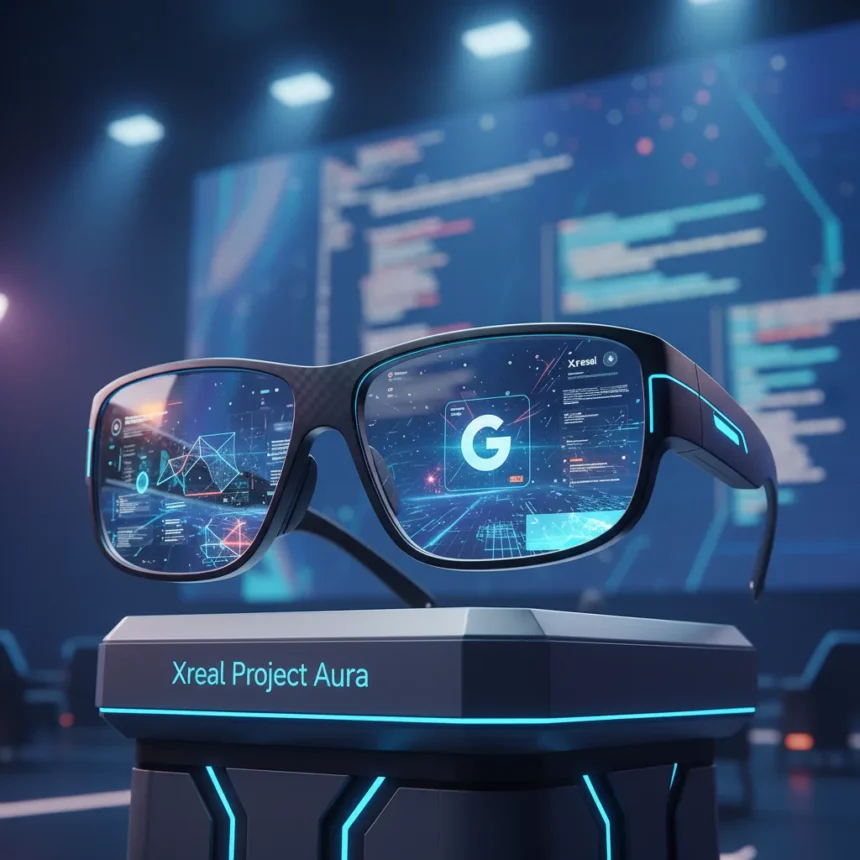
Xreal Project Aura is a pair of optical see-through smart glasses that delivers VR-headset-level capability in a wearable form factor, running Android XR and powered by a tethered Qualcomm Snapdragon compute puck. The device represents Google’s most concrete answer to the question of what Android XR hardware should actually look like—and Xreal just showed it in person at Google I/O.
Key Takeaways
- Xreal Project Aura combines VR power with glasses-like design using optical see-through lenses.
- The glasses are tethered to an external compute puck housing a Qualcomm Snapdragon chip.
- Three front-facing cameras enable spatial perception and environmental understanding.
- Project Aura runs Android XR and supports Google Play apps and Gemini integration.
- The device positions itself as the defining hardware example for Android XR smart glasses.
What Makes Xreal Project Aura Different From Bulky VR Headsets
The core appeal of Xreal Project Aura is architectural simplicity. Rather than cramming processors, batteries, and cooling systems into the frames themselves, the glasses stay light by offloading compute and power to a separate puck. This tethered approach mirrors how early VR systems worked, but inverts the logic—the headset becomes the lightweight display layer, not the computational brain. The Qualcomm Snapdragon chip inside the puck handles the heavy lifting while the glasses remain closer to ordinary eyewear in weight and form factor.
Optical see-through design is the second differentiator. Unlike VR headsets that block the real world entirely, Project Aura’s transparent lenses let you see your surroundings while digital content overlays on top. This is fundamentally different from the immersive-but-isolating experience of a Meta Quest or PlayStation VR2. You can glance at your real environment—a room, a street, a person—without removing the device. That shift from isolation to augmentation is why Project Aura feels purpose-built for Android XR rather than adapted from VR.
How Project Aura Positions Android XR as a Real-World Platform
Android XR has always been Google’s bet that smart glasses could become as essential as smartphones. Xreal Project Aura is the hardware proof of concept. The glasses run the full Android XR operating system and support Google Play apps, meaning developers can build for a massive ecosystem rather than a closed garden. Gemini integration opens the door to AI-powered assistance layered directly onto your field of vision—navigation, notifications, and real-time information without pulling out a phone.


Three front-facing cameras give the glasses spatial awareness. These sensors let the device understand your environment, track hand gestures, and enable spatial computing tasks. Combined with Android XR’s software stack, this transforms Project Aura from a passive display into an interactive computing platform. The glasses can recognize objects, map rooms, and respond to your location and movements. That capability is what separates a smart display from an actual spatial computer.
The Tethered Design Trade-Off: Why It Makes Sense for Now
Tethering to an external puck sounds like a step backward compared to standalone headsets, but it is actually a pragmatic engineering choice. A fully standalone glasses frame would need to house a powerful processor, thermal management, and a battery large enough to run all-day compute—which would make the glasses bulky and hot. By separating compute from display, Xreal keeps the frames light enough to wear comfortably for hours while maintaining the processing power needed for spatial AI and real-time rendering.


The puck can stay in a pocket or bag, connected wirelessly or via cable. This design lets the glasses themselves weigh roughly as much as regular eyeglasses, a crucial advantage for wearability. As battery and processor technology improve, future iterations could integrate more compute into the frames. For now, the tethered architecture is the honest engineering path to a glasses-shaped device that actually works.
Why Android XR Needed Hardware Like This
Android XR had been a software platform in search of hardware. Samsung hinted at Android XR glasses, but nothing concrete shipped. Google showed the vision, but the device category remained theoretical. Xreal Project Aura breaks that logjam by showing that you can build glasses that feel like glasses, run a full operating system, and deliver spatial computing without requiring a VR headset’s bulk. The device validates Android XR’s design philosophy: augmented reality and spatial interaction layered onto your everyday vision, not replacing it.
This is fundamentally different from Meta’s approach with the Orion prototype, which prioritizes full AR immersion in a more compact form, or traditional VR headsets that prioritize immersion above all else. Xreal’s optical see-through design and glasses form factor make it suited to tasks where you need to remain aware of your surroundings—navigation, work collaboration, quick notifications—rather than fully immersive gaming or entertainment.
What We Still Don’t Know About Project Aura
Xreal has not disclosed pricing, exact launch timing, or detailed battery life specifications. The device was shown at Google I/O as a working prototype, but it remains unclear when consumers can actually buy it. Field of view, display brightness, and processor performance specifics are also unconfirmed. These details matter enormously for real-world usability—a narrow field of view or dim display would undermine the entire premise.


The compute puck’s tether mechanism is also unspecified. Is it wireless, wired, or both? How far can you move from the puck before latency becomes a problem? These practical questions will determine whether Project Aura is a genuine daily-wear device or a novelty confined to controlled environments.
Is Xreal Project Aura the future of smart glasses?
Project Aura is a strong signal that optical see-through glasses running a full OS and powered by spatial AI are the direction the category is heading. However, the tethered design and unknown pricing mean it is not yet a consumer-ready product. The device proves the concept works; execution and pricing will determine adoption.
How does Project Aura compare to Meta Orion?
Both devices aim to deliver AR in a glasses form factor, but they prioritize differently. Project Aura emphasizes optical see-through transparency and Android XR integration, making it suited to augmented reality tasks. Meta Orion focuses on immersive AR with a wider field of view and standalone processing, targeting more intensive experiences. Project Aura is lighter and more transparent; Orion is more immersive but bulkier.
When will Xreal Project Aura be available?
Xreal has not announced a specific launch date or retail availability window. The device was demonstrated at Google I/O as a working prototype, indicating development is advanced, but consumer availability remains unconfirmed.
Xreal Project Aura matters because it finally answers the question of what Android XR hardware should be. Not a VR headset. Not a heads-up display. But a genuinely wearable pair of glasses that lets you see the real world while computing happens all around you. That vision has been theoretically sound for years. Seeing it work in person at Google I/O makes it tangible for the first time. Whether it ships on schedule and at a price people will pay is the next test.
Where to Buy
Edited by the All Things Geek team.
Source: Android Central