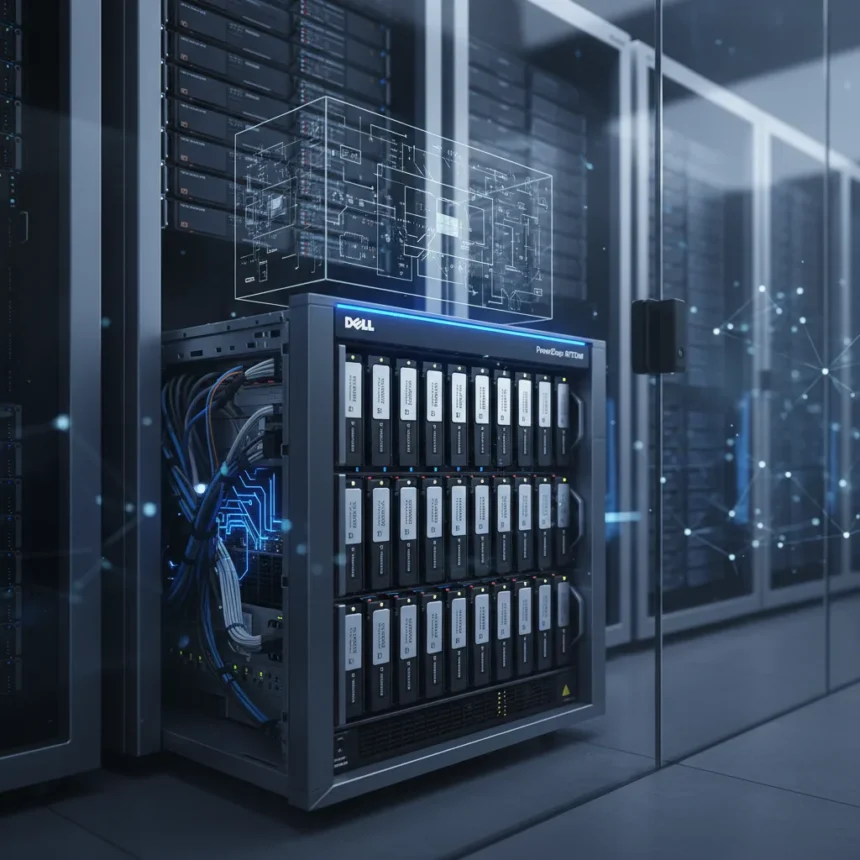
The Dell PowerEdge R7725xd storage density breakthrough represents a fundamental shift in how hyperscale operators architect AI infrastructure. Dell and KIOXIA have delivered a single 2U server configuration that holds 9.8 petabytes of flash storage, eliminating the need for sprawling storage arrays and the power overhead that comes with them.
Key Takeaways
- Dell PowerEdge R7725xd achieves 9.8PB in a single 2U chassis using 40 KIOXIA LC9 Series SSDs.
- Each drive delivers 245.76TB capacity in E3.L NVMe form factor with PCIe 5.0 interface.
- Comparable systems using conventional 30.72TB drives require seven additional servers and 280 more drives.
- The dense configuration consumes 8x less power than traditional multi-server alternatives.
- AMD EPYC 9005 processors power the system with up to five 400Gbps network interfaces.
What Makes This Server Different
Storage density in data centers has always meant compromise. You pack more drives into a rack and accept higher power consumption, cooling complexity, and operational overhead. The Dell PowerEdge R7725xd breaks that pattern by fitting 40 of KIOXIA’s LC9 Series SSDs into a single 2U form factor. Each drive carries 245.76TB, stacked in E3.L NVMe slots with PCIe 5.0 connectivity. The math is straightforward: 40 drives multiplied by 245.76TB equals 9.8 petabytes in the footprint of two rack units.
Why does this matter? Consider the alternative. Building equivalent storage capacity using conventional 30.72TB SSDs would require seven additional servers, 280 more drives, and eight times the power draw. For a hyperscaler managing petabytes of training data, model weights, and inference caches, that difference translates directly to capital expenditure, operational expense, and facility design constraints. A single 2U server replaces what would otherwise be eight full servers worth of infrastructure.
Dell PowerEdge R7725xd Architecture for AI Workloads
The system is built around AMD EPYC 9005 processors, paired with up to five 400Gbps network interfaces for moving data at hyperscale speeds. Air cooling keeps the design simple and reduces dependency on liquid cooling infrastructure that many dense storage systems require. The PowerEdge R7725xd is not a storage appliance bolted onto a compute platform—it is a purpose-built system where storage density and compute capability coexist.


KIOXIA’s LC9 Series drives are the enabling technology here. These enterprise-grade SSDs use PCIe 5.0 to deliver the bandwidth required for parallel data access across 40 drives simultaneously. Without that interface speed, the server would become a bottleneck. With it, applications can stream data from all 40 drives concurrently, turning the 2U form factor into a genuine high-performance storage engine rather than a capacity trap.
How This Reshapes AI Data Center Economics
The headline claim in the original announcement speaks to 200PB-plus racks costing around $75 million. While specific pricing for the PowerEdge R7725xd itself remains undisclosed, the density advantage is undeniable. A hyperscaler deploying AI infrastructure can now achieve the same storage capacity in roughly one-eighth the physical space and with one-eighth the power consumption compared to conventional high-capacity drive configurations.



This density advantage directly impacts facility planning. Data centers have fixed power budgets per rack. Conventional storage servers consume that budget quickly. The PowerEdge R7725xd lets operators fit vastly more capacity within the same power envelope, which means fewer racks, smaller facilities, and lower cooling costs. For organizations training trillion-parameter models or managing massive vector databases for retrieval-augmented generation, that efficiency gain compounds across hundreds or thousands of servers.
Competitive Position and Alternatives
The storage server market includes competitors from HPE, Lenovo, and others, but few have matched this specific density milestone. Most enterprise servers max out at 24 or 32 NVMe drives per 2U unit. The PowerEdge R7725xd’s 40-drive configuration is not simply a matter of adding more slots—it required collaboration with KIOXIA to deliver SSDs with the thermal and power characteristics needed to coexist in such tight quarters without throttling. Traditional 30.72TB drives in equivalent quantities would consume more power and generate more heat, making this density impossible with conventional components.
Practical Deployment Considerations
Density is only valuable if the system can sustain performance under load. The PowerEdge R7725xd addresses this through PCIe 5.0’s doubled bandwidth compared to PCIe 4.0 and through the high-speed network interfaces that prevent the server from becoming a storage island. Administrators managing these systems will need to account for the concentration of capacity—a single 2U unit now represents 9.8 petabytes that must be replicated, backed up, or distributed across failure domains carefully.
The air-cooled design simplifies deployment in existing data centers. Many ultra-dense storage systems require liquid cooling loops or specialized airflow management. The PowerEdge R7725xd fits into standard rack infrastructure without requiring facility upgrades, which accelerates time to deployment for organizations looking to expand AI capacity quickly.



Is the Dell PowerEdge R7725xd right for your infrastructure?
The PowerEdge R7725xd targets hyperscalers and large enterprises building AI platforms, data lakes, and machine learning pipelines where storage density and power efficiency directly impact operating margins. If your workloads fit into distributed storage architectures and you have the network bandwidth to feed 40 concurrent NVMe drives, this server delivers measurable advantages. Smaller organizations or those with legacy storage protocols may not justify the investment.
How does 9.8PB in 2U compare to traditional storage arrays?
Traditional SAN arrays achieve similar capacities but require multiple rack units, significantly more power, and separate compute and storage tiers. The PowerEdge R7725xd collapses that architecture into a single dense unit, eliminating the network bottleneck between compute and storage while reducing power consumption by roughly 87.5 percent compared to seven conventional servers.
What makes KIOXIA’s LC9 Series SSDs critical to this configuration?
The LC9 Series combines 245.76TB capacity with E3.L form factor and PCIe 5.0 support, enabling 40 drives to coexist in 2U without thermal or power constraints. Standard enterprise SSDs lack either the capacity or the efficiency needed for this density. The LC9 is purpose-built for hyperscale deployments where storage concentration matters.
The Dell PowerEdge R7725xd represents a genuine inflection point in data center architecture. For organizations racing to deploy AI infrastructure, this server eliminates a major constraint—the sprawl of conventional storage systems. By fitting 9.8 petabytes into 2U, Dell and KIOXIA have given hyperscalers permission to think differently about how they organize storage, compute, and power in the data center. That permission, backed by working hardware, changes the economics of AI at scale.
Edited by the All Things Geek team.
Source: TechRadar