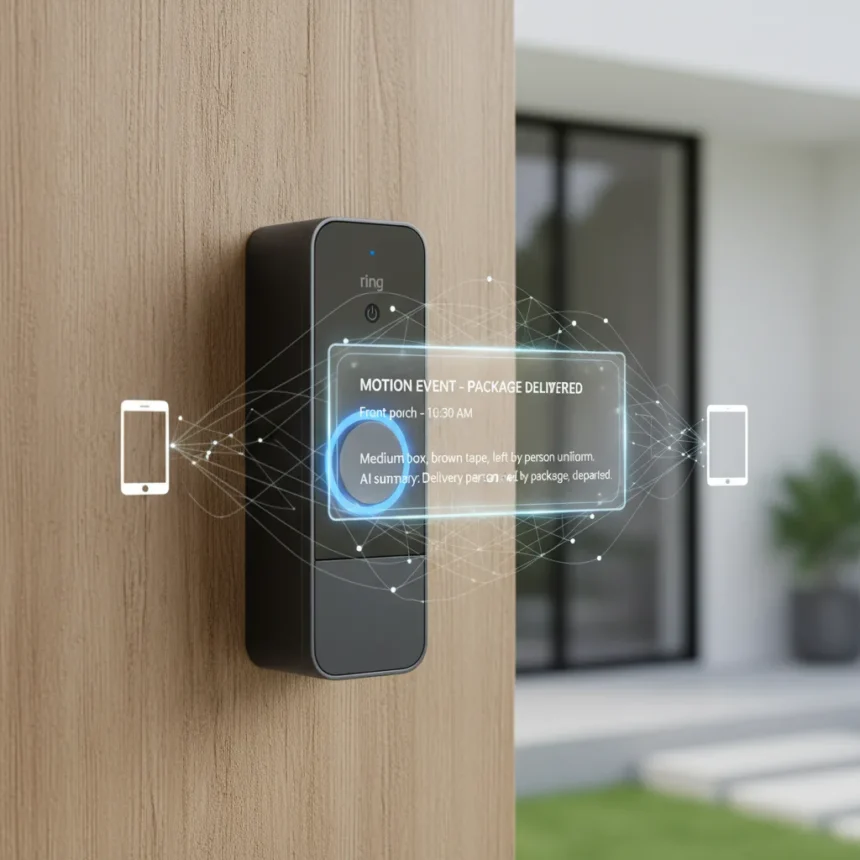
Ring’s AI doorbell feature represents a meaningful shift in how smart doorbells handle motion alerts. Rather than sending a simple notification that motion was detected, the system now generates a text description of what triggered the alert, identifying both the main subject and the action taking place. This change addresses a core frustration with traditional doorbells: the need to manually review every clip to determine whether an alert actually matters.
Key Takeaways
- Ring’s AI generates text descriptions of motion events, not just alerts, helping you assess incidents faster.
- Descriptions identify the main subject and action, letting you decide whether to view the full video or contact authorities.
- The feature works across Ring’s compatible security cameras and video doorbells through the Ring app.
- Competitors like Aqara are pushing local facial recognition and 2K video as alternative approaches to smart doorbell intelligence.
- This reflects a broader smart-home trend toward AI-assisted event descriptions and faster decision-making.
How Ring’s AI Doorbell Feature Actually Works
The workflow is straightforward but effective. When motion is detected by your Ring doorbell, the system doesn’t just ping your phone—it generates a short text description of what happened. You read that description on your notification, see what the AI identified as the subject and action, and then decide whether to open the live feed or take further action, such as contacting local authorities. This eliminates the friction of opening the app, loading the video, and watching 30 seconds of footage to confirm that a notification was just a passing delivery driver.
The feature is available in the Ring app for compatible Ring security cameras and video doorbells. This means if you own a Ring Battery Doorbell Plus, Ring Battery Doorbell Pro, or other compatible models, you can access these AI-generated descriptions without replacing your hardware. The descriptions are designed to be quick and concise, giving you the essential information you need in seconds.
Why This Matters More Than You’d Think
Smart doorbells have existed for years, but most still operate on a notification-and-review model that wastes your time. You get dozens of alerts per week—delivery drivers, mail carriers, neighbors, wind-blown debris—and checking each one manually creates alert fatigue. Ring‘s AI doorbell feature flips this by doing the initial assessment for you. The system tells you what it saw, and you decide whether that warrants your attention. That’s a subtle but powerful difference in user experience.


The competitive landscape is shifting in this direction. Aqara’s new doorbell offers local facial recognition and 2K video as headline features, showing that the market recognizes AI-assisted security as table stakes. Google Home is moving toward AI descriptions and camera history search for smart cameras, signaling that the entire smart-home industry is converging on AI-powered event understanding. Ring’s approach—generating text descriptions of motion events—is the company’s bet in this race.
Ring AI Doorbell Feature vs. Competitor Approaches
Ring’s strategy differs from rivals in meaningful ways. Where Aqara emphasizes local facial recognition and Matter compatibility, Ring leans into generative AI descriptions that work without storing face data on your doorbell. This is a trade-off: Aqara’s local processing means facial recognition happens on the device itself, while Ring’s approach relies on cloud-based AI to describe what it sees. For users concerned about privacy, local processing is attractive. For users who want fast, accurate event summaries without managing facial recognition databases, Ring’s approach is simpler.



The core Ring doorbell experience remains unchanged—you still get motion detection, live viewing, two-way talk, and real-time alerts to your phone, tablet, and PC. The AI feature layers on top of this foundation, enhancing the decision-making process rather than replacing the core functionality. This makes it a low-risk upgrade for existing Ring users.
Is Ring’s AI Doorbell Feature Worth Your Attention?
If you currently own a Ring doorbell and find yourself overwhelmed by motion alerts, this feature directly solves that problem. You no longer need to check every clip—the AI does a first pass and tells you what happened. If you’re considering a Ring doorbell and want the latest smart-home security features, compatibility with this AI functionality is now a reasonable purchase factor. The feature works across Ring’s app ecosystem, so you’re not locked into a single model.
The broader takeaway is that smart-home security is moving toward AI-assisted intelligence. Ring’s AI doorbell feature is not revolutionary, but it is practical. It saves you time by automating the most tedious part of doorbell ownership: sorting through dozens of false alarms to find the alerts that actually matter. In a market flooded with smart-home gadgets that promise more than they deliver, a feature that genuinely improves daily usability is worth paying attention to.
Does the AI doorbell feature work on all Ring doorbells?
The AI-generated descriptions are available in the Ring app for compatible Ring security cameras and video doorbells. Not all older Ring models may support this feature, so check your specific doorbell model in the Ring app to confirm compatibility.



How accurate are Ring’s AI descriptions?
The AI identifies the main subject and action that triggered the motion alert. Accuracy depends on lighting, angle, and movement clarity. Like any AI system, it is not perfect, but it is designed to give you enough information to decide whether to view the full video without watching every clip manually.
Does this feature cost extra?
The research brief does not specify pricing or subscription tier requirements for this feature. Check the Ring app or Ring’s website for current details on feature availability and any associated costs.
Ring’s AI doorbell feature represents a practical step forward in smart-home security. It does not reinvent the doorbell, but it removes friction from the most annoying part of ownership—sorting through endless motion alerts. In a market where competitors are racing to add facial recognition and local processing, Ring’s focus on readable event descriptions is a refreshingly straightforward approach to the real problem: helping you decide faster whether an alert deserves your attention.
Edited by the All Things Geek team.
Source: T3