







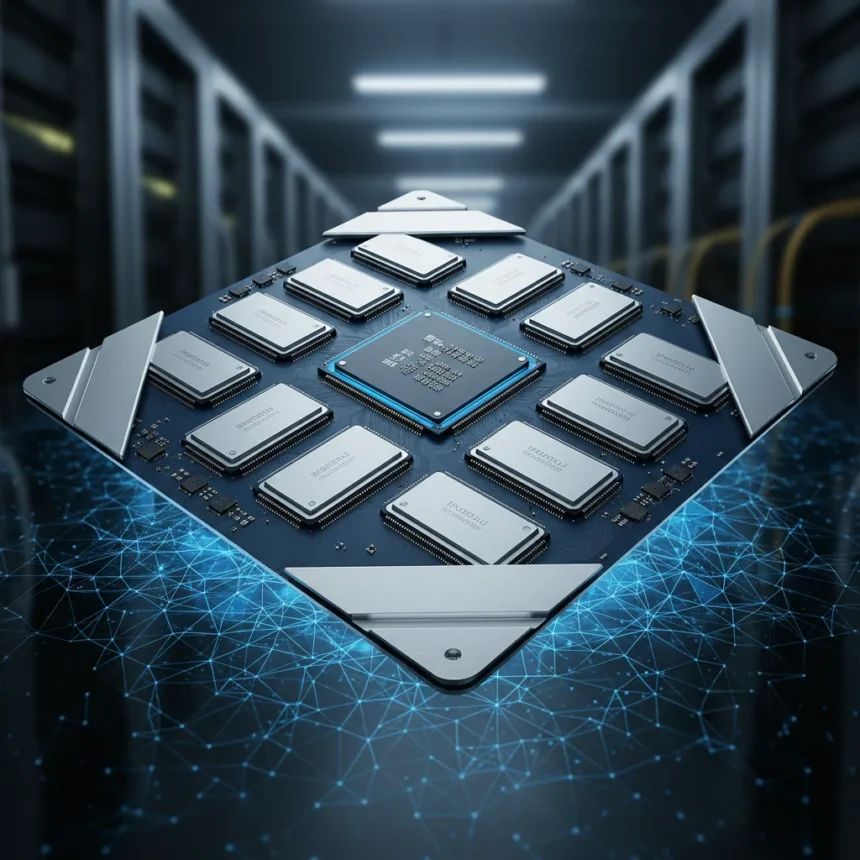
Intel Crescent Island GPU is a next-generation data center accelerator designed specifically for AI inference workloads, unveiled at Computex with support for up to 480GB of LPDDR5X memory. The chip represents Intel’s strategy to challenge Nvidia and AMD’s dominance in AI acceleration by offering massive memory capacity without relying on scarce, expensive HBM (high-bandwidth memory). Customer sampling begins in the second half of 2026.
Key Takeaways
- Intel Crescent Island GPU scales to 480GB of LPDDR5X memory, up from the original 160GB specification
- Uses Xe3P microarchitecture optimized for performance-per-watt in inference deployments
- Targets air-cooled enterprise servers to reduce total cost of ownership versus HBM-based competitors
- Positioned for tokens-as-a-service and large-context AI inference where memory capacity matters more than bandwidth
- Customer sampling expected second half of 2026, with production timeline still unconfirmed
Why Memory Capacity Matters More Than You Think
The Intel Crescent Island GPU’s defining feature is its memory strategy. Rather than chase bandwidth records with HBM3E like competitors, Intel doubled down on capacity. The original specification was 160GB of LPDDR5X; at Computex, Intel discussed configurations scaling to 480GB by using higher-capacity memory modules. This matters because modern large language models require enormous KV-cache buffers during inference—the longer the context window, the more memory you need. AMD’s MI350P offers 144GB of HBM3E, while Nvidia’s H200 NVL delivers 141GB of HBM3. Neither comes close to Crescent Island’s potential capacity.
The trade-off is bandwidth. LPDDR5X memory delivers lower throughput than HBM, meaning Crescent Island will process tokens more slowly than rivals in bandwidth-heavy workloads. But for inference scenarios where latency per token matters less than the ability to serve massive batch sizes simultaneously—think serving thousands of concurrent requests at a SaaS provider—capacity wins. Intel is betting that data centers care more about fitting longer contexts and more simultaneous requests than squeezing every microsecond of latency.
Intel Crescent Island GPU Targets Cost-Conscious Data Centers
Crescent Island is engineered for air-cooled enterprise servers, not the exotic liquid-cooled setups that HBM accelerators often demand. This design choice cuts deployment costs and complexity. HBM memory is expensive and supply-constrained; LPDDR5X is mature, widely available, and cheaper. Intel’s open and unified software stack for heterogeneous AI systems is being tested on Arc Pro B-Series GPUs to enable early optimization before Crescent Island arrives.



The inference-first positioning is deliberate. While training dominates AI headlines, inference—running trained models on new data—is where data centers actually spend money at scale. Tokens-as-a-service platforms, embedding providers, and chat API backends all need inference capacity. Crescent Island is built for that market, not for researchers training foundation models from scratch.
How Crescent Island Stacks Against the Competition
Nvidia and AMD have dominated data center AI acceleration, but both rely on HBM, which creates bottlenecks in supply and cost. Crescent Island’s LPDDR5X approach is unconventional in the AI accelerator space, positioning it as a memory-capacity specialist rather than a bandwidth champion. For workloads where context length and batch size are the limiting factors—not raw throughput—Crescent Island could offer better value per inference request.



The catch is software maturity. Nvidia’s CUDA ecosystem is entrenched; AMD’s ROCm is improving but still faces adoption friction. Intel’s software stack is being developed in parallel, tested on Arc Pro hardware before Crescent Island ships. Early adoption risk is real. But for cost-sensitive data centers willing to invest in software optimization, Crescent Island could deliver compelling economics by late 2026.
When Will Crescent Island Actually Arrive?
Intel expects customer sampling in the second half of 2026. That timeline puts production availability likely in 2027—two to three years from now. The GPU market moves fast; by then, competitors will have released newer generations. But for data centers planning long-term inference infrastructure, the memory-capacity advantage could justify waiting and factoring Crescent Island into procurement strategies.
What does Crescent Island’s 480GB memory capacity mean for AI inference?
The 480GB capacity allows data centers to serve longer context windows and larger batch sizes simultaneously without swapping data to slower storage. This is especially valuable for retrieval-augmented generation (RAG) systems and multi-user inference platforms where memory is the bottleneck, not compute speed.
How does Intel Crescent Island GPU compare to Nvidia H200?
Nvidia’s H200 NVL offers 141GB of HBM3 with higher bandwidth, while Crescent Island scales to 480GB of LPDDR5X with lower bandwidth. Crescent Island wins on capacity and cost; H200 wins on throughput. The choice depends on your inference workload’s priorities.



When can I buy Crescent Island for my data center?
Customer sampling begins in the second half of 2026, with production availability expected after that. Pricing has not been disclosed. Contact Intel’s data center sales team if your infrastructure roadmap extends into 2027.
Intel Crescent Island GPU represents a genuine architectural alternative in data center AI acceleration. It abandons the bandwidth race to win on memory capacity and cost, betting that inference-focused data centers value fitting more requests and longer contexts over raw speed. Whether that bet pays off depends on software maturity and market adoption—but the hardware strategy is sound for a market tired of HBM scarcity and premium pricing.
Edited by the All Things Geek team.
Source: Tom's Hardware




