


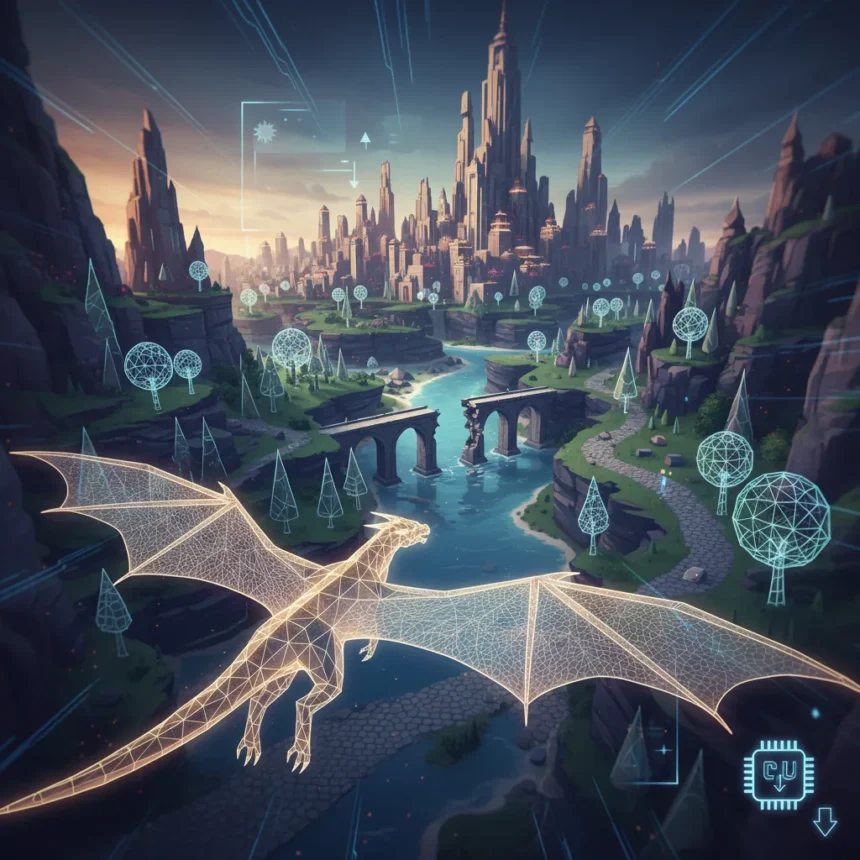
Optical illusions game development is quietly reshaping how indie studios build polished worlds on tight budgets. Instead of rendering expensive effects in real time, developers are borrowing tricks from visual psychology—faking motion blur, fabricating reflections, and warping geometry—to make games look better while demanding less from hardware.
Key Takeaways
- Halo faked motion blur on vehicle tyres by swapping pre-blurred textures instead of calculating blur in real time.
- Half-Life: Blue Shift created fake reflections by placing identical geometry under a glass surface.
- Driver used photographs as textures to simulate drivable cities on PS1 hardware.
- Isometric cameras rotated to 54.736 degrees enable impossible-geometry illusions that break when viewed from different angles.
- One team reduced character-animation adjustments by around 20 times using modern facial-performance tools.
Why Optical Illusions Matter in Game Design
Game development budgets are finite. Processing power is finite. Artists’ time is finite. Optical illusions solve all three constraints at once by exploiting how human brains perceive motion, shape, and perspective. When a player sees a blurred tyre on a speeding vehicle, their brain fills in the motion blur automatically—the game never had to calculate it. This is not cheating. This is smart psychology applied to rendering pipelines.
The earliest examples prove the concept works. Halo’s Warthog used pre-blurred textures swapped in at speed, eliminating the need for real-time motion-blur calculations that would have crushed the original Xbox’s GPU. Half-Life: Blue Shift saved geometry and reflection rendering by mirroring a room under a glass surface, letting players perceive depth and space without duplicating asset work. Driver went further, photographing real cities and using those images as textures to fake drivable urban environments on PS1 hardware that could never have rendered actual 3D buildings.
These are not one-off tricks. They are architectural patterns that indie developers now use routinely to punch above their technical weight.


How Optical Illusions Game Development Actually Works
The most sophisticated optical illusions in games rely on a specific technical setup: an isometric camera, geometry carefully blocked to exploit perspective distortion, and a rasterization engine rather than ray tracing. Setting up an isometric camera means rotating an orthographic camera to 54.736 degrees, 0, 45 degrees—a precise angle that creates the illusion of depth without perspective distortion. From this angle, moving +1 unit in Y and -1 unit in X and Z appears to return the viewer to the starting point, even though the geometry is completely flat.
Why not use ray tracing? Because ray-tracing engines like Cycles reveal the illusion’s location. Rasterization engines like Eevee preserve the trick by rendering only what the camera sees. The illusion collapses the moment the viewer moves to an angle where the geometry no longer lines up—but if your camera is locked to isometric view, the player never gets that angle.



Building the geometry itself requires precision. Start with the illusion object as a guideline, then block out the rest of the scene in basic triangle shapes. Round corners with the Bevel tool, then add Bevel and Subdivision modifiers for softer edges that feel less artificial. Add support loops to reduce artefacts where front and back block modifications do not match. This layering of modifiers is not optional—it is what makes the illusion convincing enough to survive player scrutiny.
Modern Tools Make Optical Illusions Accessible
The barrier to entry for optical illusions game development has collapsed. Tools like Epic Games’ MetaHuman can transfer facial performance from an actor to a character model using many facial camera systems, including iPhone. One team found this workflow sped up adjustments to a finished character by around 20 times compared to manual animation. That is not a marginal gain—that is a transformative shift in how small teams can produce AAA-quality character work.
The analytics piece matters too. Developers now have data showing where players succeed or fail in navigating illusion-based spaces. This feedback loop lets teams refine the visual tricks in real time, tightening the gap between what the illusion promises and what the player actually perceives. The office chair with one broken wheel that pivots unexpectedly is not a bug—it is a carefully tuned detail that players remember.
Why This Matters Right Now
Indie developers are shipping games that look like AAA productions because they are borrowing from decades of visual-psychology research and rendering innovation. Optical illusions game development transforms constraint into creativity. A small team cannot afford to render a full city in real time, so they photograph one and texture a simplified mesh. They cannot calculate motion blur on every moving object, so they pre-bake it into the asset. They cannot animate every character gesture by hand, so they transfer performance data from an actor in seconds.



The trend is not slowing. As tools improve and knowledge spreads, expect more games to rely on these tricks. Not because they are cheap—though they are—but because they work. The player does not care whether the reflection is real or mirrored geometry. They care that the world feels alive, responsive, and worth exploring. Optical illusions game development delivers that feeling at a fraction of the cost.
Can optical illusions game development work in ray-tracing engines?
Ray-tracing engines like Cycles reveal the geometry behind optical illusions because they calculate light bouncing realistically off every surface. An isometric illusion breaks instantly under ray tracing. Rasterization engines like Eevee only render what the camera sees, preserving the trick.
How do developers prevent players from breaking optical illusions?
Lock the camera angle. If the player cannot move to a perspective where the illusion fails, the trick survives indefinitely. Isometric games, top-down games, and games with fixed camera angles are naturally suited to optical illusions because the viewing angle is constant.
What makes an optical illusion convincing in a game?
Precision geometry, careful lighting, and the player’s brain doing the heavy lifting. Add support loops to eliminate artefacts, use Bevel and Subdivision modifiers to soften hard edges, and light the scene to guide the player’s eye where you want it. The illusion works because the player’s perception fills in gaps the geometry does not actually contain.
Optical illusions game development is not a novelty. It is a core technique that separates polished indie games from rough ones. The best games are not always the ones with the most processing power—they are the ones that understand how players see, what they believe, and where their brains will fill in the blanks.
Edited by the All Things Geek team.
Source: Creativebloq