





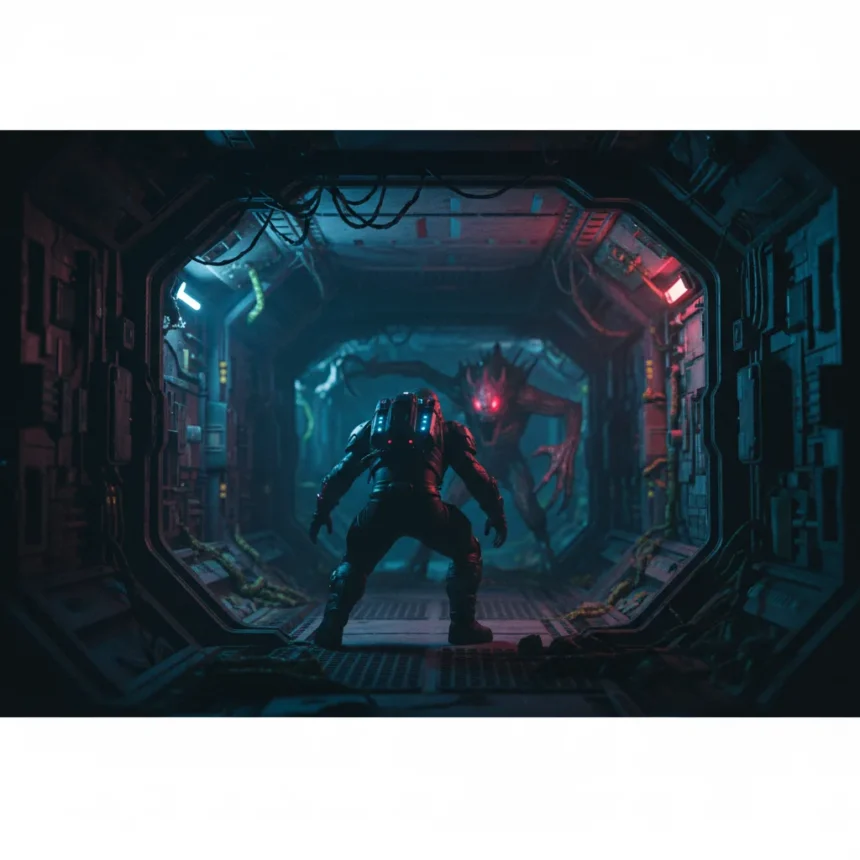
Directive 8020 space horror represents Supermassive Games’ boldest departure yet—the first Dark Pictures Anthology entry set in space, where survival means staying silent and invisible rather than fighting back. Executive producer Dan McDonald explains that this shift enables something the studio has wanted for years: threatening exploration where helplessness becomes the primary source of fear.
Key Takeaways
- Directive 8020 is the first Dark Pictures game set in space, developed by Supermassive Games.
- Players evade aliens using stealth with no weapons or combat options.
- Camera system and character controls rebuilt from scratch for smoother, more direct player control.
- Inspired by sci-fi horror films including Alien, Event Horizon, Prometheus, and Life.
- Direct character control makes survival encounters feel scarier than previous Dark Pictures titles.
Why Space Works for Supermassive’s Survival Horror Vision
Space isolates you completely. No reinforcements arrive. No escape pod launches on demand. This environment forced Supermassive Games to rethink how fear functions in interactive horror. Rather than relying on quick-time events or branching dialogue to create tension, Directive 8020 space horror puts you in direct control of a character who must move through hostile environments undetected. McDonald notes that this direct control changes everything: “now, you’ve got direct control of the character, and when something happens, it can feel much scarier and it’s a chance to do different stuff”.
The stealth mechanic is not a side option—it is the entire game. Creative director Will Doyle emphasizes that players must “stay quietly in the shadows, avoiding detection” because they lack any weapon to defend themselves. This design choice strips away the illusion of power that guns provide in most survival horror games. You are not outgunned; you are outmatched. The threat is not just present—it is inevitable unless you hide perfectly.
Rebuilt Systems Make Stealth Feel Natural
Supermassive Games rebuilt the camera system from scratch, giving players full control rather than fixed angles. This shift matters more than it sounds. In previous Dark Pictures titles, the camera often felt like a third party observing your choices. Here, your perspective is yours alone. Character movement has been overhauled as well, with controls that feel “smoother on the sticks” and “smoother than in our previous games”. These technical changes support the core design: stealth requires precision, and precision requires responsive controls.


The studio also introduced stronger survival horror action adventure elements to the gameplay. This balance between exploration, evasion, and narrative choice distinguishes Directive 8020 space horror from pure stealth games like Hitman or Splinter Cell. You are not infiltrating a compound for an objective—you are surviving an encounter with an alien threat while uncovering what happened aboard this vessel. The narrative and mechanics reinforce each other.
Sci-Fi Horror Cinema as the Blueprint
Supermassive Games drew inspiration from decades of space horror cinema. The list spans Andrei Tarkovsky’s Solaris (1972), Ridley Scott’s Alien (1979), Paul W.S. Anderson’s Event Horizon (1997), Christian Alvart’s Pandorum (2009), Ridley Scott’s Prometheus (2012), Daniel Espinosa’s Life (2017), and Egor Abramenko’s Sputnik (2020). This range reveals the studio’s intent: not to copy any single film, but to synthesize the feeling that space is fundamentally inhospitable to human life. Each film explores isolation, unknown threats, and the failure of technology to protect you. Directive 8020 space horror channels that dread through interactive choice.



What separates a game adaptation of these themes from the films themselves is agency. A film viewer watches characters make fatal mistakes. A game player makes them. This shift transforms passive horror into active dread. You control the character, so when they die, the failure is yours. McDonald understands this distinction—the emphasis on direct control is not accidental. It is the entire point.
How Directive 8020 Differs from Previous Dark Pictures Entries
The Dark Pictures Anthology has always offered branching narratives where player choices reshape the story. But earlier entries—Man of Medan, Little Hope, House of Ashes—relied heavily on quick-time events and dialogue choices to drive tension. Directive 8020 space horror shifts the weight to moment-to-moment survival. You cannot talk your way past an alien. You cannot fail a prompt and recover. You must move, hide, and think in real time. This represents a fundamental evolution in how Supermassive Games approaches interactive horror.
The stealth focus also eliminates the power fantasy that combat provides. In other horror games, you eventually find a gun, find ammunition, and shift from prey to predator. Directive 8020 space horror refuses this progression. You remain vulnerable throughout. This sustained helplessness is what makes space the perfect setting—there is nowhere to run, no authority to call, no hope of overwhelming force. Only silence and shadows.
What Makes This Long-Awaited?
Supermassive Games has been working toward this type of threatening exploration for years, according to McDonald. The studio’s previous titles proved their mastery of branching narrative and cinematic presentation, but Directive 8020 space horror represents a chance to prove they can execute survival mechanics with the same polish. The rebuild of the camera and control systems suggests this was not a quick pivot—it was a deliberate design overhaul to support a new vision.



Is Directive 8020 a departure from the Dark Pictures formula?
Yes. While it retains the branching narrative and cinematic presentation of previous Dark Pictures games, Directive 8020 space horror emphasizes real-time stealth survival over quick-time events and dialogue choices. The rebuilt camera and control systems support this shift, making moment-to-moment evasion the primary source of tension rather than narrative branching alone.
What sci-fi horror films inspired Directive 8020?
Supermassive Games drew from a range of space horror cinema, including Alien, Event Horizon, Prometheus, Life, Pandorum, Solaris, and Sputnik. These films share themes of isolation, technological failure, and inhospitable environments—all of which shape Directive 8020 space horror’s design.
Can you fight aliens in Directive 8020?
No. Players have no weapons and must evade aliens using stealth, staying quietly in the shadows to avoid detection. This design choice removes the power fantasy of combat and sustains a sense of helplessness throughout the game.
Directive 8020 space horror succeeds because it understands something fundamental: space is not a setting—it is a condition. It removes every safety net and forces you to survive on silence and precision. Supermassive Games rebuilt its technical foundation to support this vision, proving that a long wait can yield something genuinely different from what came before.
This article was written with AI assistance and editorially reviewed.
Source: TechRadar