





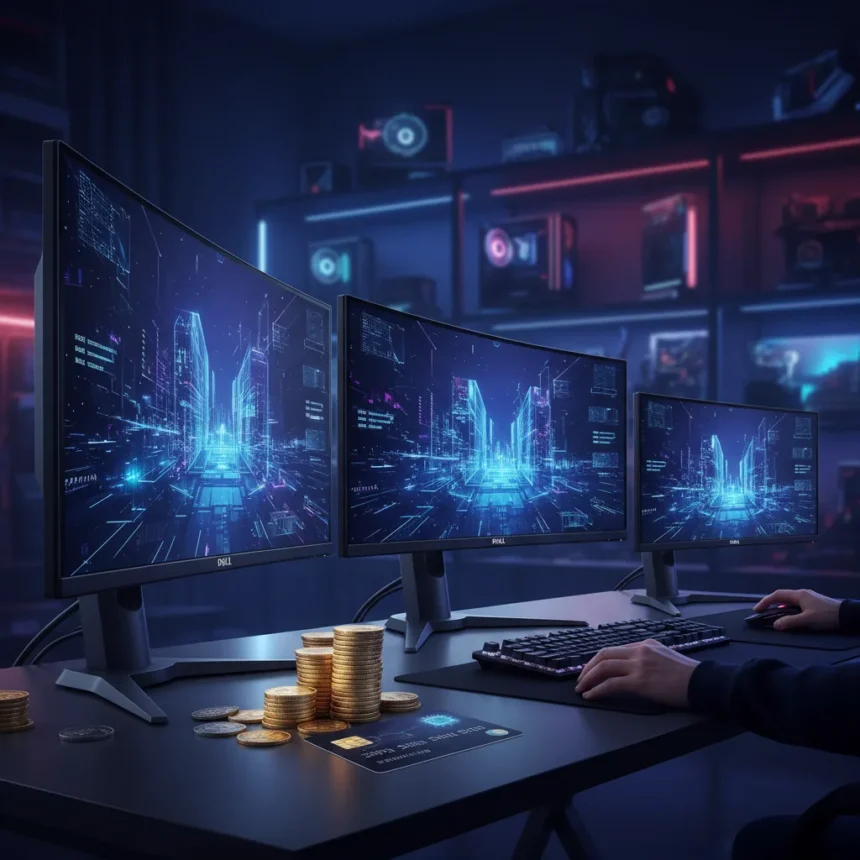
Gaming monitor pricing has become the central battleground in PC gaming hardware right now, and Dell’s new Alienware displays are at the heart of why this moment matters. For years, gamers obsessed over refresh rates, response times, and panel technology as the defining factors in monitor choice. Today, gaming monitor pricing is reshaping which displays actually sell and which sit gathering dust on retailer shelves.
Key Takeaways
- Gaming monitor pricing now determines upgrade decisions more than raw specifications.
- Dell’s new Alienware monitors signal a market shift toward value-conscious competition.
- The current gaming hardware landscape makes affordability the primary differentiator.
- Monitor manufacturers are rethinking their pricing strategies across product tiers.
- Budget-friendly gaming displays are becoming the real competitive battleground.
Why Gaming Monitor Pricing Matters Right Now
The gaming hardware market has reached an inflection point. High-end components continue to push performance boundaries, but the real action—the part that actually moves units and shapes purchasing decisions—happens at the price point where everyday gamers actually shop. Gaming monitor pricing has become the metric that separates products that resonate from those that languish in inventory.
For the past decade, monitor makers competed on specifications: who could offer 360Hz first, who could shrink response times to 0.03ms, who could pack the most quantum dots into a panel. These metrics still matter, but they no longer drive purchase intent the way they once did. A gamer with a $300 budget doesn’t care that a $1,200 monitor exists—they care whether a $300 monitor gives them what they need. Gaming monitor pricing has shifted from a secondary consideration to the primary filter through which consumers evaluate every other feature.
This shift explains why Dell’s new Alienware monitors are significant. The company is not making this announcement because of some revolutionary new technology or breakthrough panel innovation. The significance lies in where these displays sit in the market’s price-to-performance hierarchy and what that positioning says about how the industry is responding to current conditions.



The Current State of PC Gaming Hardware
The PC gaming market is in a peculiar position. Graphics cards remain expensive relative to historical norms. Processors are powerful but not dramatically more affordable than previous generations. Monitors, meanwhile, have become commoditized—not in a negative sense, but in the sense that 144Hz, 165Hz, and 240Hz panels are now table stakes rather than premium features. This commoditization creates an opportunity for manufacturers willing to compete aggressively on gaming monitor pricing.
Gamers upgrading their systems right now face a calculation: spend heavily on GPU and CPU improvements, or invest in a better display? For many, the answer hinges on what monitors cost. If gaming monitor pricing remains high, players defer monitor upgrades and put money toward graphics cards. If manufacturers lower prices, they can capture budget that would otherwise flow to other components.

Dell appears to be betting on the latter scenario. By introducing new Alienware monitors at price points that make them accessible to a broader audience, the company is essentially saying that gaming monitor pricing is where the market’s attention actually is. This is not a revolutionary product announcement—it is a strategic market bet.
What Gaming Monitor Pricing Reveals About Competition
The emphasis on gaming monitor pricing in the current market reveals something important about how manufacturers view competition. When specs converge—when most monitors at a given price tier offer similar refresh rates and response times—price becomes the differentiator. Brands can no longer rely on exclusive features to justify premium positioning. Instead, they compete on value: delivering solid specifications at prices that feel fair to buyers.
This dynamic favors companies with efficient manufacturing and distribution, companies willing to accept thinner margins, and companies that understand their customer base well enough to avoid over-specifying products. A monitor with 360Hz refresh rate and a 0.03ms response time is wasted on a player whose GPU can only push 240fps. Gaming monitor pricing that reflects realistic performance targets—rather than aspirational maximums—is what resonates with actual buyers.
Dell’s Alienware brand has historically positioned itself as premium gaming hardware. If the company is now making gaming monitor pricing a central part of its strategy, it signals that even premium-tier manufacturers recognize the market’s shift. Competitors who fail to adjust their gaming monitor pricing strategies risk losing relevance.


The Broader Implications for Gaming Hardware
Gaming monitor pricing is not just about displays. It reflects a broader recalibration in how PC gaming hardware is marketed and sold. The era when gamers aspired to own the absolute highest-spec components appears to be ending. Instead, a pragmatic approach is taking hold: buy what you actually need, at a price that doesn’t force compromises elsewhere in your build.
This shift has implications for GPU makers, CPU manufacturers, and peripheral brands. If gaming monitor pricing becomes the primary decision driver, then the entire ecosystem must adjust. Motherboard makers might find themselves competing more fiercely on value. Keyboard and mouse manufacturers might need to reconsider their pricing strategies. The monitor market is not isolated—it is part of a larger conversation about what PC gaming costs.
For gamers, this is potentially good news. Competition on gaming monitor pricing tends to benefit consumers more than competition on exotic features. When manufacturers fight over price points, they have to become more efficient, cut unnecessary features, and focus on what actually matters to users. The result is better value across the board.
Is gaming monitor pricing the most important factor in buying a display?
Gaming monitor pricing is the primary decision filter for most buyers, but it is not the only factor. Specifications matter—a monitor’s refresh rate, response time, and panel type should still match your GPU’s capabilities. Ergonomics, build quality, and warranty support also influence the decision. However, if two monitors offer similar specs and features, price becomes the tie-breaker, and that is where most purchasing decisions are made today.
Why are gaming monitor prices changing right now?
Gaming monitor pricing is shifting because the market has matured. High refresh rates and fast response times are no longer exclusive to premium displays. Competition has increased, manufacturing costs have stabilized, and consumer demand has shifted toward value. Manufacturers like Dell are responding by repositioning their product lines to emphasize gaming monitor pricing that reflects actual market conditions rather than historical premium positioning.
How does gaming monitor pricing compare to other PC gaming components?
Gaming monitor pricing has become more competitive relative to GPUs and CPUs, which have remained expensive. A quality gaming monitor now represents better value than it did five years ago, while graphics cards and processors have not seen comparable price decreases. This shift makes monitors an attractive upgrade target for gamers with limited budgets, and it explains why gaming monitor pricing has become such a focal point for manufacturers and consumers alike.
The gaming hardware market is rewarding companies that understand what gamers actually want to spend money on. Dell’s new Alienware monitors matter not because they are revolutionary, but because they reflect an accurate read of the market. Gaming monitor pricing is no longer a secondary consideration—it is the primary conversation. Manufacturers who compete effectively on this front will thrive. Those who ignore it will find themselves increasingly irrelevant.
Edited by the All Things Geek team.
Source: T3