



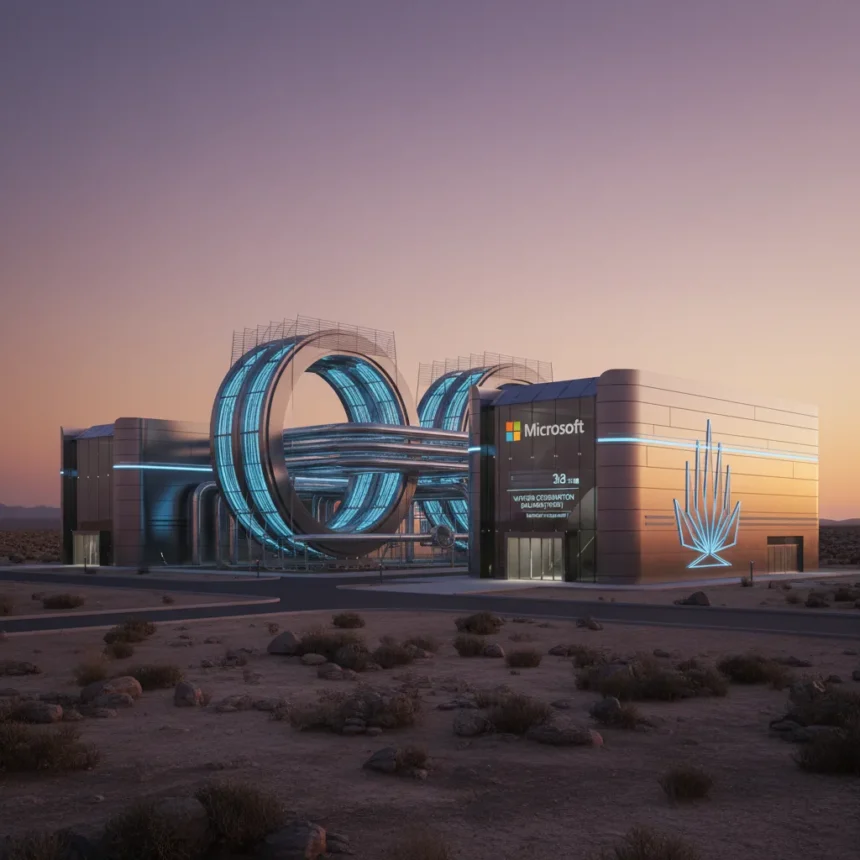
AI data centers water consumption has become a critical environmental issue as artificial intelligence infrastructure scales globally. Microsoft announced in August 2024 that its newest datacenter designs consume zero water for cooling through a closed-loop system that circulates liquid directly to chips, eliminating the need for evaporative cooling that traditionally requires millions of gallons annually. The company claims its latest facility in Mount Pleasant, Wisconsin uses about as much water annually as a typical restaurant.
Key Takeaways
- Microsoft’s closed-loop cooling design, launched in August 2024, eliminates water evaporation in AI data centers.
- The new system can avoid more than 125 million liters of water per year per datacenter.
- Microsoft achieved a 39% improvement in water-use intensity, dropping from 0.49 L/kWh in 2021 to 0.30 L/kWh in its last fiscal year.
- New datacenters using this technology will begin coming online in late 2027.
- Microsoft targets water-positive operations by 2030 across its owned fleet.
How closed-loop cooling cuts AI data centers water consumption
Traditional datacenters rely on evaporative cooling towers that spray water into the air to dissipate heat, consuming vast quantities of fresh water. Microsoft’s new approach eliminates this entirely by circulating cooling fluid directly to each chip in a sealed system, much like a car radiator. Once filled during construction, the liquid continuously cycles between servers and chillers without requiring a fresh supply or losing water to evaporation. This architectural shift addresses the mounting tension between AI’s computational demands and water scarcity in regions where major tech infrastructure concentrates.
The closed-loop design uses chip-level cooling to provide precise temperature control without the waste inherent in traditional systems. By bringing cooling directly to the silicon itself rather than cooling entire rooms, Microsoft reduces the volume of liquid needed and the energy required to manage it. A 2022 audit of Microsoft’s existing practices eliminated 90% of instances where excess water was being used, demonstrating that even incremental improvements across the fleet matter.
AI data centers water consumption reduction across Microsoft’s fleet
Microsoft’s broader water strategy extends beyond new construction. The company has expanded the use of reclaimed and recycled water at datacenter sites in Texas, Washington, California, and Singapore, among other locations. Many Microsoft facilities can rely on outdoor air cooling for most of the year, requiring no water at all for thermal management. Where water is used, the company reports reusing it two to five times before returning it to local utilities for treatment and release.

The company’s fleet-wide water-use intensity averaged 0.30 liters per kilowatt-hour in its last fiscal year, a 39% improvement from 0.49 L/kWh in 2021. This metric matters because it shows how efficiently the company is cooling compute per unit of electricity consumed. Microsoft aims to push this metric near zero for each new datacenter using zero-water evaporation technology, though the company acknowledges a nominal increase in annual energy usage compared with evaporative designs.
The tradeoff: water savings versus energy implications
Closing the cooling loop solves one environmental problem while introducing another question: does the energy cost offset the water benefit? Microsoft states that the shift to next-generation datacenters will create only a nominal increase in energy usage compared with traditional evaporative designs. The company does not quantify this energy increase or its indirect water footprint through grid consumption, leaving the full environmental calculus unclear. What is clear is that AI workloads demand both water and electricity, and Microsoft’s engineering focuses on reducing the more constrained resource—water—in regions where it matters most.



The timing of these deployments is significant. Microsoft began rolling out the new cooling technology in August 2024, but the first datacenters using it will not come online until late 2027. This lag between design adoption and physical deployment means the water benefits will materialize gradually, not immediately. For a company targeting water-positive operations by 2030 across its owned portfolio, the schedule is tight.
How does Microsoft’s approach compare to traditional datacenter cooling?
Traditional evaporative cooling systems can consume more than 125 million liters of water annually per datacenter. Some large AI facilities in the United States reportedly use up to 5 million gallons of water every day, underscoring why Microsoft’s closed-loop approach represents a meaningful architectural shift. The company’s restaurant-level water claim—while catchy—reflects the dramatic reduction possible when evaporation is eliminated entirely. However, this comparison is Microsoft’s own statement and has not been independently verified by third parties.
Is Microsoft’s water-positive goal by 2030 achievable?
Microsoft’s commitment to become water positive by 2030 depends on new datacenters coming online and existing facilities improving efficiency. The company’s 40% improvement target for water-use intensity across its owned fleet by 2030 is ambitious but grounded in specific engineering changes: closed-loop cooling, expanded use of reclaimed water, and seasonal reliance on outdoor air where geography permits. Whether this goal accounts for the full lifecycle water footprint of AI compute—including indirect water use in electricity generation—remains unclear from the available disclosures.
Will closed-loop cooling become the industry standard for AI data centers?
Microsoft’s adoption of closed-loop, direct-to-chip cooling signals an industry direction, but adoption by competitors and smaller operators will depend on capital costs and regional water availability. The technology itself is not new—liquid cooling has existed in high-performance computing for years—but applying it at datacenter scale for AI workloads represents an engineering commitment. If other major cloud providers follow Microsoft’s lead, the water footprint of AI infrastructure could shift dramatically. If adoption remains limited to Microsoft’s owned fleet, the environmental benefit will be constrained to one company’s operations.



When will Microsoft’s new water-efficient datacenters actually launch?
Microsoft began designing and deploying the closed-loop cooling technology in August 2024, but physical datacenters using this system will not come online until late 2027. This means the claimed water savings—avoiding 125 million liters annually per facility—are still three years away from realization. The gap between announcement and deployment is typical for infrastructure projects, but it underscores that Microsoft is addressing a future problem, not solving a present one.
Microsoft’s closed-loop cooling strategy represents a genuine engineering response to the water demands of AI infrastructure. The company’s claim that its newest datacenters use restaurant-level water annually is striking, but the real test will come when these facilities actually operate at scale. Until late 2027, when the first of these systems come online, the water-efficiency gains remain theoretical. For now, Microsoft has clearly identified a problem—AI infrastructure consuming millions of gallons of water annually—and proposed a solution worth watching.
Edited by the All Things Geek team.
Source: Tom's Hardware