





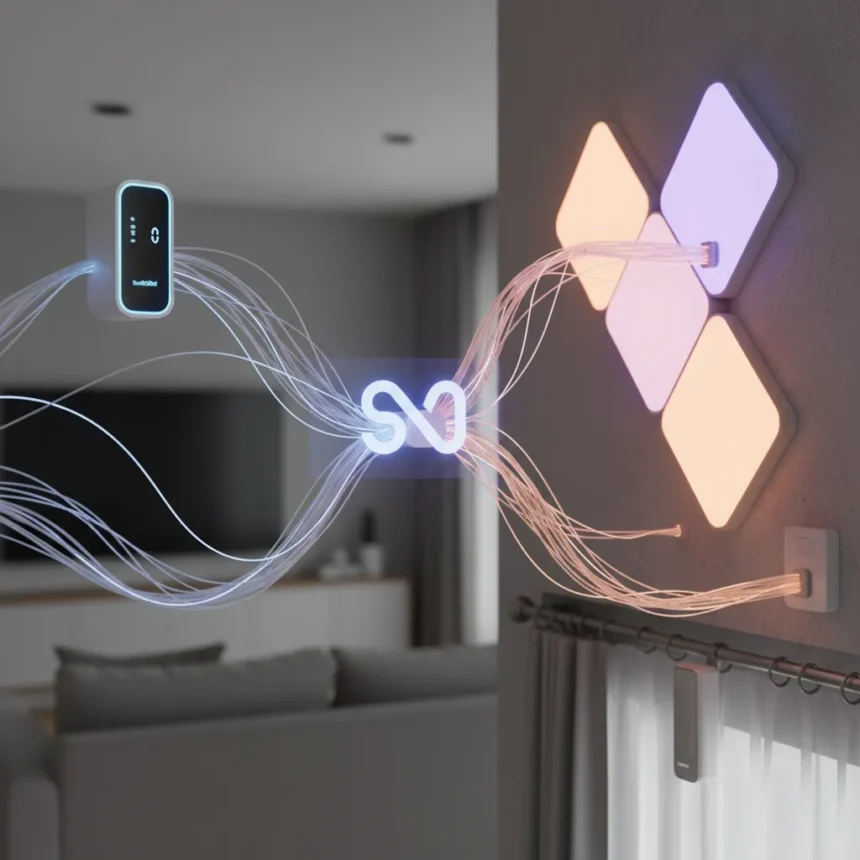
The SwitchBot and Nanoleaf partnership represents a significant moment in smart home consolidation. Two brands that have carved distinct niches—one in automation and remote control, the other in ambient lighting—are now joining forces in what the industry describes as a multi-million pound deal. This is not just another product collaboration; it signals how fragmented smart home ecosystems are beginning to integrate.
Key Takeaways
- SwitchBot and Nanoleaf have announced a multi-million pound partnership focused on smart home ecosystem integration.
- The deal suggests future products could blend automation with RGB lighting capabilities.
- SwitchBot’s recent Matter-enabled hubs indicate the company is prioritizing open-standard compatibility.
- The partnership may reshape how consumers expect lighting and automation to work together.
- No specific product launches or timelines have been confirmed from the partnership announcement.
Why This Partnership Matters for Smart Home Buyers
Smart home fragmentation has been a persistent frustration for consumers. You buy a SwitchBot Hub to control your infrared devices and automate routines. You buy Nanoleaf panels for ambient lighting. They work independently, but integrating them requires workarounds, third-party apps, or voice assistants as intermediaries. The SwitchBot and Nanoleaf partnership suggests both companies recognize this gap and are willing to invest in bridging it.
This is different from a typical co-marketing deal. A multi-million pound commitment implies genuine technical integration—either at the protocol level, through shared APIs, or via bundled hardware. When two ecosystem players of this scale combine resources, it typically means they are building something that neither could achieve alone. For buyers, this could mean smarter automation routines that account for ambient lighting, or lighting scenes that respond to home activity patterns detected by SwitchBot’s sensors.
SwitchBot’s Recent Hardware Push and What It Signals
SwitchBot has been aggressive about staying relevant in a market increasingly dominated by Apple HomeKit, Google Home, and Amazon Alexa. The company released the SwitchBot Hub 2, which integrates infrared remote controls, uses a Swiss-made temperature and humidity chip, and includes an adaptive light sensor for automating brightness based on ambient conditions. More recently, SwitchBot announced the Hub 3, a new smart home hub with Matter and infrared blaster capabilities, indicating the company is committed to open-standard compatibility rather than proprietary lock-in.


This hardware trajectory matters because it shows SwitchBot is investing in the infrastructure that a partnership with Nanoleaf would need. Matter support, adaptive sensors, and open protocols are the foundation for true ecosystem integration. The SwitchBot and Nanoleaf partnership likely builds on this momentum, using Matter as a common language between automation and lighting.
The Speculative Product Question: RGB Lighting and Automation
Industry observers have raised an intriguing question: could the partnership lead to a robot vacuum with integrated RGB lighting? It sounds niche, but it reflects a broader trend. Smart home devices are becoming more visually distinctive. A robot vacuum that not only cleans but also communicates status through color—red for obstacles, green for completion, blue for low battery—would be both functional and expressive. Nanoleaf’s expertise in programmable lighting could make this feasible in ways that feel natural rather than gimmicky.



However, that no specific product has been announced from this partnership. The question remains speculative. What we know is that the deal exists, it is commercially significant, and both companies have the technical capability to explore such ideas. Whether they actually do remains to be seen.
What About Ecosystem Fragmentation?
The broader context here is that smart home fragmentation is not going away. Matter is supposed to solve this, but adoption has been slower than enthusiasts hoped. Companies like SwitchBot and Nanoleaf still need to differentiate, and they do so through specialized hardware and software. A partnership between them does not necessarily mean they will open their ecosystems to every other brand. Instead, it likely means they are creating a tighter integration between their own product lines, which is a partial solution to fragmentation rather than a complete one.
For consumers already invested in either ecosystem, the partnership is good news. For those trying to build a truly universal smart home that treats all brands as interchangeable, the reality remains complicated. The SwitchBot and Nanoleaf partnership is a step toward coherence, but not a complete answer to ecosystem fragmentation.
Is this partnership exclusive to SwitchBot and Nanoleaf products?
The research brief does not specify whether the partnership is exclusive or whether it will extend to third-party integrations. Given that SwitchBot has emphasized Matter compatibility, some level of openness seems likely, but the exact scope of the deal has not been publicly detailed.



When will new products from this partnership launch?
No launch date or confirmed product roadmap has been announced. The partnership itself is the news; specific product announcements would likely follow in the coming months or quarters, but nothing is confirmed yet.
Will this partnership work with my existing smart home setup?
That depends on your current devices. If you are already using SwitchBot or Nanoleaf products, integration should improve. If you use other brands, the partnership may not directly affect your setup, though Matter compatibility in SwitchBot’s recent hubs suggests some level of cross-ecosystem support.
The SwitchBot and Nanoleaf partnership is a reminder that smart home consolidation is happening, but it is happening unevenly. Some ecosystems are integrating faster than others. For now, the deal is a signal of intent rather than a finished product, but it is worth watching closely as both companies reveal what they have built together.
Where to Buy
Edited by the All Things Geek team.
Source: T3




