






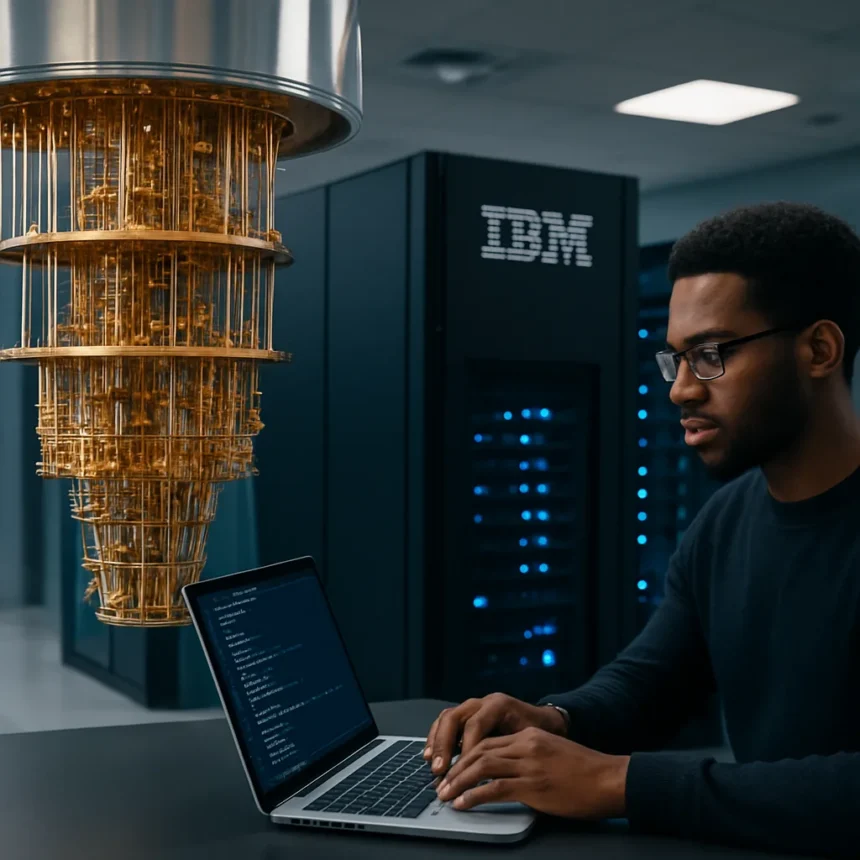
Quantum-centric supercomputing represents IBM’s vision for merging quantum processors with classical high-performance computing systems, announced on March 12, 2026, from Yorktown Heights, New York. The industry’s first published reference architecture for this hybrid approach aims to tackle scientific problems that neither quantum nor classical systems can solve alone. But the gap between blueprint and breakthrough remains wide.
Key Takeaways
- IBM published the first industry reference architecture for quantum-centric supercomputing on March 12, 2026.
- The architecture integrates quantum processors (QPUs) with CPUs, GPUs, and shared storage across on-premises and cloud environments.
- Early demonstrations include simulating iron-sulfur clusters using IBM’s Heron processor paired with RIKEN’s Fugaku supercomputer’s 152,064 classical nodes.
- Real-world commercial deployments remain developmental, with no announced timelines or pricing.
- Three-phase roadmap moves from QPU accelerators to middleware-enabled platforms to fully integrated end-to-end systems.
What Quantum-Centric Supercomputing Actually Is
Quantum-centric supercomputing integrates quantum processors with classical computing resources—CPUs, GPUs, high-speed networking, and shared storage—into a unified system spanning on-premises infrastructure, research centers, and cloud environments. Unlike standalone quantum computers, this architecture treats quantum and classical resources as complementary components orchestrated through open software frameworks like Qiskit, IBM’s quantum development toolkit.
The approach directly addresses a fundamental limitation of current quantum hardware: quantum processors excel at specific narrow tasks governed by quantum mechanics, particularly in chemistry and materials science, but struggle with broader computational workflows. Classical systems dominate general computation but cannot efficiently simulate quantum phenomena. Hybrid quantum-centric systems split the workload. Quantum processors handle the quantum-mechanical portions of a problem—say, simulating molecular interactions—while classical systems manage data orchestration, error correction, qubit calibration, and reset operations. This division of labor is not new in theory, but IBM’s published blueprint provides the first industry standard for integrating these systems at scale.
How IBM’s Architecture Actually Works in Practice
IBM demonstrated quantum-centric supercomputing through two concrete simulations. The first involved RIKEN’s Fugaku supercomputer and IBM’s Heron quantum processor working in closed-loop data exchange to simulate iron-sulfur clusters—a chemistry problem intractable for either system alone. The classical system contributed all 152,064 compute nodes to support the quantum simulation, showing how hybrid workflows distribute computational burden. A second demonstration simulated a 303-atom protein using quantum-centric co-processing.



These are not production applications. They are proof-of-concept experiments proving the architecture’s feasibility. The simulations show that quantum and classical systems can exchange data reliably and that quantum processors can contribute meaningful calculations to larger scientific workflows. Jay Gambetta, director of IBM Research and an IBM fellow, framed the vision clearly: quantum processors work alongside classical supercomputing to solve problems previously out of reach, extending Richard Feynman’s decades-old vision of quantum simulation into practical hybrid systems.
The actual technical foundation rests on hardware that includes quantum systems paired with classical runtime components—FPGAs, ASICs, and CPUs—handling error correction and qubit management. These classical components are not afterthoughts; they are essential infrastructure without which quantum processors cannot function reliably. This dependency on classical support systems is why standalone quantum computers have struggled to deliver business value. Quantum-centric architecture makes that dependency explicit and architectural.


IBM’s Three-Phase Roadmap: From Accelerators to Integration
IBM outlined a three-phase strategy for deploying quantum-centric systems. Phase one treats quantum processors as specialized accelerators attached to existing supercomputers, much like GPUs augment CPU-based clusters. This approach requires minimal disruption to existing HPC infrastructure—quantum accelerators slot into familiar workflows. Phase two introduces middleware that abstracts the complexity of managing quantum, CPU, and GPU resources, presenting them as a single logical system to developers and scientists. Phase three, least detailed in IBM’s public statements, targets fully integrated systems supporting end-to-end scientific workflows without requiring developers to manually orchestrate quantum-classical handoffs.
This roadmap is pragmatic but deliberately vague on timelines. Phase one is closest to deployment—quantum accelerators can attach to existing systems today. Phase two and three remain developmental. IBM has not announced when phase two will reach production or what phase three will entail beyond conceptual promise. This ambiguity is intentional: quantum hardware is advancing rapidly, and committing to timelines invites disappointment when hardware maturates slower than predicted.
Real-World Applications: Chemistry and Materials Science, Not Yet
IBM targets quantum-centric supercomputing at applications in chemistry, materials science, optimization, and scientific challenges unsolvable by single computing approaches. Chemistry is the obvious first domain—quantum mechanics governs molecular behavior, and simulating molecular interactions classically requires exponential computational resources. Materials science follows naturally; designing new materials requires simulating their quantum properties. Optimization problems—routing, scheduling, portfolio design—are theoretically suited to quantum algorithms, though practical quantum advantage remains unproven at scale.
The gap between target applications and deployed systems is substantial. The RIKEN and IBM iron-sulfur cluster simulation is a research achievement, not a product. No pharmaceutical company has announced that quantum-centric supercomputing will accelerate drug discovery. No materials manufacturer has committed to using hybrid quantum systems to design new compounds. The demonstrations prove feasibility; they do not prove business impact. That distinction matters. Feasibility in the lab and viability in production are separated by years of engineering, validation, and integration work.



Why the Timeline Question Matters More Than the Architecture
The real challenge in quantum computing has never been the science—Feynman’s vision was correct, and quantum processors can simulate quantum systems. The challenge is engineering: building quantum processors that maintain coherence long enough to run meaningful calculations, developing error correction that does not require more qubits than the problem itself, and integrating quantum systems into workflows that business and research institutions actually use.
IBM’s quantum-centric architecture is a step toward that integration, but it is a blueprint, not a product. No pricing exists because quantum-centric supercomputing is not yet commercially available. No deployment dates have been announced because IBM does not know when quantum hardware will mature sufficiently to justify enterprise investment. The three-phase roadmap is a strategic framework, not a commitment. Phase one—quantum accelerators on existing supercomputers—could arrive within 2-3 years if quantum processor stability improves. Phase two and three are 5+ years away, assuming no major setbacks in quantum error correction.
How This Compares to Standalone Quantum Approaches
IBM’s quantum-centric model differs fundamentally from earlier standalone quantum computer strategies, which treated quantum systems as independent machines. Standalone quantum computers require solving all problems quantum-mechanically or not at all. Hybrid quantum-classical systems allow problems to be decomposed—quantum portions run on quantum hardware, classical portions run on classical systems, and results are integrated. This decomposition is far more pragmatic. It does not require quantum processors to outperform classical systems across all problem types; it only requires quantum processors to outperform classical systems on the specific quantum-mechanical subproblems they are designed for.
This architectural shift reflects maturation in the field. Early quantum computing rhetoric promised universal quantum advantage—quantum computers that would outperform classical systems on nearly everything. That vision has faded as quantum hardware limitations became clearer. Quantum-centric supercomputing abandons the universal advantage claim in favor of targeted advantage on specific problem classes. It is a more honest and likely more achievable vision, but it also means quantum computing will remain a specialized tool for specialized problems, not a general-purpose replacement for classical computing.
The Collaboration Factor: RIKEN and Rensselaer Polytechnic
IBM’s demonstrations involved partnerships with RIKEN, Japan’s largest research institution, and Rensselaer Polytechnic Institute. RIKEN provided Fugaku, one of the world’s fastest supercomputers, creating a natural testbed for quantum-classical integration. Rensselaer contributed expertise in workflow orchestration—the software and systems that manage data flow between quantum and classical components. These partnerships are not casual; they suggest that IBM is building ecosystem support for quantum-centric systems before commercial deployment.
The RIKEN collaboration is particularly significant because it demonstrates international deployment. Quantum-centric supercomputing is not a US-only initiative. Japan’s investment in quantum research and its world-class supercomputing infrastructure make it a natural partner. If quantum-centric systems eventually deploy at scale, they will likely appear first at major research institutions with existing supercomputing infrastructure—RIKEN, national labs in the US, research centers in Europe. Commercial enterprises will follow years later, once the technology matures and use cases solidify.
What Still Needs to Happen Before Real-World Launches
IBM’s architecture is necessary but not sufficient for real-world quantum-centric supercomputing. Several engineering and business challenges remain unsolved. First, quantum processor stability must improve. Current quantum processors lose coherence within microseconds to milliseconds. Useful simulations require longer coherence times or better error correction. Second, quantum software frameworks like Qiskit must mature to the point where scientists can write quantum-classical workflows without deep quantum expertise. Third, institutions must validate that hybrid quantum-classical systems deliver business value—faster drug discovery, better materials, optimized logistics—not just research papers. Fourth, quantum-centric systems must integrate into existing HPC environments without requiring infrastructure overhaul.
IBM has made progress on all these fronts, but progress is not completion. The architecture announcement signals that IBM believes these challenges are solvable and that hybrid quantum-classical systems are the right path forward. It does not signal that solutions are imminent or that commercial deployments are near. The gap between announcement and availability typically spans 3-5 years in supercomputing, and quantum-centric systems are more complex than conventional HPC.
Is Quantum-Centric Supercomputing Hype or Reality?
It is both. The architecture is real—IBM has published it, demonstrated it with RIKEN, and engaged research institutions. The vision is credible—hybrid quantum-classical systems are more pragmatic than standalone quantum computers. But the timeline is uncertain, and the business case is unproven. Hype enters when IBM or media coverage suggests that quantum-centric supercomputing will imminently transform industries. Reality is that this is a research direction with genuine potential but no guaranteed timelines for deployment or proven commercial impact.
The honest assessment: quantum-centric supercomputing is the most plausible path forward for quantum computing in the next decade. It abandons unrealistic universal advantage claims in favor of targeted advantage on specific problems. It acknowledges that quantum and classical systems are complementary, not competitive. It provides an architectural blueprint for integration. But it remains a blueprint. Real-world launches—systems deployed at research institutions and eventually enterprises—are likely 3-5 years away, and business impact will take longer still.
FAQ
What is the difference between quantum-centric supercomputing and standalone quantum computers?
Standalone quantum computers attempt to solve problems entirely using quantum processors. Quantum-centric supercomputing decomposes problems into quantum-mechanical and classical portions, routing each to the appropriate system. This hybrid approach is more pragmatic because it does not require quantum processors to outperform classical systems across all problem types, only on the specific quantum-mechanical subproblems they are designed for.
When will quantum-centric supercomputing be commercially available?
IBM has not announced specific deployment timelines. The three-phase roadmap suggests quantum accelerators (phase one) could arrive within 2-3 years if quantum processor stability improves, while middleware-enabled platforms (phase two) and fully integrated systems (phase three) remain 5+ years away. Commercial enterprise deployments will likely follow research institution deployments by several years.
What applications will quantum-centric supercomputing enable?
IBM targets chemistry, materials science, optimization, and scientific challenges unsolvable by single computing approaches. Early demonstrations include simulating iron-sulfur clusters and 303-atom proteins, but these are research proofs-of-concept, not production applications. Pharmaceutical companies, materials manufacturers, and logistics firms are potential end users, but business impact remains unproven.
IBM’s quantum-centric supercomputing architecture is a credible step toward practical quantum computing, but it is a blueprint, not a product. The vision is sound—hybrid quantum-classical systems that decompose problems intelligently across complementary hardware. The demonstrations prove feasibility. But real-world launches remain years away, timelines are uncertain, and business impact is unproven. For researchers and institutions with quantum-class problems, this architecture matters. For everyone else, quantum-centric supercomputing remains a future promise, not a present tool.
This article was written with AI assistance and editorially reviewed.
Source: TechRadar