






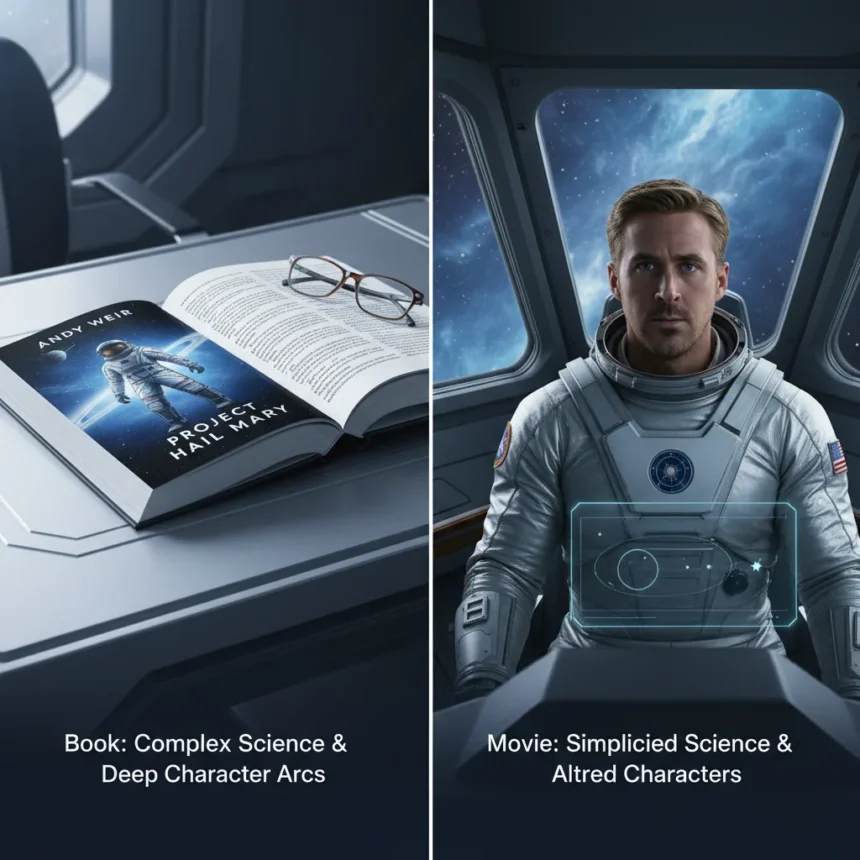
Project Hail Mary book vs movie reveals significant departures from Andy Weir’s source material in the upcoming March 2026 film adaptation. Director Phil Lord and Christopher Miller, working from Drew Goddard’s screenplay, face the challenge of translating a science-heavy novel into a blockbuster format. The result is a film that preserves emotional core while making deliberate choices that reshape how audiences experience Grace’s mission.
Key Takeaways
- Project Hail Mary movie simplifies complex science explanations for broader audience appeal
- Ryan Gosling’s Ryland Grace is portrayed as goofier than the book’s intelligent, memory-loss-stricken scientist
- Rocky the alien character loses sass and personality nuance in the film adaptation
- Eva Stratt transforms from mysterious antagonist to more positive character, cutting her video diary scenes
- Emotional Grace-Rocky friendship and core plot structure remain faithful to the novel
The Goofier Version of Ryland Grace
Ryan Gosling’s portrayal of Ryland Grace differs markedly from the book’s characterization. The film version plays Grace as significantly goofier than Weir’s original depiction of a smart scientist grappling with amnesia and survival. This tonal shift serves the movie’s pacing demands—a 2.5-hour runtime requires streamlining both character complexity and scientific exposition. Gosling’s comedic energy drives the film forward, but it trades some of the book’s intellectual tension for blockbuster charm. The emotional beats between Grace and his alien companion remain intact, yet the journey to those moments feels lighter, less burdened by the weight of scientific problem-solving that defined Weir’s narrative.
Rocky Loses His Edge in Project Hail Mary Movie
Rocky, the alien character central to the story’s emotional arc, retains roughly 87% accuracy to the book but sacrifices personality in translation. The film version of Rocky is less sassy than his literary counterpart, missing the sharp wit and growing impatience that Weir developed across the novel. In the book, readers witness Rocky’s patience wearing thin as communication challenges mount, adding tension and depth to the friendship. The movie’s Rocky remains a visual triumph—audiences see an alien brought to life with remarkable fidelity—yet the character lacks some of the sass that made the book’s dynamic between Grace and Rocky feel genuinely contentious at times. This softening serves the film’s emotional arc but flattens the complexity of their relationship.
Eva Stratt’s Transformation from Antagonist to Ally
Eva Stratt undergoes perhaps the most significant character overhaul in Project Hail Mary book vs movie adaptation. The book presents Stratt as a mysterious, dangerous figure—someone desperate to expose her methods and motivations. Her video diary scenes in the novel reveal layers of complexity and dark humor. The film strips away this antagonism, reframing Stratt as far too positive and removing her diary entries entirely. This change softens the narrative’s political edge. Weir’s book uses Stratt as a morally ambiguous force driving the mission forward through questionable means; the movie converts her into a more straightforward supporter. The loss of her cheeky messages and introspective moments diminishes character depth, though it does simplify the film’s emotional stakes.

Science Gets Dumped Down for Cinema
The most sweeping change across Project Hail Mary book vs movie is the deliberate simplification of scientific explanation and technical detail. The book’s appeal rests partly on Weir’s meticulous approach to physics, chemistry, and problem-solving methodology. The film adaptation acknowledges this gap frankly—the science is dumbed down to serve broader audience accessibility. This is not a flaw unique to this adaptation; it reflects the inherent challenge of translating dense technical narratives into visual storytelling constrained by runtime and viewer patience. Where the book luxuriates in the mechanics of Grace’s solutions, the movie prioritizes emotional beats and visual spectacle. Flashback sequences that explore Grace’s scientific reasoning are compressed, and complex concepts are either glossed over or explained in simplified terms. The core plot structure mirrors the book—amnesia opening, flashbacks, challenges on Adrien, Grace becoming a teacher—yet the intellectual scaffolding supporting that structure is substantially lighter.
What the Movie Preserves from the Book
Despite these changes, the adaptation captures the emotional foundation that makes Andy Weir’s story resonate. The Grace-Rocky friendship, the communication struggles, the trust-building process, and the shared goal to save multiple worlds remain intact. The book’s deeper character nuance and complicated mission feelings are not fully explored in film, yet the essential emotional journey survives translation. This preservation matters because it suggests the filmmakers understood what made readers love the novel—not the technical minutiae, but the human (and alien) connection at its heart. Where the book excels in layers of flashback complexity and scientific depth, the movie succeeds in visual spectacle and emotional immediacy. Both versions tell the same story; they simply emphasize different elements of that story.



How Project Hail Mary Compares to The Martian Adaptation
Andy Weir’s previous novel adaptation, The Martian, faced similar pressures to balance hard science with cinematic storytelling. Ridley Scott’s film became a smash success by prioritizing survival drama over technical exposition, much like the Project Hail Mary movie does. The key difference: The Martian’s science, while simplified, remained credible enough that audiences felt the problem-solving was earned. Project Hail Mary’s heavier simplification suggests the filmmakers made a more aggressive choice to prioritize character and emotion over technical accuracy. Both adaptations prove that Weir’s stories can survive significant changes when the core emotional arc remains intact.
Is the Project Hail Mary movie faithful to the book?
The adaptation is largely faithful to overall plot structure and emotional beats, but makes substantial changes to characterization and scientific depth. Ryan Gosling’s goofier Grace, the softened Rocky, and the reframed Eva Stratt represent deliberate creative choices rather than oversights. The film preserves what matters most—the Grace-Rocky friendship and the mission to save worlds—while streamlining everything else for cinema.
What gets cut from Project Hail Mary in the movie?
Eva Stratt’s video diary scenes and cheeky messages are removed entirely, along with much of the book’s scientific exposition and flashback complexity. The film compresses technical problem-solving sequences and simplifies explanations to maintain pacing within its 2.5-hour runtime.
Does the Project Hail Mary movie ruin the book?
Neither version ruins the other; they serve different purposes. The book offers depth, scientific rigor, and character nuance. The movie delivers visual spectacle, emotional immediacy, and accessibility to audiences unfamiliar with Weir’s work. Both can coexist as valid interpretations of the same story, each excelling in what the medium does best.



Project Hail Mary book vs movie ultimately reflects the eternal tension between literary adaptation and cinematic storytelling. The film makes bold choices—goofier protagonist, softer antagonist, simplified science—that transform the experience without destroying it. Readers who cherish Weir’s scientific precision and character layers will find the book superior. Audiences seeking emotional connection and visual wonder will find the movie compelling. The adaptation proves that fidelity does not require sameness; it requires honoring what made the source material matter in the first place.
Where to Buy
Edited by the All Things Geek team.
Source: Tom's Guide