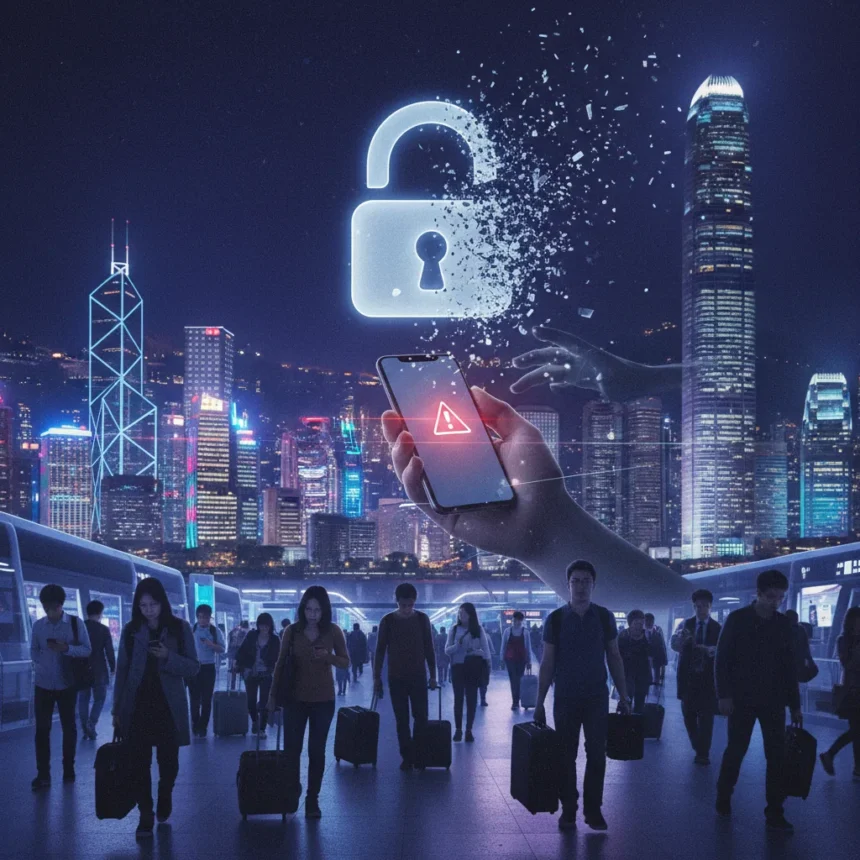
Hong Kong’s government has amended its National Security Law to grant police and border agents sweeping power to demand device passwords from anyone—including US citizens and multinational workers—without court warrants or judicial oversight. The shift represents a watershed moment in how authoritarian governments weaponize border control to access private communications, financial data, and confidential business information.
Key Takeaways
- Hong Kong police can demand phone and computer passwords under vague “national security” suspicions with no warrant required.
- Refusal carries up to 1 year imprisonment and HK$100,000 fine (approximately $12,774 USD).
- The law applies globally—anyone entering or leaving Hong Kong, plus anyone outside the territory, can be compelled to comply.
- Doctors, lawyers, and corporate employees can be forced to disclose patient, client, and company data, overriding confidentiality.
- Trend reflects worldwide expansion of invasive border controls targeting digital privacy.
What Hong Kong’s New Law Actually Does
On Monday prior to March 28, 2026, Hong Kong’s government finalized amendments that transform device access from a warrant-based procedure into an on-demand tool for any officer who suspects “seditious materials” or national security violations. Border agents, customs officers, and police now possess identical authority. No judicial review. No independent oversight. An officer’s suspicion alone is sufficient legal grounds.
The scope is deliberately vague. Thomas Benson, senior policy advisor at Hong Kong Watch, explained the danger: “Practically anything can become a matter of national security concern and that gives tremendous latitude for the Hong Kong government, and for the organs of the mainland People’s Republic of China state that operate in Hong Kong, to apply a national security condition and compel practically anyone”. This is not accidental imprecision—it is the mechanism that allows the law to reach anyone, anywhere, for almost any reason.
Providing a false or misleading password carries up to 3 years imprisonment and a HK$500,000 fine (approximately $63,902 USD). The penalties are severe enough to deter resistance and create compliance through fear rather than legal clarity.


Device Password Demands Override Professional Confidentiality
The amendment explicitly states that the obligation to surrender passwords overrides “duty of confidentiality or any other restriction”. This language dismantles attorney-client privilege, doctor-patient confidentiality, and corporate data protection in a single clause.
A lawyer representing a dissident client cannot refuse. A doctor treating a political activist cannot claim medical privacy. A tech worker carrying company source code or trade secrets cannot invoke corporate confidentiality. The law forces disclosure of information that would otherwise be legally protected in nearly every democratic jurisdiction. Chung Ching Kwong, senior analyst at the Inter-Parliamentary Alliance on China, underscored the practical reality: “The police in Hong Kong have now [the] power to force people to hand over their phone and computer passwords as part of new national security laws… any kind of random policeman can come to you and say, ‘I suspect that you have seditious materials in your phone or computer’… the national security law applies to everybody outside or inside of Hong Kong”.



Why This Threatens Global Travelers and Workers
The law’s extraterritorial reach is the feature most dangerous to international business and tourism. It applies to travelers passing through Hong Kong, multinational corporation employees with Hong Kong operations, and anyone outside Hong Kong whom authorities suspect of violating national security rules. A US citizen boarding a flight in Hong Kong, a British banker visiting for a conference, a journalist reporting on Beijing—all fall within the law’s jurisdiction.
For corporate employees, the risk is acute. An engineer from a tech company, a consultant from a financial firm, or a researcher from a pharmaceutical company cannot guarantee that sensitive work data will remain confidential if detained at a border. The amendment creates a scenario where business travelers must choose between surrendering proprietary information or facing imprisonment. This is not theoretical—it is now law.
The Hong Kong government claims the amendment will not affect “law-abiding persons,” implying that only those with illegal intent need worry. This framing ignores that “national security” and “sedition” are terms without clear legal definition in the amendment itself, leaving interpretation entirely to the discretion of officers conducting searches.
A Symptom of Broader Border Invasiveness
Hong Kong is not an outlier. The source article’s title references a worldwide trend toward more invasive border controls, though specific comparable laws in other jurisdictions are not detailed. What is clear is that device password demands represent an escalation beyond traditional customs searches—they target the digital lives of travelers, not just their luggage.



The Hong Kong amendments also expand customs powers to freeze and confiscate assets related to security crimes and to order removal of online messages deemed dangerous to national security. These mechanisms compound the password demand authority, creating a comprehensive digital surveillance and control apparatus at the border.
What Happens If You Refuse?
Refusing to provide a password results in up to 1 year imprisonment and a HK$100,000 fine. The penalties are substantial enough to force compliance from most travelers. Providing a false password or misleading information triggers even harsher penalties: up to 3 years imprisonment and HK$500,000. In effect, the law eliminates meaningful resistance—comply fully or face serious criminal consequences.
Frequently Asked Questions
Does the Hong Kong device password law apply to US citizens?
Yes. The law applies to everyone entering, leaving, or operating within Hong Kong, regardless of nationality. US citizens are explicitly included. The national security law has extraterritorial reach, meaning it can apply to people outside Hong Kong as well.
Can a lawyer or doctor refuse to disclose device passwords?
No. The amendment explicitly overrides confidentiality obligations, including attorney-client privilege and doctor-patient confidentiality. Professionals cannot claim these protections as grounds for refusal.
What counts as a “national security” violation under the law?
The amendment does not provide a clear definition. Critics argue this vagueness is intentional, allowing authorities to interpret almost any content as a national security threat. The lack of specificity is the law’s most dangerous feature.
The Hong Kong device password amendments represent a critical inflection point for digital privacy globally. Travelers, workers, and residents now face a choice: surrender sensitive data at the border or risk imprisonment. For multinational companies, the law creates liability exposure that no standard data protection policy can mitigate. For journalists and activists, it transforms Hong Kong from a transit hub into a surveillance checkpoint. The amendments are law now, and they are not reversing. Anyone with business in Hong Kong must operate under the assumption that device access is no longer private.
Edited by the All Things Geek team.
Source: Tom's Hardware