



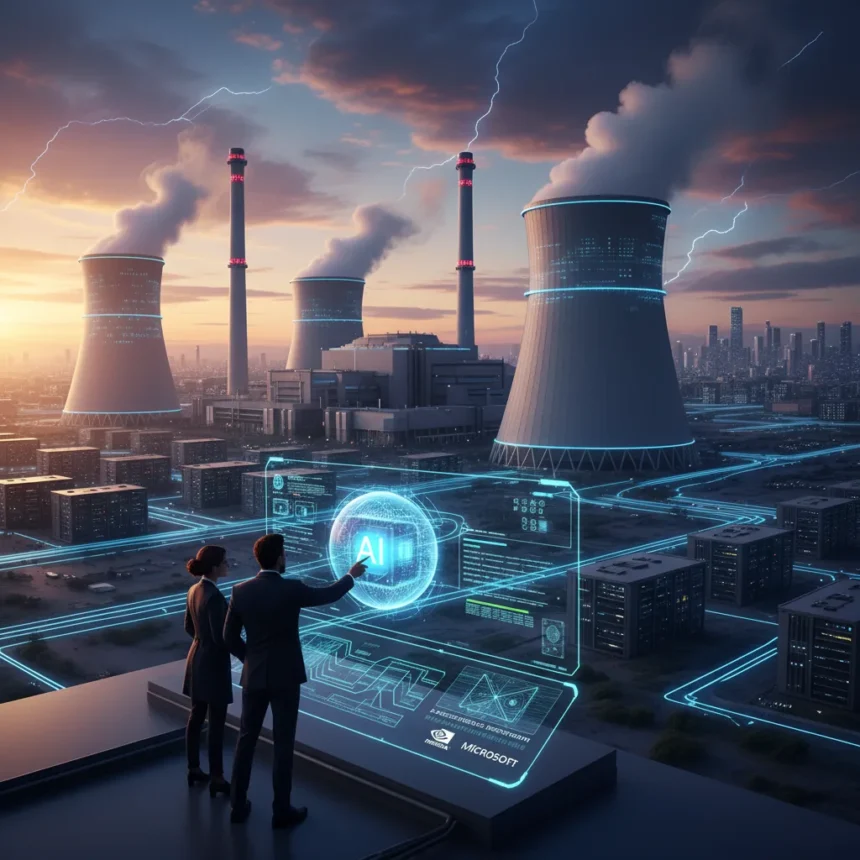
AI for nuclear energy has moved from theoretical to operational. On March 24, 2026, Microsoft and Nvidia announced a partnership at CERAWeek 2026 in Houston to create an end-to-end AI-powered digital ecosystem that compresses the nuclear lifecycle—from permitting through operations—addressing what both companies describe as a historic surge in power demand driven by AI data centers.
Key Takeaways
- Microsoft and Nvidia announced AI for nuclear energy partnership on March 24, 2026, at CERAWeek in Houston.
- Partnership targets permitting, design, construction, and operations phases with integrated AI tools and digital twins.
- Aalo Atomics reports 92% reduction in permitting time using the generative AI solution.
- Early adopters include Southern Nuclear, Everstar, and Aalo Atomics, with deployments on Microsoft Azure.
- Partnership addresses delivery bottleneck in nuclear industry amid rising data center energy demands.
Why Nuclear Energy Needs AI Right Now
The nuclear industry faces a paradox: it is essential for delivering reliable, carbon-free power at scale, yet it remains trapped in decades-old workflows that slow deployment. Regulatory documentation, permitting complexity, and fragmented design processes have created a bottleneck that traditional methods cannot fix quickly enough. As Darryl Willis, Microsoft’s Corporate VP for Global Energy and Resources, explains: By unifying data, traceability, and simulation across phases, AI accelerates design validation with high-fidelity 3D models and Digital Twins, improves licensing consistency through AI-assisted document workflows, and connects design assumptions to operational performance. This is not incremental improvement—it is architectural reimagining of how nuclear projects move from concept to operation.
Data center operators, particularly those building AI infrastructure, cannot wait. The computational demands of large language models and enterprise AI require power at scales that existing grids cannot reliably supply. Nuclear energy is the obvious solution: it produces enormous amounts of carbon-free electricity without intermittency. But if nuclear plants take a decade to permit and build, the energy crisis will have already hit. The partnership directly addresses this timing mismatch.
The AI for Nuclear Energy Ecosystem: Four Phases
The partnership integrates Microsoft Azure, NVIDIA Omniverse, Earth 2, CUDA-X, AI Enterprise, PhysicsNeMo, Isaac Sim, Metropolis, and Microsoft’s Generative AI for Permitting Solution Accelerator into a unified workflow. Rather than separate tools, the ecosystem treats the entire nuclear lifecycle as interconnected data layers.


Permitting is the first bottleneck. Aalo Atomics, a startup collaborating on the initiative, reports a 92% reduction in permitting time using Microsoft’s generative AI solution for document creation and gap analysis. This is not theoretical—Aalo reports approximately $80 million in annual savings from accelerated permitting alone. The generative AI handles the documentation burden that has historically trapped nuclear projects in regulatory review cycles.
Design acceleration follows. Digital twins and high-fidelity 3D models, powered by NVIDIA’s simulation tools, allow engineers to validate designs virtually before construction begins. This compresses the feedback loop between design assumptions and regulatory approval. Southern Nuclear is already using Microsoft Copilot for engineering and licensing tasks, integrating AI assistance directly into workflows that have traditionally been manual and document-heavy.


Construction and operations represent the final phases. Unified data systems, traceability logs, and auditable workflows—all powered by AI—give operators, regulators, and stakeholders continuous visibility into project status and performance. Everstar, an NVIDIA Inception startup building on Azure and collaborating with the U.S. Department of Energy, National Renewable Energy Laboratory, and Argonne National Laboratory, is deploying these operational frameworks. As Kevin Kong, Everstar’s CEO, notes: The nuclear industry has been bottlenecked by documentation burden and regulatory complexity for decades. This partnership means our customers get the secure, scalable cloud deployments they demand. It’s a significant step toward making nuclear power fast, safe, and unstoppable.
How This Differs from Traditional Nuclear Approaches
Historically, nuclear projects have relied on siloed expertise: permitting teams work separately from design teams, who work separately from construction and operations. Each phase involves manual document review, regulatory sign-offs, and knowledge transfer delays. This fragmentation is not a flaw in individual companies—it is a structural feature of an industry built before cloud computing, AI, and real-time data integration existed.
The Microsoft-Nvidia approach eliminates these silos. By creating a shared digital backbone that connects permitting data to design assumptions to operational performance, the ecosystem creates feedback loops that improve each phase. Regulators see consistent, auditable documentation. Engineers validate designs against real operational constraints. Operators inherit clear performance baselines from design. This is not just faster—it is fundamentally more reliable because every phase is informed by the others.
Compared to fragmented approaches where each nuclear utility or developer builds its own tools, the unified ecosystem offers scale advantages that smaller players cannot match. Microsoft’s cloud infrastructure and Nvidia’s simulation and AI engines provide capabilities that individual companies would struggle to develop independently. This matters because nuclear is capital-intensive and risk-averse; standardized, proven workflows reduce perceived risk for both regulators and investors.


Early Results and Real-World Validation
The partnership is not speculative. Aalo Atomics’ 92% permitting time reduction is a concrete outcome, not a projection. Southern Nuclear’s integration of Copilot into engineering workflows is operational today, not a future roadmap. Everstar’s collaborations with the DOE and national laboratories signal regulatory acceptance of AI-assisted nuclear workflows at the highest levels of government. These early wins matter because they prove the concept works at scale and with regulatory approval.
The timing is deliberate. Data center power demand is accelerating, and utilities and developers are actively seeking ways to deploy nuclear capacity faster. A proven, standardized, cloud-based ecosystem removes excuses for delay. Brad Smith, Microsoft President and Vice Chair, is backing this initiative at the executive level, signaling corporate commitment.
What Happens Next
The partnership is live as of March 2026, with early adopters already deploying tools on Azure. The next phase will likely involve more nuclear operators and utilities adopting the ecosystem, more data flowing through the digital backbone, and continuous refinement of AI models based on real-world outcomes. As more projects use the same tools and workflows, regulatory confidence will increase, permitting timelines will compress further, and the nuclear industry will finally break out of its delivery bottleneck.
This is not a silver bullet. AI cannot change physics or eliminate genuine safety requirements. But it can eliminate bureaucratic friction, accelerate validation, and create transparency. For an industry that has been hamstrung by process rather than capability, that is transformative.
Will AI for nuclear energy actually speed up plant construction?
Yes, but with caveats. Aalo Atomics’ 92% permitting reduction is real, and permitting is a genuine bottleneck. However, construction timelines are constrained by physical labor, supply chains, and regulatory inspections—not just documentation. AI accelerates design and approval phases, but cannot pour concrete faster. The partnership addresses the slowest phase (permitting and design), which is significant but not the entire timeline.
Can smaller nuclear developers afford these AI tools?
The tools are deployed on Microsoft Azure, which is cloud-based and scalable. Large utilities and well-funded startups like Aalo and Everstar can adopt them immediately. Smaller developers may face integration costs or training requirements, but the cloud model means they do not need to build proprietary infrastructure. Pricing details are not disclosed, but the cloud-based approach is designed for accessibility across company sizes.
Why do data centers care about nuclear energy specifically?
Data centers running large AI models consume enormous amounts of electricity 24/7. Solar and wind are intermittent. Nuclear provides massive, constant, carbon-free power—exactly what AI infrastructure needs. As demand for AI compute accelerates, utilities cannot meet power requirements without nuclear. This partnership solves the permitting and deployment delays that have prevented nuclear from scaling in response.
The partnership between Microsoft and Nvidia represents a rare alignment of incentives: tech companies need power, nuclear needs modernization, and AI can accelerate nuclear deployment without compromising safety. Whether this actually breaks the nuclear bottleneck will depend on whether other utilities and regulators adopt the same tools and workflows. If they do, the nuclear renaissance that energy analysts have predicted for years might finally become real.
Edited by the All Things Geek team.
Source: TechRadar