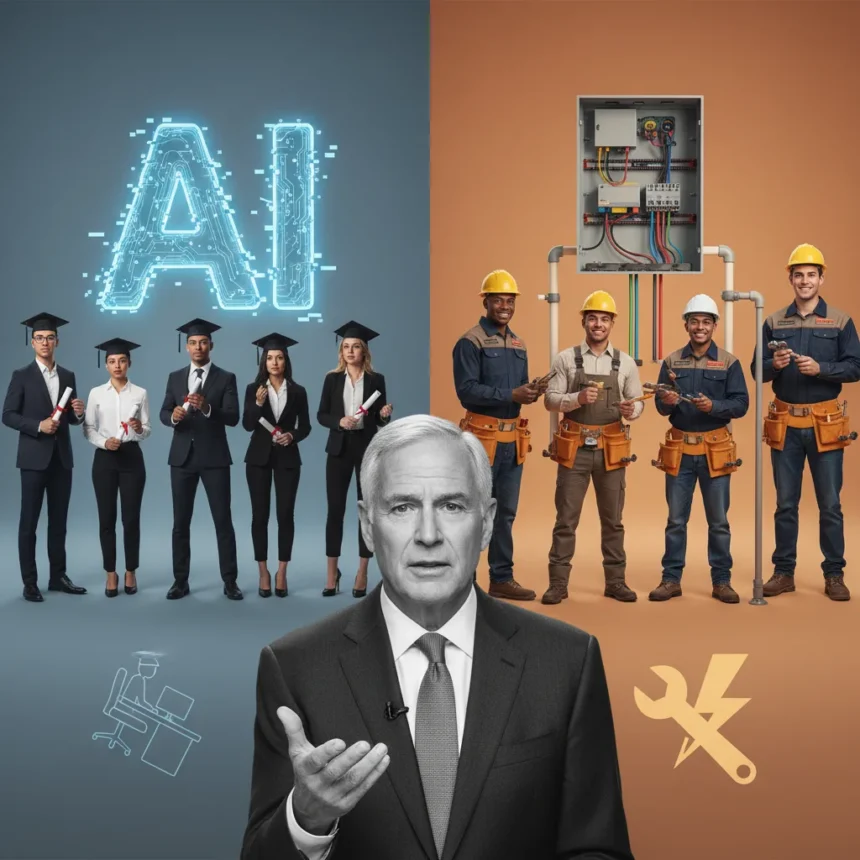
Skilled trades career opportunities are becoming more valuable than AI positions, according to BlackRock CEO Larry Fink, who warned the class of 2026 this week that college graduates chasing white-collar tech roles face a reckoning. Speaking at BlackRock’s 2026 Infrastructure Summit on March 11, Fink delivered an uncomfortable truth: the post-World War II pathway from college degree to office job is collapsing, and society is not prepared for what comes next.
Key Takeaways
- Class of 2026 graduates face highest unemployment risk in years due to AI disrupting entry-level white-collar roles
- Skilled trades like plumbing, electrical work, and HVAC are in crisis-level demand driven by data center expansion
- BlackRock committed $100 million to skilled-trade training programs targeting 50,000 workers over five years
- Job postings fell 16% while applications per role jumped 26% in the past year, signaling brutal entry-level competition
- No consensus exists on AI’s true labor market impact, even among industry leaders
The Entry-Level Job Market Is Collapsing Faster Than Society Can Adapt
The numbers are stark. Job postings on Handshake dropped more than 16 percent between August 2024 and August 2025, while applications per role climbed 26 percent. More than half of employers surveyed by the National Association of Colleges and Employers rate the class of 2026 job market as poor or fair—the most pessimistic assessment since the pandemic. Fink did not mince words: “The speed at which AI is changing, we’re not adapting our society fast enough”. The real crisis is not mass layoffs. It is that millions of young workers are preparing for jobs that are evaporating before they graduate.
The post-WWII social contract promised that a college degree unlocked white-collar employment. AI is shredding that contract. Entry-level roles in finance, law, consulting, and technology—traditionally the gateway for recent graduates—are being automated or consolidated. Yet society continues pushing every capable student toward four-year degrees and AI certifications, creating a glut of overqualified applicants chasing fewer positions. Fink’s warning arrives as class of 2026 graduation ceremonies approach, making the stakes immediate and personal for millions of families.
Data Center Boom Is Creating Skilled Trades Demand Nobody Saw Coming
Here is the paradox Fink highlighted: while entry-level white-collar jobs vanish, skilled trades are facing a severe shortage. The expansion of AI infrastructure—particularly data centers—demands electricians, HVAC technicians, plumbers, and ironworkers at scale. BlackRock itself led a $40 billion acquisition of Aligned Data Centers in 2025 with Microsoft and Nvidia, a deal that underscores the massive capital flowing into infrastructure. Each data center requires thousands of skilled workers to build, maintain, and operate. Yet the U.S. workforce is unprepared to fill these roles. “AI is going to create many jobs and we’re not prepared as a society to fulfill those jobs. And to me, this is a crisis,” Fink said.



The skilled trades offer something entry-level white-collar jobs increasingly cannot: stability, immediate income, and genuine labor scarcity. A plumber or electrician entering the workforce today faces competition from peers, not from AI algorithms. Demand is real, tangible, and growing. Yet cultural messaging still frames skilled trades as fallback options for those who cannot cut it in college. Fink is pushing back hard against that narrative, positioning trades as equally viable career paths with comparable earning potential and job security.
BlackRock’s $100 Million Bet on Retraining Signals Urgency
Last week, BlackRock announced a $100 million commitment to skilled-trade training programs in partnership with nonprofits and workforce development organizations, targeting 50,000 workers over five years. The timing is telling. This is not a charitable gesture—it is a direct response to a labor shortage that threatens BlackRock’s own infrastructure investments. If data centers cannot be built and maintained due to lack of skilled workers, the entire AI expansion slows. Fink’s public warnings and BlackRock’s financial commitment are two sides of the same urgent message: the economy needs electricians and plumbers more than it needs another cohort of business school graduates.



The investment also signals that major institutional players now view skilled-trade training as a core business concern, not a peripheral social issue. When a $10 trillion asset manager commits nine figures to workforce development in trades, it reshapes market incentives. Vocational programs, apprenticeships, and trade certifications suddenly become competitive with traditional four-year degrees in terms of employer backing and funding.
The AI Labor Impact Remains Genuinely Uncertain
Despite Fink’s stark warnings, he acknowledged in BlackRock’s annual letter that “there is no consensus on what AI will mean for the labour market, particularly for entry-level white-collar roles. The truth is, no one knows with certainty”. This honesty is refreshing in a tech landscape crowded with confident predictions. Some economists argue AI will create net job growth across the economy. Others fear mass displacement. Fink sits in neither camp—he sees AI creating new jobs (in skilled trades and infrastructure) while destroying old ones (entry-level office work) at a pace society cannot match.
The real risk is not AI itself but the mismatch between where jobs are being created and where young workers are being trained. Fink is essentially saying: stop pushing everyone toward college and AI careers. Start directing talent toward the jobs that are actually opening up. “What are we going to do about that? It’s a conversation worth having,” he asked.
Why This Matters Right Now
Class of 2026 graduates are weeks away from entering a job market fundamentally different from the one their older siblings faced. The competition for entry-level white-collar roles is ferocious. The supply of skilled trades workers is critically low. Fink’s message—delivered from the helm of the world’s largest asset manager—carries weight because it reflects real market conditions, not ideological positioning. He is not arguing that college is worthless or that everyone should become a plumber. He is arguing that society’s obsession with AI jobs and white-collar careers has created a dangerous imbalance.


For graduates, parents, and policymakers, the implication is clear: skilled trades career opportunities deserve serious consideration, not as backup plans but as primary paths. The data supports it. The market supports it. And now, one of finance’s most influential voices is saying it loudly.
Is the job market really that bad for class of 2026 graduates?
Yes. More than half of employers rate the market as poor or fair, the most pessimistic outlook since the pandemic. Job postings fell 16 percent while applications per role jumped 26 percent, creating intense competition for fewer positions.
What skilled trades jobs are in highest demand?
Electricians, HVAC technicians, plumbers, and ironworkers are facing severe shortages, driven primarily by data center expansion and AI infrastructure buildout. These roles offer immediate income and genuine labor scarcity.
Is BlackRock really investing in trade training programs?
Yes. BlackRock committed $100 million last week to skilled-trade training with nonprofits and workforce partners, targeting 50,000 workers over five years. The investment reflects real labor market needs tied to BlackRock’s own infrastructure acquisitions.
Fink’s message cuts through the noise: not every career path runs through a computer science degree or an AI bootcamp. The fastest-growing, most secure opportunities for class of 2026 may well involve a wrench, a toolbelt, and a shortage of qualified competitors.
Edited by the All Things Geek team.
Source: TechRadar