


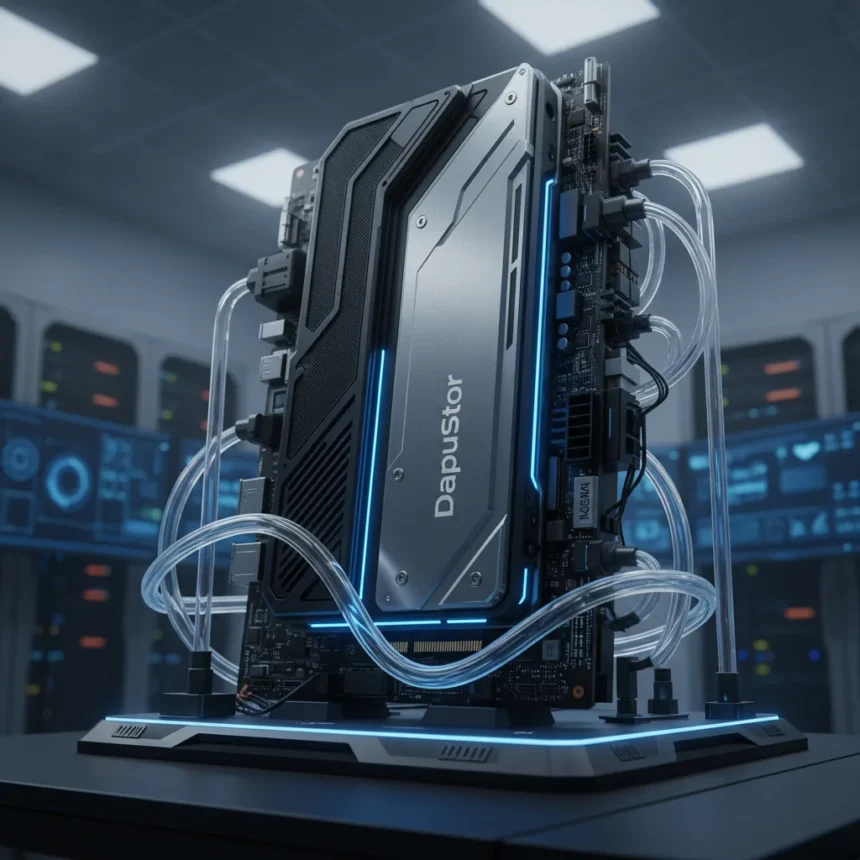
DapuStor’s R6060 represents a fundamental shift in what PCIe Gen5 SSD capacity means at scale. The drive scales up to 245.76TB in E3.L form factor, making it the largest single SSD most data centers will never actually buy. But the engineering matters regardless of whether enterprises deploy it.
Key Takeaways
- DapuStor R6060 reaches 245.76TB capacity in E3.L form factor, the highest PCIe Gen5 density available
- Sequential read speed hits 14GB/s with 4GB/s writes using Flexible Data Placement architecture
- QLC NAND technology and FDP reduce write amplification for data center workloads
- 122TB models already deployed by customers, proving the platform’s stability
- This is enterprise hardware—pricing and availability remain restricted to OEM channels
What Makes the R6060 Different From Earlier PCIe Gen5 Drives
The R6060 is DapuStor’s second-generation PCIe Gen5 QLC SSD, and the jump from first-generation models is architectural rather than incremental. Where earlier enterprise SSDs prioritized speed or capacity separately, the R6060 combines both using Flexible Data Placement (FDP), a NAND management technique that reduces write amplification by allowing the drive’s controller to place data more efficiently across memory cells. This matters because data centers running analytics, machine learning inference, or large-scale storage clusters care about cost-per-terabyte as much as raw throughput.
Sequential read performance reaches approximately 14GB/s, while sequential writes hit 4GB/s. For context, that read speed is roughly 2.3 times faster than a typical PCIe Gen4 enterprise drive, though the write speed reflects QLC NAND’s inherent trade-off between capacity and write performance. The drive uses QLC (quad-level cell) NAND, which stores four bits per cell instead of three—the density gain that enables 245TB in a single drive, but at the cost of slower write speeds and reduced endurance compared to TLC alternatives.
Why 245TB in a Single Drive Matters (Even If It’s Rare)
Capacity records are not just marketing. A single 245.76TB drive reduces the number of physical devices a data center must manage, deploy, and power—each of which carries operational overhead. 122TB models are already in production deployments with customers, proving the platform works at scale. The jump to 245TB doubles that density, which means some enterprises can consolidate their storage footprint into fewer chassis, fewer power supplies, and fewer network connections.


But here is the catch: this drive is not for consumer NAS boxes, gaming rigs, or even most mid-market servers. The E3.L form factor is a 3.5-inch enterprise standard, not a standard 2.5-inch or M.2 slot. It requires specific carrier cards and backplane support. Pricing is not public, but enterprise-grade QLC SSDs at this scale typically cost far more per drive than consumer alternatives—though the per-terabyte cost may be competitive in bulk deployments.
PCIe Gen5 SSD Capacity Versus Predecessor Generations
The PCIe Gen5 SSD capacity landscape has shifted dramatically in the last two years. Earlier PCIe Gen4 enterprise drives maxed out around 30-60TB in similar form factors. PCIe Gen5 architecture alone does not explain the jump—the real driver is QLC NAND maturation and controller optimization. DapuStor’s FDP implementation specifically addresses one of QLC’s historic weaknesses: write amplification, where a drive must rewrite data multiple times as it manages cell degradation.


Compared to consumer-grade PCIe Gen5 M.2 drives, which top out around 4-8TB and prioritize speed over density, the R6060 inverts the optimization entirely. It sacrifices some write speed to achieve unprecedented capacity. That trade-off is sensible for cold storage, archival, and read-heavy analytics workloads—exactly the use cases driving enterprise SSD demand.
Deployment Reality and Availability
DapuStor does not sell the R6060 to individuals or small businesses. The drive is available exclusively through OEM channels and enterprise storage integrators. If you are reading this article and considering buying one, you are not the target customer. The product exists in a narrow slice of the market: hyperscalers, cloud providers, and large financial institutions with custom storage infrastructure.
The 122TB variant already shipping to customers proves the architecture is production-ready. The 245TB model extends that same platform to its logical capacity limit. Availability will likely follow the same path: OEM commitments first, then selective enterprise availability through authorized integrators.
Should Your Organization Care About the R6060?
If your company operates a data center with petabyte-scale storage requirements, the R6060 warrants evaluation. The per-terabyte cost, real-world endurance in your specific workload, and integration complexity with your existing infrastructure are the real questions. For everyone else—even most enterprise IT teams—this is a technical achievement to appreciate rather than a product to pursue.



What is the R6060’s real-world write performance like?
Sequential writes hit 4GB/s, which is slower than PCIe Gen4 TLC drives but reflects QLC NAND’s inherent characteristics. For sequential write-heavy workloads, this drive is not optimal. For mixed workloads with dominant read patterns, the 14GB/s read speed and FDP architecture make it compelling.
Can the R6060 replace smaller enterprise SSDs in a data center?
Possibly, depending on your architecture. Consolidating multiple smaller drives into one 245TB unit reduces operational complexity, but it also creates a single point of failure for that much capacity. Most hyperscalers distribute data across multiple drives for redundancy anyway, so the consolidation benefit is architectural efficiency rather than risk reduction.
Is QLC NAND reliable enough for enterprise use?
QLC NAND has matured significantly in enterprise deployments. The R6060 uses Flexible Data Placement to mitigate write amplification, the primary reliability concern with QLC. Real-world endurance depends on your specific workload, but the 122TB models already deployed by customers suggest the platform is production-stable.
The R6060 is a speed monster that most organizations will never own, but that does not diminish what DapuStor has achieved. At 245.76TB, it redefines what a single SSD can hold, and the engineering behind that capacity—particularly FDP and QLC optimization—matters for the future of enterprise storage. For the hyperscalers and cloud providers who do deploy it, the R6060 represents a meaningful step forward in density and efficiency.
Edited by the All Things Geek team.
Source: TechRadar