






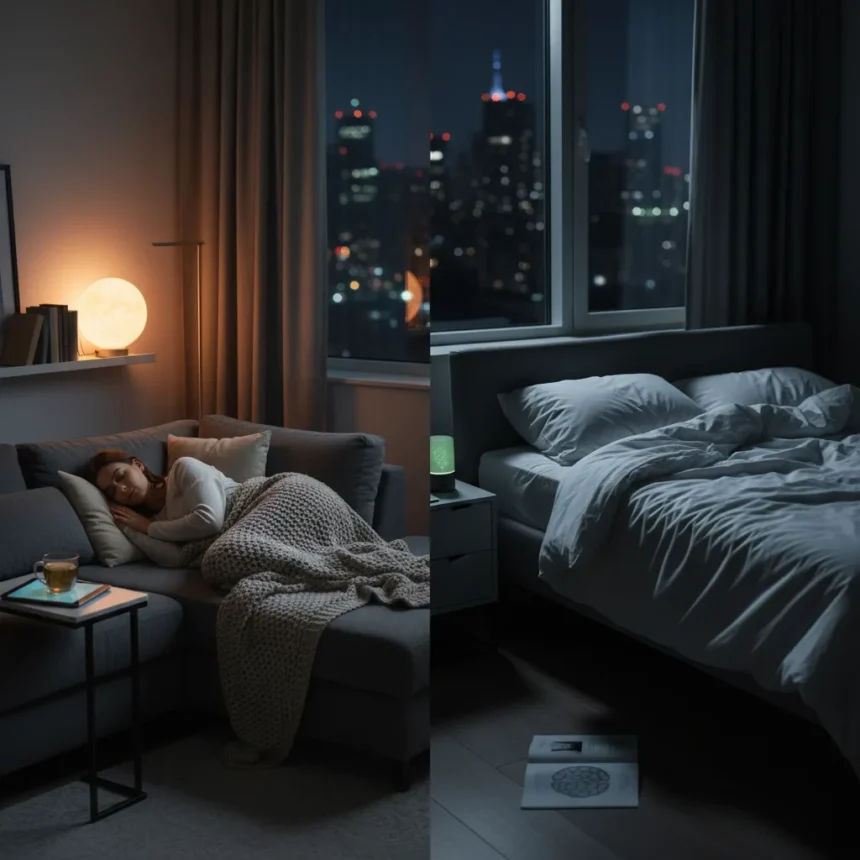
You fall asleep on the couch but lie awake in bed for hours. This isn’t random. The reason you fall asleep on the couch but not in bed stems from a psychological phenomenon called classical conditioning—your brain has learned to associate your bed with stress and wakefulness rather than rest. The good news: neuroplasticity allows your brain to unlearn this fear, and a simple routine switch can rewire those associations.
Key Takeaways
- Couch sleeping feels easier because there’s no pressure or anxiety about falling asleep, unlike in bed where conditioning creates stress.
- Your brain associates the bed with insomnia and worry, triggering hyperarousal—a survival response that keeps you awake.
- Long-term couch sleeping causes neck and back pain, breathing disruptions, and worsened sleep apnea or GERD.
- Stimulus control therapy—using your bed only for sleep—can rebuild positive sleep associations through neuroplasticity.
- Cognitive behavioral therapy for insomnia (CBT-I) treats the root cause of anxiety without medication risks like tolerance or sleep-driving.
Why Your Brain Falls Asleep Everywhere Except Your Bed
The couch feels like a safe place to sleep because you’re not thinking about sleep. Dr. Mike McGrath, a board-certified psychiatrist and chief clinical officer, explains the mechanism clearly: “From a psychological perspective, it’s easier for a person to fall asleep on a couch compared to a bed because the person isn’t necessarily thinking or worried about falling asleep. Without this worry or pressure to fall asleep, they might find it easier to sleep”. On the couch, you’re relaxed. Your guard is down. There’s no performance pressure.
Your bed, by contrast, has become a threat signal. Through classical conditioning—the same mechanism that made Pavlov’s dogs salivate at the sound of a bell—your brain now pairs the bed with sleeplessness, anxiety, and failure. Every night you lie there awake, that association strengthens. Your nervous system responds with hyperarousal, a survival response that floods your body with cortisol and adrenaline, keeping you alert and vigilant. The bed has become the problem, not the solution.
This conditioning is powerful but not permanent. Your brain can unlearn it. Neuroplasticity—the brain’s ability to form new neural pathways—means that with consistent practice, your bed can become calm again. The pathway forward requires discipline, but the mechanism is straightforward.


The Physical Toll of Long-Term Couch Sleeping
Sleeping on the couch might feel better in the moment, but it damages your body. Dr. Donald Beasley, an ENT specialist and founder of Boise ENT, describes the cascade: “The awkward angles can really mess with your neck and back. This doesn’t just cause discomfort and back problems; it can also lead to breathing issues that disrupt your sleep and leave you feeling exhausted when you wake up. Over time, this really isn’t good for your health”. Couches are not designed for eight hours of sleep. The angles strain your cervical spine. Your breathing gets compromised. If you have sleep apnea or acid reflux, couch sleeping accelerates those conditions.
The exhaustion compounds. You sleep poorly on the couch, wake with neck pain, then dread going to bed because you know you won’t sleep. The cycle deepens. Meanwhile, sleep deprivation itself becomes a health crisis—roughly one in three Americans are significantly sleep-deprived, and that deficit accumulates into cardiovascular risk, metabolic dysfunction, and weakened immunity. Couch sleeping is not a sustainable solution.



The Stimulus Control Therapy Fix: Reclaim Your Bed
The solution is stimulus control therapy, a evidence-based approach grounded in the same conditioning principles that created the problem. The rules are simple but non-negotiable. Use your bed for sleep only—no planning, no phone scrolling, no television, no reading. The sole exception is sex. Everything else happens outside the bedroom.
Create a comfortable alternative space. Choose a chair or couch in another room, stock it with a book and remote control, and engage in relaxing activities there until you feel genuinely sleepy. Avoid stimulating content like video games or news—these activate your nervous system when you need to downregulate. Only when you feel drowsy should you move to bed. If you’re not asleep within 10 to 15 minutes, get up and return to your comfort spot. Do not clock-watch or lie there fighting sleep. That creates more anxiety.
The key is consistency. Every night you sleep in bed strengthens the new association. Every time you get up when you can’t sleep, you reinforce the message: the bed is for sleep, not for wakefulness or worry. Nap only in bed to ensure all sleep happens there and rebuilds positive conditioning. This approach takes two to four weeks to show results, but it works because it addresses the root cause—the learned association—rather than masking symptoms with medication.
CBT-I vs. Medication: Why the Behavioral Approach Wins
Sleeping pills like Ambien work fast. They also carry risks: tolerance builds, meaning you need higher doses over time; sleep-driving and midnight eating can occur; and dependency looms. Cognitive behavioral therapy for insomnia (CBT-I) is equally effective as medication but without those downsides. It treats the anxiety driving the insomnia, not just the symptom.


CBT-I combines stimulus control therapy with cognitive restructuring—challenging the catastrophic thoughts that fuel sleep anxiety—and sleep restriction, which consolidates sleep quality by limiting time in bed. The approach takes longer than popping a pill, but it produces lasting change. Once your brain relearns that the bed is safe, you don’t need ongoing treatment. The neuroplasticity holds.
When to See a Doctor About Your Sleep
If you’ve been struggling to fall asleep in bed for more than three months, most nights of the week, it’s time to consult a sleep specialist or your primary care physician. Chronic insomnia is treatable, and early intervention prevents the cascade of health problems that sleep deprivation triggers. A doctor can rule out underlying sleep disorders like apnea or restless leg syndrome and recommend CBT-I as a first-line treatment.
Can I retrain my brain to sleep in bed again?
Yes. Neuroplasticity allows your brain to unlearn the fear association between your bed and wakefulness. Consistent stimulus control therapy—using your bed only for sleep and leaving it if you can’t sleep within 10 to 15 minutes—rebuilds positive sleep associations over two to four weeks.
Is it okay to keep sleeping on the couch if I sleep better there?
Short-term, it may feel better. Long-term, couch sleeping causes neck and back pain, breathing disruptions, and worsened sleep apnea or GERD. The temporary relief is not worth the cumulative physical damage. Addressing the root cause—bed anxiety—is the healthier path.
How is CBT-I different from sleep medication?
Both work, but CBT-I treats the anxiety driving insomnia, while medications like Ambien mask the symptom. Medications carry risks of tolerance, sleep-driving, and dependency; CBT-I produces lasting change without ongoing medication. For most people, behavioral therapy is the first choice.
The path forward is clear: stop using the couch as a sleep crutch and rebuild your bed as a safe, calm place. It requires discipline and patience, but your brain is capable of change. Two to four weeks of consistent stimulus control therapy can undo months or years of conditioned insomnia. The couch felt good because it was easy. The bed will feel good because it’s right.
Edited by the All Things Geek team.
Source: Tom's Guide