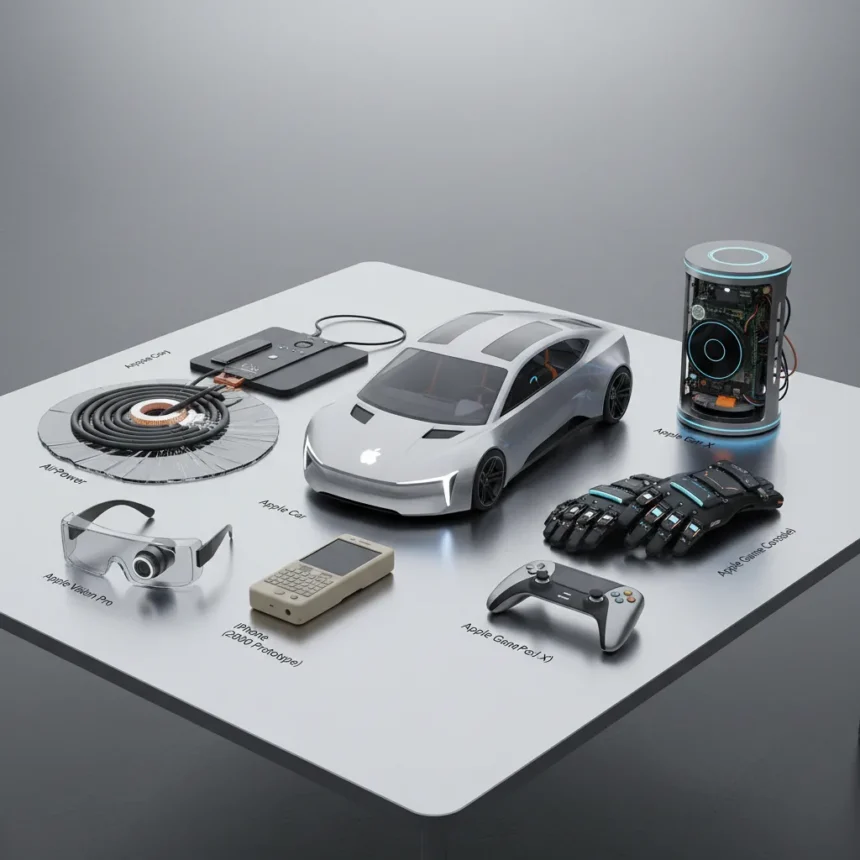
Apple canceled products represent one of tech’s most fascinating graveyard of ambition. Over the past 50 years, from 1976 to today, Apple has quietly shelved some of its most hyped projects—prototypes that generated rumors, internal demos that impressed executives, and concepts that seemed inevitable until they simply vanished. The pattern is stark: sometimes that long-rumored Apple product stays a rumor and never graces the real world.
Key Takeaways
- Apple canceled the Apple Car (Project Titan) after 10 years of development in early 2024
- AirPower wireless charger was announced but canceled due to overheating issues
- Early iWatch prototypes tested both rectangular and circular designs before shipping
- iPhone prototypes featured slide-out QWERTY keyboards before the full touchscreen design
- Apple TV gaming ambitions were scaled back from a high-end console to a streaming box
Why Apple Kills Its Own Ideas
Apple canceled products are not failures of imagination—they are casualties of ruthless prioritization. The company reportedly kills 90 percent of its internal ideas before they reach consumers, a discipline that separates Apple from competitors who ship half-baked concepts hoping something sticks. This culling process explains why so few Apple canceled products ever leak as finished prototypes. When Apple cancels something, it usually means the engineering, market fit, or business case collapsed, not that the idea lacked merit.
The recent cancellation of the Apple Car in early 2024 exemplifies this pattern. After a decade of development under Project Titan, Apple shut down the autonomous electric vehicle project entirely, redirecting resources toward artificial intelligence and services—areas where the company saw clearer returns. The Car reportedly had no steering wheel and represented Apple’s most ambitious hardware play outside consumer electronics, yet internal obstacles and shifting priorities made it expendable.
Apple Canceled Products That Almost Shipped
The Macintosh Office, envisioned in the 1980s, was designed as a server-based system for networked document sharing. Apple demoed the concept internally, but technical hurdles and a strategic shift toward the LaserWriter printer ended the project before it reached customers. It never became the office networking standard Apple imagined.

The Apple eMate 300 came closer to reality. Launched as a Newton-based tablet-like PDA for education in 1997, the eMate featured a clamshell design and touch-sensitive screen—a form factor that predated the iPad by over a decade. When Apple canceled the entire Newton line, the eMate died with it, leaving only prototypes as evidence that Apple was thinking about portable tablets long before the market demanded them.
Early iPhone prototypes included slide-out QWERTY keyboards, a design choice that seemed natural given BlackBerry’s dominance in 2006. Apple abandoned the physical keyboard entirely in favor of a full touchscreen, a decision that defined the modern smartphone. The canceled keyboard variant represents an alternate history of mobile computing that never materialized.



The Wireless Charging and Gaming Ambitions That Failed
AirPower was perhaps Apple’s most visible canceled product. Announced in 2017, the wireless charging mat promised to charge the iPhone, Apple Watch, and AirPods simultaneously using a proprietary Qi-based system. Apple canceled AirPower in 2018 after struggling with overheating issues that the company could not solve within acceptable thermal limits. Rumors suggested a price around $150–200, but consumers never got the chance to buy one. The failure left Apple relying on standard Qi chargers and MagSafe technology instead.
Apple’s television ambitions reveal a similar pattern of scaled-back ambition. In the 2010s, rumors swirled about a high-end Apple TV that would function as a full gaming console, complete with motion controls and AAA game support. The vision never materialized. Instead, Apple TV evolved into a streaming box with gaming as an afterthought, a far cry from the PlayStation and Xbox competitors Apple reportedly aimed to challenge.
The iWatch Prototypes and Apple Car Vision
Before the Apple Watch shipped in 2015, Apple tested multiple iWatch prototypes with both rectangular and circular designs. The final product settled on a rectangular form, but the exploration of circular designs—which competitors like Samsung later embraced—shows Apple canceled products extended even to successful product lines. The prototypes represented genuine design uncertainty that the market eventually resolved.
The Apple Car stands as the most ambitious Apple canceled products in company history. Project Titan ran for approximately 10 years, from 2014 until early 2024, consuming billions in R&D and attracting top automotive and AI talent. The autonomous electric vehicle with no steering wheel represented Apple’s bet that it could disrupt transportation the way it disrupted phones and tablets. Yet internal disagreements over autonomous capability levels, cost constraints, and the rise of AI as a corporate priority led to the project’s termination. Unlike most Apple canceled products that remained rumors, the Car’s cancellation was officially confirmed, making it the most transparent failure in the company’s recent history.



What Apple Canceled Products Reveal About Innovation
The pattern of Apple canceled products over 50 years shows that innovation is not a straight line from idea to market. Even companies with unlimited resources and design talent kill projects constantly. The difference between Apple and its competitors is that Apple rarely ships mediocre compromises—when something does not meet the company’s bar, it disappears entirely rather than launching as a half-finished product. This ruthlessness protects Apple’s brand but leaves a trail of near-mythical products that exist only in prototypes, patents, and industry rumors.
Apple canceled products also reveal how quickly priorities shift. The company that spent a decade on an autonomous car suddenly decided AI and services mattered more. The company that dreamed of wireless charging mats settled for standard Qi. The company that explored circular smartwatches shipped a rectangular one. These pivots are not failures of vision—they are corrections made when reality collides with ambition.
Did Apple really cancel an autonomous car project?
Yes. Project Titan, Apple’s autonomous electric vehicle initiative, ran from 2014 until early 2024, when Apple officially canceled it. The car reportedly had no steering wheel and represented the company’s most ambitious hardware project outside consumer electronics. Apple confirmed the cancellation and redirected resources toward artificial intelligence initiatives.
Why did Apple cancel AirPower?
Apple canceled AirPower in 2018 due to overheating issues with the wireless charging mat. The device was designed to charge the iPhone, Apple Watch, and AirPods simultaneously but could not meet Apple’s thermal and performance standards. The company never solved the engineering challenges that would have allowed it to ship safely.
What was the Apple eMate 300?
The Apple eMate 300 was a Newton-based tablet-like PDA with a clamshell design and touch-sensitive screen, prototyped in 1997 for the education market. It never shipped because Apple canceled the entire Newton product line, leaving the eMate as a near-mythical precursor to modern tablets like the iPad.
Apple canceled products teach a hard lesson: ambition without execution is just expensive prototyping. The company’s graveyard of unreleased devices—from office networking systems to autonomous vehicles—shows that even the world’s most valuable corporation must choose what to build and what to abandon. The products that never shipped often matter more to Apple’s story than the ones that did, because they reveal where the company’s vision exceeded its engineering capability or market timing.
Edited by the All Things Geek team.
Source: TechRadar