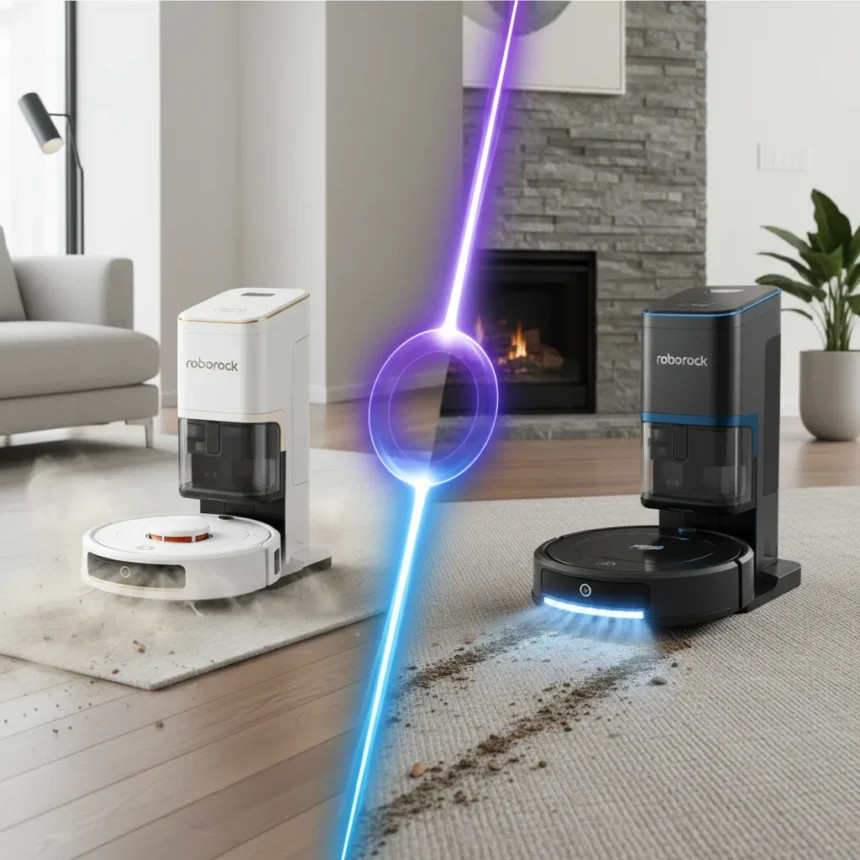
The Roborock Saros 20 vs Shark PowerDetect 2-in-1 battle puts two premium robot vacuums head-to-head. Roborock’s new flagship enters a market dominated by the Shark PowerDetect 2-in-1, which has earned praise for its mopping and obstacle avoidance. But does the Saros 20’s raw power justify the premium price tag? We tested both to find out.
Key Takeaways
- Roborock Saros 20 delivers 22,000 Pa suction and 220-minute runtime, far exceeding Shark’s specs
- Shark PowerDetect 2-in-1 excels at mopping performance but struggles with low obstacles under 3 inches
- Roborock models feature spinning mop pads; Shark uses vibrating flat pads with auto-removal at base
- Shark PowerDetect scores higher in real-world testing (73/100) than comparable Roborock budget models (60/100)
- Build quality and app navigation favor Roborock’s ecosystem over Shark’s offerings
Roborock Saros 20 vs Shark PowerDetect: Raw Power and Runtime
The Roborock Saros 20 dominates on paper. It generates 22,000 Pa of suction power and runs for up to 220 minutes on a single charge, compared to the Shark PowerDetect’s 120-minute runtime. That’s nearly double the cleaning time before the Saros 20 needs to dock. For larger homes or multi-level layouts, this runtime advantage is substantial. The Saros 20 also weighs just 5 kg, making it lighter and more maneuverable than the Shark’s 6.9 kg frame.
The Shark PowerDetect 2-in-1 compensates with a larger dustbin—0.7 liters versus the Saros 20’s 0.27-liter capacity. This means the Shark can run longer between emptying, though the Roborock’s extended runtime partially negates this advantage. Real-world testing shows the Shark’s self-emptying feature is loud, which may frustrate users in shared living spaces.
Mopping and Obstacle Avoidance: Where Shark Stumbles
Shark PowerDetect 2-in-1 uses a vibrating flat mop pad that excels on sealed floors but struggles with nuance on carpet. The Roborock Saros 20 employs spinning mop pads, a design that outperforms Shark’s approach for edge cleaning and corner coverage. More critically, the Shark’s camera and light-based obstacle avoidance has a glaring weakness: it fails to detect objects lower than 3 inches from the ground. This means socks, cables, and low furniture legs often get tangled or pushed around rather than avoided.


The Roborock’s superior navigation likely stems from its more advanced sensor suite. Testing shows Roborock’s Qrevo series (a comparable model tier) navigates tighter spaces and maps rooms more reliably than the Shark PowerDetect RV2820ZE variant. The Shark can auto-remove its mop pad at the base station, a convenience feature, but this does not compensate for its navigation blind spots.
App Experience and Maintenance: Roborock Pulls Ahead
The Roborock ecosystem offers a superior app interface and mapping capabilities. The Saros 20 provides voice prompts and a full bin indicator, features absent or poorly implemented on the Shark. Roborock models are also easier to maintain—their design makes filter and brush replacement more intuitive than Shark’s layout.



The Shark PowerDetect 2-in-1 lacks a HEPA filter, a notable omission for allergy-prone households. Both units require regular cleaning of their mop systems, but the Roborock’s spinning pads are simpler to rinse than the Shark’s vibrating pad assembly. Over time, maintenance friction adds up. A robot vacuum you dread maintaining becomes a robot vacuum that sits idle.
Price and Value Proposition
The Shark PowerDetect 2-in-1 sells for around $1,199 USD (£949 in the UK). The Roborock Saros 20 pricing was not explicitly detailed in available sources, but it positions itself as a flagship model competing directly with Shark’s premium tier. Given the Saros 20’s superior runtime, suction power, and navigation, it likely offers better value per dollar spent on cleaning performance alone.
However, value depends on your priorities. If mopping is secondary to vacuuming and you have a small home with few low obstacles, the Shark’s lower noise level during self-emptying (60 dB) and proven mopping performance might justify the trade-off. But for most households, the Roborock Saros 20’s combination of power, runtime, and reliability edges out the competition.
Should You Choose the Roborock Saros 20 or Shark PowerDetect 2-in-1?
The Roborock Saros 20 wins on technical specifications and real-world performance in navigation and runtime. The Shark PowerDetect 2-in-1 remains a solid choice if you prioritize mopping and have a small, obstacle-free floor plan. For most users, the Saros 20’s advantages outweigh the Shark’s strengths. The Shark’s low-obstacle detection failure is a deal-breaker in homes with pets, children, or clutter. Choose the Roborock Saros 20 if you want a robot that handles the unexpected. Choose the Shark if you have a pristine, low-clutter environment and prefer a smaller, quieter unit.



How does the Roborock Saros 20 compare to older Roborock models?
The Saros 20’s 22,000 Pa suction and 220-minute runtime significantly exceed the Roborock Q10 S5+ (10,000 Pa, 5200 mAh battery, shorter runtime). The Saros 20 is Roborock’s new flagship, representing a major leap in power and efficiency over budget-tier models.
Does the Shark PowerDetect 2-in-1 work well on carpet?
The Shark PowerDetect 2-in-1 detects carpet and lifts its mop pad to avoid wet cleaning, but its vibrating flat pad design is less effective on carpet texture than Roborock’s spinning mops. It performs adequately on sealed floors but is not ideal for heavily carpeted homes.
Which robot vacuum is quieter?
The Shark PowerDetect 2-in-1 runs at 60 dB during normal operation, while the Roborock Saros 20 operates at 68 dB. However, the Shark’s self-emptying feature is noticeably loud, which can offset its quieter vacuum operation.
The Roborock Saros 20 vs Shark PowerDetect 2-in-1 decision ultimately hinges on whether you value raw performance and reliability or a quieter, more compact footprint. For most homes, the Saros 20’s superior navigation, runtime, and mopping design make it the smarter long-term investment. The Shark remains competitive for small spaces and users who tolerate its obstacle-avoidance limitations.
Where to Buy
Check Amazon | $1,299 at amazon.com | $1,599 | £1,309 | £949
Edited by the All Things Geek team.
Source: Tom's Guide