





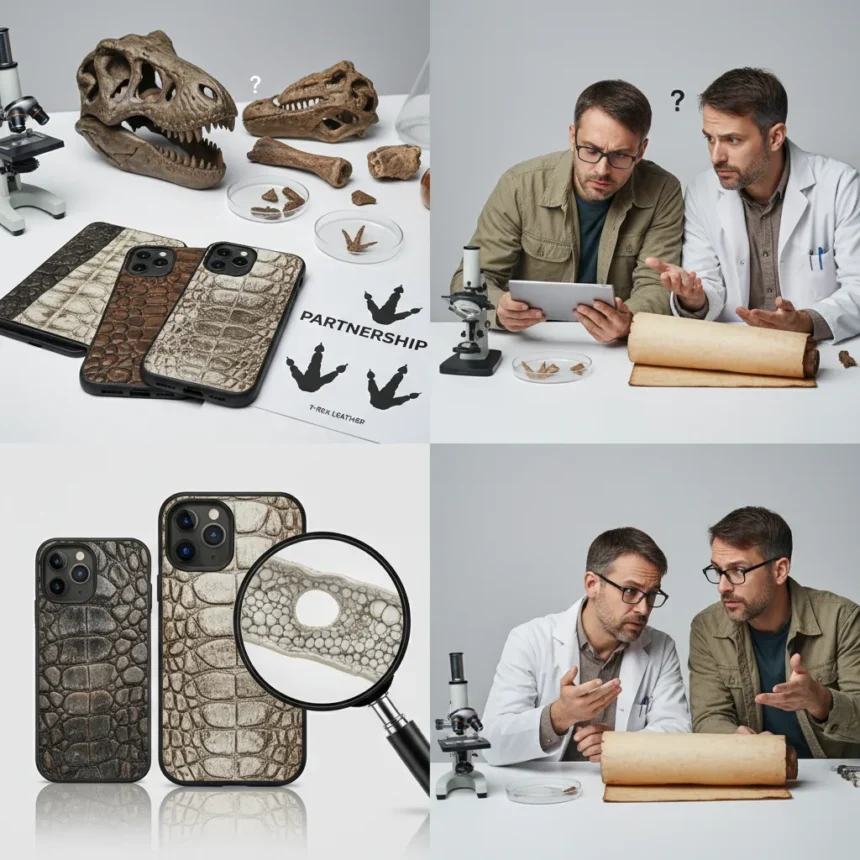
Lab-grown T-Rex leather sounds like science fiction. VML, The Organoid Company, and Lab-Grown Leather Ltd announced a partnership in Amsterdam on April 25, 2025, claiming they would create the world’s first T-Rex leather material for fashion accessories, including iPhone cases, by the end of 2025. Within weeks, paleontologists dismantled the entire premise.
Key Takeaways
- Partnership announced April 25, 2025, aims to produce lab-grown T-Rex leather iPhone cases and accessories by end of 2025.
- Material uses fossilized T-Rex collagen as a blueprint; cells are engineered with synthetic DNA and grown on a scaffold-free platform.
- Paleontologist Thomas Holtz Jr. calls the claims “fantasy” and “misleading”—no viable T-Rex DNA exists, only bone collagen fragments.
- Lab-grown leather itself is real; the dinosaur branding is marketing theater, not scientific achievement.
- Similar to VML’s past “Mammoth Meatball” project, positioning creative agencies as biotech pioneers.
What Lab-Grown T-Rex Leather Actually Is
Lab-grown T-Rex leather is not made from dinosaur DNA or actual dinosaur skin. The material uses fossilized T-Rex collagen—fragments found in bone, not skin—as a reference blueprint. The Organoid Company designs synthetic DNA sequences inspired by that collagen structure. Lab-Grown Leather Ltd then engineers cells with this synthetic DNA and grows them on a scaffold-free tissue engineering platform called ATEP™. The cells self-assemble into a material structurally similar to traditional leather in durability, tactility, and repairability.
Professor Che Connon of Lab-Grown Leather stated: “Our proprietary advanced tissue engineering platform has once again proven its versatility. By collaborating with VML and The Organoid Company, we’re unlocking the potential to engineer leather from prehistoric species, starting with the formidable T-Rex. This venture showcases the power of cell-based technology to create materials that are both innovative and ethically sound”. The engineering is legitimate. The dinosaur angle is marketing.
Why Paleontologists Say It’s Misleading
Thomas Holtz Jr., a vertebrate paleontologist at the University of Maryland, pulled no punches: “What this company is doing seems to be fantasy.” He explained that no T-Rex DNA exists in any fossil—DNA degrades over millions of years and has never been recovered from dinosaur remains. Collagen has been found only in T-Rex bone, never in skin or other tissues. Creating actual T-Rex leather would require DNA from the dinosaur itself, which is scientifically impossible.


The core issue is semantic fraud. Lab-grown T-Rex leather is not T-Rex leather. It is synthetic material engineered from a collagen template inspired by a fossilized dinosaur. Calling it “T-Rex leather” implies genetic authenticity that does not exist. The partnership is selling a branding story, not a paleontological breakthrough. Skeptics compare it to similar VML stunts—like the “Mammoth Meatball” project—where creative agencies use extinct species as marketing hooks rather than scientific anchors.
How This Compares to Other Lab-Grown Leathers
Lab-grown leather itself is not new. Competitors in the space use scaffold-based tissue engineering, which requires structural supports during growth. Lab-Grown Leather’s scaffold-free ATEP™ platform eliminates that step, allowing cells to self-assemble naturally. This is a genuine technical advantage over traditional synthetic leather alternatives that rely on plastic or plant-based scaffolds.


Against traditional leather, lab-grown material avoids deforestation, animal harm, and chemical tanning. It is biodegradable and marketed as lower environmental impact. The difference is material science, not dinosaur genetics. Any lab-grown leather—whether branded as T-Rex, mammoth, or simply “advanced synthetic”—offers the same cruelty-free and eco-friendly benefits. The dinosaur name adds zero functional value to an iPhone case.
When Will T-Rex Leather Actually Arrive?
The partnership expects to deliver initial fashion accessories, including iPhone cases, by the end of 2025. No pricing has been announced. Long-term plans include automotive and luxury goods applications. Availability will likely be limited at launch, given the novelty and production complexity.
The real question is whether consumers will pay premium prices for a material that is functionally identical to non-dinosaur lab-grown leather, minus the extinct-species branding. If the product succeeds, it will be because the material itself is superior—not because it came from a T-Rex blueprint that never actually existed.
Is the T-Rex leather actually made from dinosaur DNA?
No. Viable T-Rex DNA does not exist in any fossil. The material uses fossilized collagen fragments from T-Rex bone as a design reference, then engineers synthetic DNA inspired by that structure. It is synthetic leather with dinosaur-themed marketing, not authentic prehistoric material.



Why would a company claim T-Rex leather if it’s not real?
VML is a creative agency—storytelling is its core business. Branding a lab-grown leather product as “T-Rex leather” attracts media attention and positions the collaboration as latest innovation rather than incremental biotech improvement. The Mammoth Meatball project followed the same playbook. Hype drives investment and consumer interest far more effectively than technical accuracy.
Will lab-grown T-Rex leather iPhone cases actually be available?
The partnership plans to launch fashion accessories by the end of 2025, though no specific retailers or prices have been confirmed. Whether consumers will embrace a dinosaur-branded case at a premium price point remains uncertain. The material itself is real; the dinosaur story is the only thing questionable.
Lab-grown T-Rex leather is a textbook example of biotech hype outpacing scientific reality. The tissue engineering is legitimate. The environmental benefits are real. But calling it “T-Rex leather” is marketing theater dressed up as paleontology. Consumers shopping for an iPhone case should focus on the actual material properties—durability, repairability, biodegradability—and ignore the dinosaur branding. The case will work fine either way.
Edited by the All Things Geek team.
Source: TechRadar




