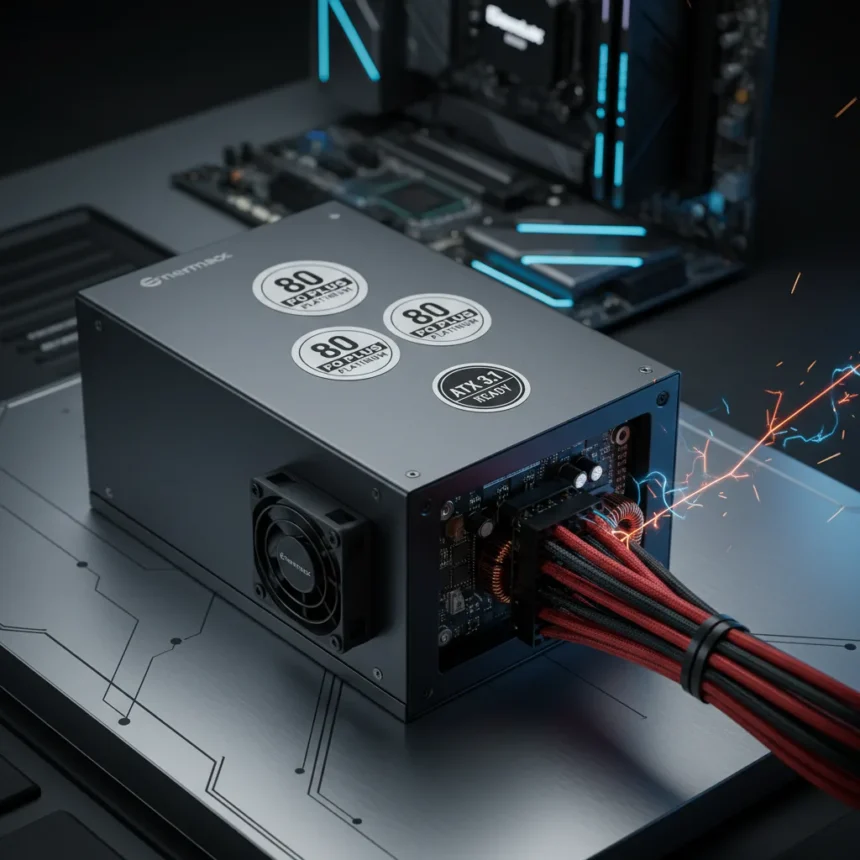
The Enermax Revolution III S 1000W is a fully modular power supply with 1000W capacity, Platinum efficiency certification from three independent bodies (80 Plus, Cybenetics, and PPLP), and native ATX 3.1 support, launching January 2026 at $179.99 for the black variant and $189.99 for white.
Key Takeaways
- Triple Platinum certifications (80 Plus, Cybenetics, PPLP) across 1,450+ load levels at 115V and 230V
- 13-year warranty exceeds typical 10-year industry standard for premium Platinum units
- Native 12V-2×6 connector supports up to 600W for flagship GPUs without adapters, full ATX 3.1 compliance
- Small 120mm FDB fan with semi-fanless mode averages 32.79 dBA noise output
- Transient testing reveals 3.3V rail stability issues despite ATX 3.1 certification
Enermax Revolution III S 1000W Efficiency Claims Hold Up—Mostly
The Enermax Revolution III S 1000W achieves Platinum certification across three independent testing regimes, a rare distinction in the market. Cybenetics validation confirmed efficiency across 1,450+ load combinations at both 115V and 230V input voltages, with an average power factor of 0.953. Vampire power consumption sits low, and the unit maintains consistent performance across the full load spectrum—a genuine strength for users building high-end systems that demand stable, clean power delivery.
The triple certification matters because it signals independent verification rather than relying on a single testing body. Cybenetics’ certification, issued September 23, 2025, reflects particularly rigorous assessment. However, the same Cybenetics report flagged a critical caveat: transient testing exposed instability on the 3.3V rail, raising questions about how the unit behaves during rapid load spikes—exactly the scenario that occurs when GPUs throttle or CPUs shift power states.
ATX 3.1 Native Support Arrives, But With Caveats
The Enermax Revolution III S 1000W includes a native 12V-2×6 connector capable of delivering up to 600W on a single cable, eliminating the need for adapters when pairing the PSU with next-generation flagship GPUs. This is a genuine advantage over older units, which require external adapters that add bulk and potential failure points. Full ATX 3.1 compliance means the power supply is genuinely future-proofed for the next generation of high-end hardware.

Yet the Cybenetics testing report notes that despite ATX 3.1 compliance claims, transient response on the 3.3V rail showed issues during rapid load transitions. This discrepancy matters for users pairing the PSU with systems that stress multiple rails simultaneously—a scenario common in workstations and gaming rigs pulling hard on both GPU and CPU. The unit meets the standard on paper, but real-world transient behavior warrants caution until independent reviewers publish full stress-testing results under extreme conditions.
Cooling Design Trades Silence for Thermal Headroom
The Enermax Revolution III S 1000W employs a single 120mm fluid-dynamic bearing fan with semi-fanless operation, staying silent until load exceeds 60%, at which point the fan engages. Average noise output measures 32.79 dBA across the full load spectrum, placing it among the quieter 1000W units. For office systems or silent builds, this is a win.



The trade-off emerges under sustained heavy load. A single 120mm fan, particularly in a 1000W chassis, has limited thermal capacity compared to dual-fan designs found in premium competitors like Corsair and Seasonic’s flagship Platinum models. The small fan also creates a peculiar cable routing challenge: the mesh-sleeved cables and included combs, while excellent for aesthetics and airflow, require precise routing to avoid blocking the fan intake. Users building in tight cases or with large GPU backplates may find the cable layout frustrating, though the fully modular design does offer flexibility.
13-Year Warranty Sets It Apart—But Reflects Conservative Design
The 13-year warranty is genuinely unusual in the Platinum segment, where most competitors (Corsair, Seasonic, EVGA) offer 10 years. This extended coverage suggests Enermax has high confidence in component longevity, particularly the 100% Japanese industrial-grade capacitors. The extended warranty also reflects the unit’s conservative power delivery design—it is not pushing components to their limits, which aids reliability but also contributes to the thermal limitations under peak load.
For buyers prioritizing longevity and warranty peace of mind over maximum thermal performance, the 13-year guarantee is compelling. It is a genuine differentiator in a market where warranty length has stagnated.
Fully Modular Design With Practical Limitations
The Enermax Revolution III S 1000W ships with mesh-sleeved cables and cable combs, delivering both aesthetic appeal and improved airflow inside the chassis. Full modularity means you connect only the cables you need, reducing clutter in cramped builds. However, the small fan footprint makes cable routing critical—poor routing can choke the intake, negating the efficiency gains from modular flexibility.



Should You Buy the Enermax Revolution III S 1000W?
Buy it if you value warranty longevity, silence, and future-proof ATX 3.1 native support for a mid-range Platinum price. The triple certification and 13-year warranty justify the cost for system builders planning five-year-plus ownership horizons. Skip it if you are building a compact case or pushing sustained loads above 800W—the small fan and transient rail concerns make larger competitors safer bets for extreme scenarios.
Does the Revolution III S 1000W handle transient spikes reliably?
Cybenetics testing revealed instability on the 3.3V rail during transient events, despite ATX 3.1 compliance. This is a legitimate concern for systems with rapid power state transitions, though real-world impact depends on your specific hardware combination and workload profile.
How does the 13-year warranty compare to other Platinum PSUs?
Most premium Platinum units from Corsair, Seasonic, and EVGA offer 10-year warranties, making the Enermax Revolution III S 1000W’s 13-year coverage genuinely unusual and a key differentiator.
Is the native 12V-2×6 connector necessary right now?
Not immediately, but it will be essential for next-generation flagship GPUs launching in 2026 and beyond. The native connector eliminates adapter risk and simplifies cable management, making it a genuine future-proofing advantage over older units.
The Enermax Revolution III S 1000W is a solid mid-range Platinum choice for builders prioritizing warranty coverage and quiet operation, but its thermal constraints and transient rail quirks make it a risky pick for extreme builds or compact cases. The triple certification and extended warranty shine brightest for users planning long-term ownership and willing to accept the cooling trade-offs that come with a single-fan design.
Where to Buy
Edited by the All Things Geek team.
Source: Tom's Hardware