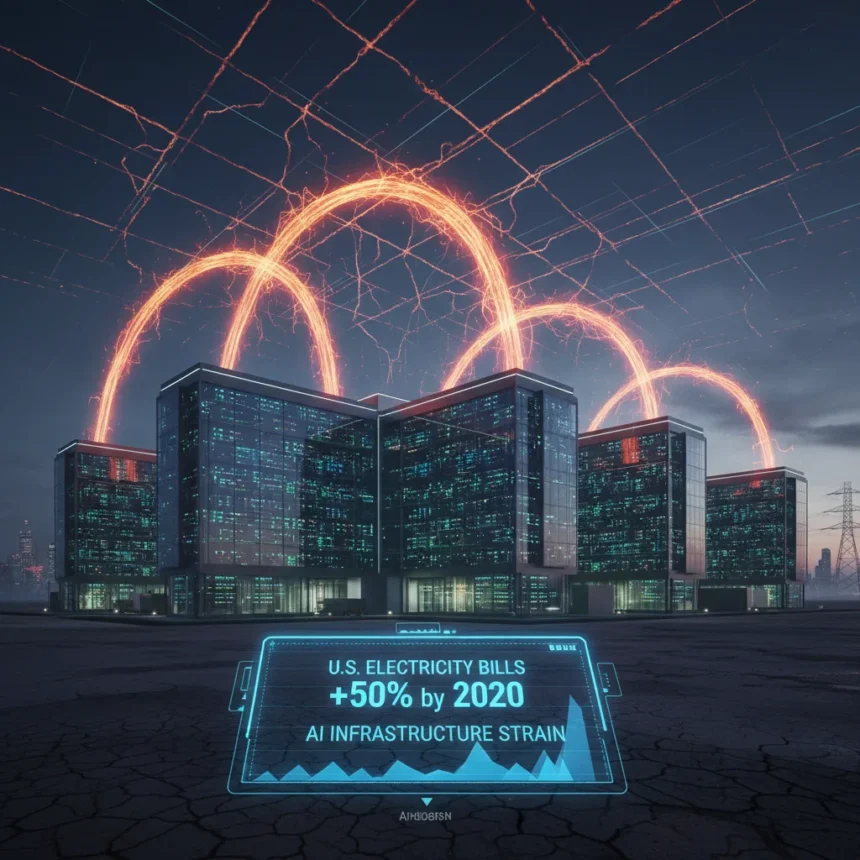
Data center electricity costs are about to become your problem. A new study warns that data centers and digital infrastructure could hike power costs in some U.S. states by more than 50% by 2030, transforming what was once a corporate concern into a household expense.
Key Takeaways
- Data center electricity costs could surge over 50% by 2030 in some states, directly raising consumer power bills.
- AI-driven data centers consume as much electricity as 100,000 households, placing extraordinary demands on aging grids.
- U.S. electricity grids remain powered primarily by natural gas and coal, limiting capacity for new infrastructure.
- State-level impacts will vary dramatically, with some regions facing far steeper increases than others.
- The cost spike reflects broader grid strain from rapid data center expansion tied to AI adoption.
Why Data Center Electricity Costs Matter to Your Power Bill
For years, data center expansion was an abstract infrastructure story—something tech companies and utilities debated behind closed doors. That changed the moment researchers quantified the household impact. Data center electricity costs are no longer just about corporate energy budgets; they are about whether your monthly power bill climbs by double digits. The warning hits different when you realize the cost is coming out of your wallet, not a tech company’s spreadsheet.
The core issue is scale. AI-driven data centers consume as much electricity as 100,000 households, yet they occupy a fraction of the physical footprint. One facility can spike regional demand faster than utilities can build new generation capacity. When demand outpaces supply, prices rise—and residential customers absorb the cost.
The Grid Problem Behind Data Center Electricity Costs
The U.S. electrical grid was not designed for this. Most American electricity still comes from natural gas and coal, fuels that took decades to build out. Data centers are expanding in months. That mismatch creates a bottleneck: utilities cannot flip a switch and add generation capacity fast enough to keep up with data center electricity costs and the demand they create.


The problem is geographic. Some states will face far steeper increases than others, depending on local grid capacity and where data centers cluster. A state with abundant hydroelectric power will weather the surge better than one relying entirely on aging coal plants. But even well-positioned regions will feel the pinch as data center electricity costs compound across multiple facilities. Some projections estimate data centers could consume between 4.6% to 9.1% of U.S. electricity generation by 2030, with other models pushing that range to 6.7% to 12% of total consumption by 2028.
How Data Center Electricity Costs Compare to Other Infrastructure Demands
Historically, utilities managed demand growth by spreading it across decades. Roads get wider. Power plants get larger. But data center electricity costs compress that timeline. A single hyperscale facility can demand as much power as a city of 50,000 people, and it can go online in 18 months. Traditional infrastructure simply cannot keep pace.



Compare this to renewable energy buildout. Solar and wind farms take years to permit and construct. Data centers move faster. This asymmetry means utilities are forced to rely on existing generation—mostly fossil fuels—to feed new demand. Until renewable capacity catches up, data center electricity costs will be underwritten by the dirtiest, most expensive parts of the grid.
What States Should Expect
The 50% warning applies to some states, not all. States with robust renewable infrastructure or excess generation capacity will see smaller increases. States with aging grids and limited surplus capacity could face the full brunt. Virginia, for instance, faces particular pressure as major data center hubs cluster in Northern Virginia. One energy model projected an 8% national energy price increase by 2030, but state-level impacts will vary wildly.
The timeline matters. 2030 is not distant—it is five years away. Utilities cannot build new power plants in that window. They cannot retrofit grids overnight. The increase is baked in, barring a dramatic slowdown in data center construction or a massive surge in renewable capacity deployment.
The Real Cost to Households
What does 50% mean in dollars? That depends on where you live and your current bill. A household paying $120 monthly could see bills rise to $180. Multiply that across millions of customers, and the aggregate impact becomes a political issue. Regulators and utilities will face pressure to absorb costs, raise rates, or find new revenue sources—none of which are painless.



The irony is sharp: consumers benefit from the AI services and cloud infrastructure that data centers power. We use them every day. But the infrastructure cost is invisible until it appears on a power bill. That disconnect is about to close.
Can Anything Slow Data Center Electricity Costs?
Three levers exist. First, efficiency: newer data centers use less power per unit of compute than older ones, but gains plateau. Second, renewable energy: if utilities and data center operators accelerate solar, wind, and nuclear buildout, they can offset some demand growth. Third, geographic distribution: spreading data centers across regions with different grid characteristics reduces concentration risk. None of these solve the problem entirely, but combined they could blunt the edge.
What will not happen: a pause in AI adoption or data center construction. That genie is out of the bottle. The only question is how fast utilities can adapt, and the answer—based on current buildout timelines—is not fast enough.
Will my power bill definitely increase by 50%?
Not uniformly. The 50% figure applies to some states with constrained grids and heavy data center clustering. Your bill increase depends on your state’s generation capacity, the number of data centers nearby, and how aggressively utilities deploy renewables. Some regions may see 20% increases; others could approach 50% or higher. Check with your local utility for state-specific projections.
Can data centers use renewable energy instead?
In theory, yes. In practice, not fast enough. Data centers are expanding faster than renewable capacity is being built. Some operators are investing in solar and wind, but existing generation remains the primary power source. Until renewable buildout dramatically accelerates, data centers will continue drawing from grids powered largely by natural gas and coal.
Is this just about AI?
AI accelerated the problem, but data centers have been growing for years. Cloud computing, streaming, and cryptocurrency mining all contributed. AI simply turbocharged demand because training and running large language models consumes enormous electricity. The warning applies to the entire data center ecosystem, though AI is the fastest-growing segment.
The bottom line: data center electricity costs are shifting from a utilities-and-tech-companies problem to a household problem. Your power bill is about to reflect the infrastructure demands of AI and cloud computing. The only question is how much, and whether your state’s grid can absorb the shock without breaking.
Edited by the All Things Geek team.
Source: TechRadar