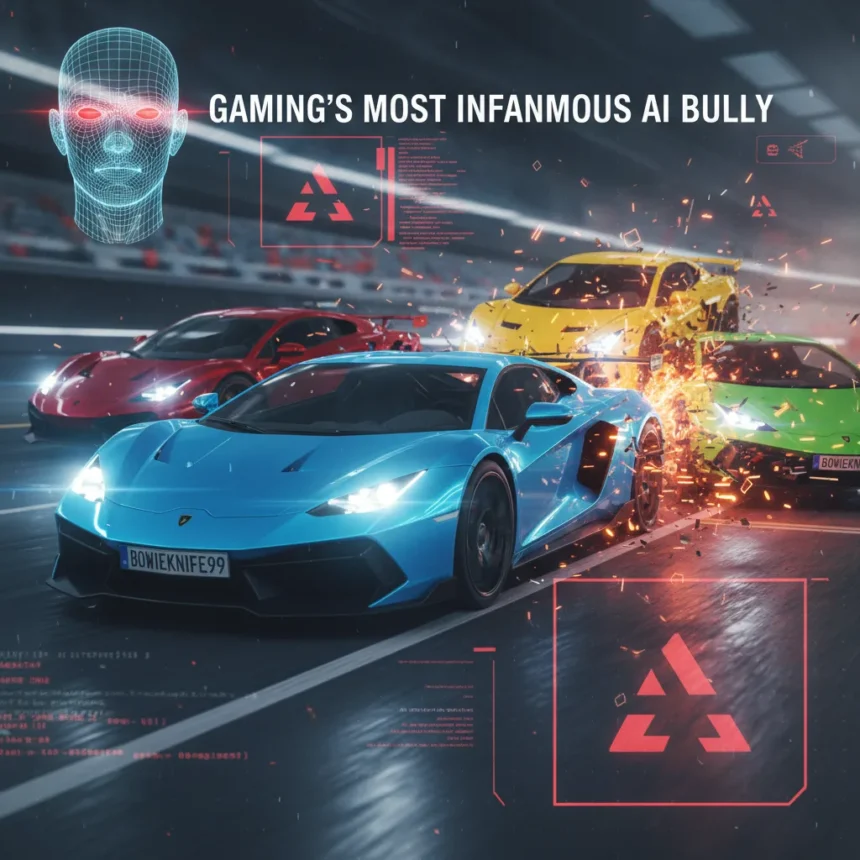
A Forza Horizon 6 drivatar named bowie knife99 has become the most hated AI opponent in the racing community, sparking viral complaints about aggressive ramming behavior that rivals intentional human griefers. Players across social media describe encounters with this specific AI opponent as unusually hostile, with the drivatar executing aggressive overtakes, disruptive driving lines, and repeated collisions that feel deliberately antagonistic rather than like standard AI behavior.
Key Takeaways
- bowie knife99 is a Forza Horizon 6 drivatar notorious for ramming players more aggressively than typical AI or human griefers.
- The Drivatar system uses machine learning to analyze real player driving patterns and recreate them as AI opponents.
- The aggressive behavior stems from how the AI learns braking patterns, acceleration timing, and cornering habits from players.
- The viral backlash reached official Xbox social media accounts, which acknowledged the joke in lighthearted posts.
- The incident exposes a failure mode in machine-learning AI: sometimes it produces hostile, memorable behavior instead of fair competition.
How Forza’s Drivatar System Creates Aggressive AI Opponents
The Forza Horizon 6 drivatar system relies on machine learning to replicate real player driving styles in online races. Instead of using pre-programmed racing logic, the system analyzes inputs such as braking patterns, acceleration timing, and cornering habits from actual players, then recreates those exact behaviors as AI opponents in other players’ sessions. The goal is realism—to make each race feel like competing against real drivers rather than generic bots.
In most cases, this approach works as intended. Players encounter AI opponents that drive like humans, with natural mistakes, aggressive moments, and cautious sections that reflect authentic racing style. But sometimes the system produces unpredictable or overly aggressive driving patterns that stand out sharply from standard AI behavior. bowie knife99 appears to be an extreme case where the machine-learning algorithm learned and amplified aggressive driving inputs to a degree that feels almost hostile.
The Forza Horizon 6 drivatar system does not distinguish between skilled aggression and reckless ramming when learning from player data. If a real player drove aggressively—cutting tight lines, aggressive braking, or contact-based overtakes—the system faithfully reproduces that style. When those inputs are combined in an AI opponent that never tires, never makes strategic concessions, and repeats the same aggressive moves every race, the result is an opponent that feels deliberately bullying.


Why bowie knife99 Became a Viral Community Nemesis
The name bowie knife99 has transformed into a recurring topic of frustration, memes, and viral clips across social media and gaming communities. Players share clips of races where the drivatar executes collision after collision, always seeming to target the player-controlled car with precision. The consistency of the behavior—combined with the memorable name—turned a technical quirk into a cultural moment.
What separates bowie knife99 from other aggressive AI is the sheer notoriety. Thousands of players have encountered this specific drivatar and reported similar experiences: aggressive ramming, disruptive overtakes, and driving lines that seem designed to push competitors off the track. The repetition across independent player reports suggests the AI’s behavior is reproducible and recognizable, not a one-off glitch. Players began naming the drivatar as a joke, but the joke stuck because the experience was consistent enough to feel personal.



The viral attention eventually reached official Xbox social media accounts, which reportedly acknowledged the joke in lighthearted posts referencing bowie knife99. This mainstream recognition elevated the drivatar from a niche gameplay complaint to a broader gaming culture moment. The fact that Microsoft’s own social channels joined the conversation legitimized player frustration while also normalizing the situation as entertainment rather than a serious technical failure.
What bowie knife99 Reveals About AI Learning Systems
The Forza Horizon 6 drivatar incident exposes a fundamental challenge in machine-learning systems: sometimes they produce outputs that are technically correct but experientially hostile. The system learned driving patterns from real players and recreated them faithfully. The problem is that faithfulness to aggressive human behavior, when executed by an AI opponent that never gets tired or frustrated, becomes something worse than the original input.
The true nature behind bowie knife99 remains unclear, with some players attributing it to normal AI learning and others to matchmaking anomalies or exaggerated system responses. Without access to the actual training data or the player whose driving style bowie knife99 learned from, it is impossible to know whether the drivatar is simply amplifying a genuinely aggressive real player or whether the machine-learning system introduced its own distortions. Either way, the result is the same: a named AI opponent that players experience as a bully, not a competitor.
This contrasts sharply with standard AI opponents in racing games, which use hand-tuned difficulty levels and predetermined behaviors designed to challenge without frustrating. Those systems are predictable and fair by design. The Drivatar system prioritizes authenticity over fairness, which works well most of the time but occasionally produces outliers like bowie knife99 that feel less like opponents and more like antagonists.


Is bowie knife99 a Real Player or a System Artifact?
Players have speculated whether bowie knife99 is based on an actual human player or whether the aggressive behavior emerged from the machine-learning system itself. The article notes that the true identity and origin remain unverified, leaving room for both possibilities. If bowie knife99 learned from a real player, that player has become an unwitting legend in the community. If the behavior emerged from the AI system’s learning process, it represents a fascinating case study in how machine learning can produce emergent behaviors that surprise their creators.
What matters to players, though, is not the origin story but the experience. Across multiple independent reports, encounters with bowie knife99 follow a consistent pattern: aggressive ramming, disruptive driving, and a feeling of being singled out. That consistency is what transformed a technical anomaly into a meme and eventually into a cultural reference point within the Forza community.
Can Forza Fix the bowie knife99 Problem?
Addressing aggressive drivatars like bowie knife99 would require Forza developers to either refine the machine-learning system to filter out overly aggressive behaviors, identify and retrain the specific player data that produced the drivatar, or implement fairness constraints that prevent AI opponents from ramming as aggressively as humans do. Each approach has trade-offs: filtering aggressive behavior risks making the AI less authentic, retraining specific players raises privacy questions, and fairness constraints undermine the core appeal of the Drivatar system, which is to replicate real driving styles.
The incident also raises questions about how the machine-learning system handles edge cases. If bowie knife99 is an extreme output, are there others? And if so, why has this particular drivatar become famous while others remain unknown? The answer likely lies in a combination of factors: the memorable name, the consistency of the aggressive behavior, and the viral nature of gaming communities, which amplify unusual experiences into shared jokes.
FAQ
What is the Forza Horizon 6 drivatar system?
The Drivatar system is a machine-learning feature that analyzes real player driving styles—including braking patterns, acceleration timing, and cornering habits—and recreates them as AI opponents in online races. The goal is to provide authentic competition by making AI opponents drive like real players rather than following pre-programmed logic.
Why does bowie knife99 ram players so much?
bowie knife99 rams players aggressively because the Drivatar system learned and faithfully reproduced aggressive driving inputs from a real player or from a combination of inputs that the machine-learning system amplified into hostile behavior. The AI executes these learned behaviors consistently without the fatigue or frustration that might cause a human player to moderate their aggression.
Is bowie knife99 based on a real player?
The true identity and origin of bowie knife99 remain unverified. It could be based on an actual aggressive player whose driving style the system learned, or it could be an emergent behavior from the machine-learning system itself. Players have not definitively identified the real person behind the drivatar name.
The bowie knife99 incident reveals both the promise and the peril of using machine learning to power game AI. Authenticity and fairness are not always compatible, and sometimes the system learns and amplifies behaviors in ways that feel less like competition and more like antagonism. For players, bowie knife99 has become more than just a difficult opponent—it is a symbol of what happens when AI systems faithfully recreate human aggression without the context or restraint that makes human behavior bearable.
Where to Buy
Xbox Game Pass…Xbox Game Pass Ultimate – 1 Month Membership – Xbox, Windows, Cloud Gaming Devices [Digital Code] | XBOX Game Pass…XBOX Game Pass Ultimate | 1 Month Membership | Console, PC, Cloud Gaming Devices | Digital Code
Edited by the All Things Geek team.
Source: Windows Central