





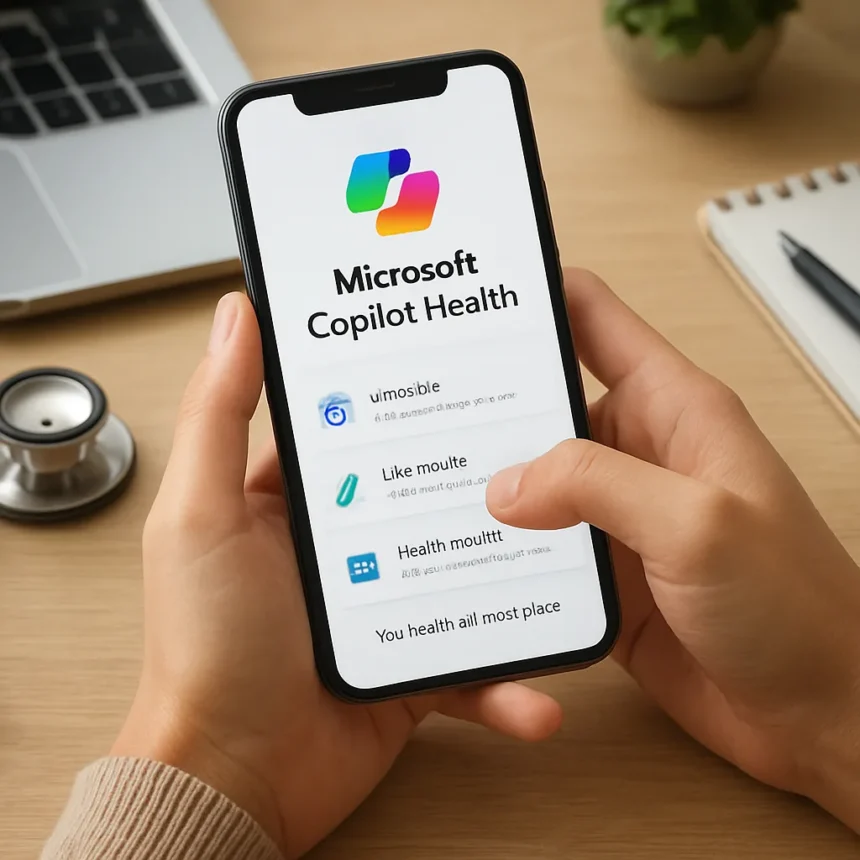
What Is Microsoft Copilot Health?
Microsoft Copilot Health is a new AI-powered health companion developed by Microsoft, currently available via waitlist to users in the United States who are 18 or older. The service aggregates personal health data from wearables, electronic health records, and lab results to deliver personalized health insights — all within a dedicated, encrypted environment that is isolated from the general Copilot assistant. It does not replace doctors, and Microsoft has been careful to frame it as a tool that works alongside medical professionals, not instead of them.
The announcement arrives at a moment when millions of people are already turning to AI chatbots to make sense of symptoms, test results, and medical jargon their physicians do not always have time to explain. Microsoft Copilot Health formalizes that behavior and builds a structured, privacy-focused layer around it. That is a meaningful distinction from simply typing health questions into a general-purpose AI assistant.
How Microsoft Copilot Health Actually Works
The core proposition of Microsoft Copilot Health is data aggregation. Rather than asking you to describe your health situation from scratch, it pulls together information you have already generated — through fitness wearables, connected health records, and laboratory results — and uses that context to provide more relevant, personalized responses. Think of it as giving an AI assistant a full medical file rather than a blank page.
Privacy architecture matters here, and Microsoft has addressed it directly. Health data within Copilot Health is encrypted and kept separate from the broader Copilot ecosystem. That separation is important for user trust, particularly given how sensitive health information is. Whether that architecture will satisfy regulators and privacy advocates over the long term remains to be seen, but the structural commitment is a positive signal.



The service was also informed by input from over 230 physicians across 24 countries, which gives it a degree of clinical grounding that purely consumer-facing AI tools often lack. That does not make it a diagnostic tool, but it does suggest the outputs are shaped with medical context in mind rather than being generated in a vacuum.
Microsoft Copilot Health vs Other AI Health Tools
Microsoft Copilot Health enters a space that other technology companies have been circling for years. General-purpose AI assistants from Google and OpenAI can answer health questions, but they do so without access to your personal health data — meaning every conversation starts cold. The structural advantage Microsoft is building is personalization at scale: an AI that knows your history before you ask the first question.



Apple Health has long aggregated wearable and health record data on device, but it does not layer a conversational AI assistant on top of that data in the way Copilot Health proposes to. The combination of structured personal health data and a large language model capable of contextualizing it is genuinely new territory for a mainstream consumer product. Whether Microsoft can execute on that combination reliably — and safely — is the real test.
Why the Personal Use Case Matters
The Windows Central article that prompted this piece tells a story many people will recognize: an individual using Copilot to surface a health concern that had been missed or overlooked in a clinical setting. That narrative is powerful precisely because it reflects a real gap. Appointments are short, specialists are overloaded, and patients often leave consultations with unanswered questions. An AI that can help bridge that gap — not by replacing a doctor’s judgment, but by helping a patient arrive at an appointment better informed — has genuine value.
Microsoft Copilot Health is not a diagnostic engine. It will not tell you what is wrong with you. But it can help you connect dots across your own data, formulate better questions for your physician, and understand what your lab results actually mean in plain language. For people navigating complex or chronic health situations, that kind of support can be the difference between feeling lost and feeling in control.
Is Microsoft Copilot Health available outside the US?
As of its launch, Microsoft Copilot Health is available via waitlist to US residents aged 18 and over. No international rollout timeline has been announced. Users outside the United States will need to monitor Microsoft’s official channels for updates on availability in their region.


Does Microsoft Copilot Health replace seeing a doctor?
No. Microsoft has explicitly stated that Copilot Health does not replace medical professionals. The service is designed to complement clinical care by helping users understand and organize their personal health data, not to provide diagnoses or treatment recommendations.
How does Copilot Health handle my personal health data?
Microsoft Copilot Health stores health data in an encrypted environment that is isolated from the general Copilot assistant. This means your health information is not used to train or inform the broader Copilot system. Microsoft has positioned data privacy as a foundational design principle of the service, though independent audits of that architecture have not yet been publicly reported.
Microsoft Copilot Health is a genuinely interesting product that arrives at exactly the right moment — when consumer appetite for AI-assisted health guidance is high and the tools to deliver it responsibly are finally maturing. The waitlist-only US launch is a cautious start, and caution is appropriate here. But if Microsoft can deliver on the promise of a privacy-respecting, clinically informed, and genuinely useful health companion, it will have built something that matters far beyond the tech industry.
Edited by the All Things Geek team.
Source: Windows Central




