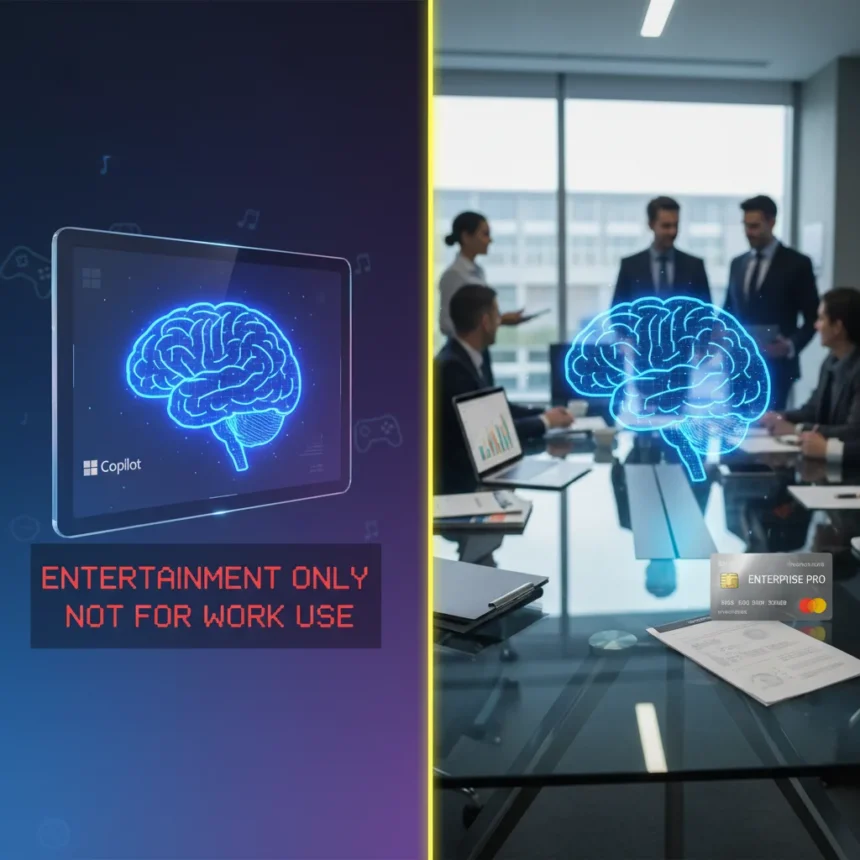
Microsoft Copilot’s official terms of use contain a stark disclaimer that directly contradicts how the company positions the tool to enterprise customers. The Microsoft Copilot terms of use explicitly state: “Copilot is for entertainment purposes only. It can make mistakes, and it may not work as intended. Don’t rely on Copilot for important advice. Use Copilot at your own risk.” This language appears across Copilot’s consumer-facing platforms—copilot.microsoft.com, copilot.com, and copilot.ai—raising serious questions about liability and the gap between marketing claims and legal reality.
Key Takeaways
- Microsoft’s Copilot terms explicitly restrict use to entertainment only, prohibiting commercial or business purposes.
- The “entertainment only” disclaimer applies to consumer Copilot but not Microsoft 365 Copilot enterprise apps.
- Competitors like Claude and ChatGPT omit “entertainment purposes only” language in their terms.
- Microsoft charges $99/user/month for Copilot Cowork in Microsoft 365 E7 tier despite consumer-level liability disclaimers.
- Terms prohibit reliance for important decisions and explicitly deny liability for business losses or missed opportunities.
The Entertainment Disclaimer That Won’t Go Away
The “entertainment purposes only” language has persisted across multiple versions of Copilot’s terms of service, creating a fundamental disconnect between what Microsoft sells and what its legal team permits. The terms go further than simple accuracy warnings—they explicitly prohibit commercial use entirely. Microsoft states: “You agree not to use our Services for any commercial or business purposes and we (and our Providers) have no liability to you for any loss of profit, loss of business, business interruption, or loss of business opportunity.” This means a company deploying Copilot to generate marketing copy, analyze data, or assist with decision-making is technically violating the service agreement.
The contradiction becomes sharper when you examine what Microsoft actually sells. Copilot Cowork, marketed as an enterprise agent within Microsoft 365, costs $99 per user per month on the E7 tier—a 65% price jump from the E5 tier. Yet the underlying Copilot service at copilot.microsoft.com remains bound by entertainment-only restrictions. Microsoft’s licensing deal with Anthropic, worth approximately $500 million annually, suggests the company is betting heavily on AI productivity—not casual entertainment. The terms, however, tell a different story.
Why Competitors Don’t Use This Language
Claude, ChatGPT, and Google Gemini all include disclaimers warning users about inaccuracies and hallucinations, but none explicitly label their services as “entertainment purposes only”. Claude Pro, Anthropic’s paid tier, actually permits commercial use for US users, creating a stark contrast to Copilot’s blanket prohibition. This suggests Microsoft’s legal team is using the entertainment label as a shield against liability claims from a broad consumer base—including minors using Copilot in Word or Excel—rather than a genuine product categorization.



The gap between Microsoft’s messaging and its terms raises a question: if Copilot is truly entertainment-only, why does Microsoft embed it into productivity tools like Word, Excel, and Outlook? Why does it advertise Copilot as “transformational for enterprises”? The answer likely lies in liability management. By classifying the consumer-facing service as entertainment, Microsoft can argue it bears no responsibility for business users who rely on its output, even if those users accessed Copilot through official Microsoft channels.
What the Fine Print Actually Prohibits
Beyond the entertainment label, Microsoft’s Copilot terms of use impose strict operational limits. Users cannot use bots or scrapers to access the service, and Microsoft reserves the right to limit speed or performance without notice. The company can suspend or revoke access without warning for breaches, fraud, or illegal activity. When Copilot takes actions on a user’s behalf—sending emails, creating files, running commands—users assume full responsibility for the consequences. Microsoft disclaims liability entirely.



The terms also restrict content types. Users cannot generate adult content, violence, gore, hateful material, terrorism-related content, or deepfakes without consent. These restrictions are standard for AI services, but they underscore that Copilot is treated as a consumer entertainment product, not an enterprise tool, in Microsoft’s legal framework. The disconnect is impossible to ignore: a tool restricted to entertainment, marketed for work, priced for enterprises, and buried in productivity software.
The Enterprise Pricing Problem
Microsoft’s pricing strategy amplifies the contradiction. Copilot Pro exists as a subscription product, yet the terms restrict it to non-professional use, creating irony for a product with “Pro” in the name. Copilot Cowork, the enterprise variant, commands premium pricing but relies on the same underlying technology bound by entertainment-only disclaimers. If a company pays $99 per user per month for Copilot Cowork and experiences a business loss due to Copilot’s mistakes—a flawed analysis, a missed insight, a hallucinated fact—Microsoft’s terms suggest the company has no recourse.
This structure may be deliberate. By keeping the consumer-facing Copilot service classified as entertainment-only, Microsoft avoids the regulatory scrutiny and liability exposure that would come with officially endorsing it for business use. Yet by integrating Copilot into Microsoft 365 enterprise apps, the company captures the revenue and market positioning of an enterprise AI provider. It is a legal hedge that works only if enterprises accept the risk.
Should Enterprises Be Concerned?
Organizations using Copilot for work are technically in breach of the service agreement. They are also operating without Microsoft’s warranty or liability protection. If Copilot generates a flawed analysis that leads to a bad business decision, or if it produces content that exposes the company to legal risk, Microsoft has explicitly disclaimed responsibility. The entertainment-only label is the company’s legal shield.



This does not mean Copilot is useless for work. It means enterprises are assuming the risk themselves. They are betting that Copilot’s output will be good enough to justify the cost and the liability exposure. Some will win that bet. Others will discover, too late, that an AI trained to be entertaining is not the same as an AI trained to be reliable.
Is the entertainment-only disclaimer new?
No. The “entertainment purposes only” language has appeared across multiple versions of Copilot’s terms and persists in the current version. It is not a recent addition but a consistent feature of how Microsoft legally positions the service.
Does the entertainment disclaimer apply to Microsoft 365 Copilot?
The consumer-facing Copilot terms explicitly state they do not apply to Microsoft 365 Copilot apps or services unless specified otherwise. Enterprise Copilot has separate terms, but the underlying technology and liability structure remain murky.
Why would Microsoft use entertainment language for a business tool?
The most likely explanation is liability protection. By classifying consumer-facing Copilot as entertainment, Microsoft avoids responsibility for business users who access it through Word, Excel, or the web. It is a legal strategy that lets the company market Copilot to enterprises while disclaiming accountability to consumers.
Microsoft has built Copilot into the heart of its productivity suite and charged enterprises premium prices to access it. Yet the legal fine print still says the service is for entertainment only. That gap between promise and disclaimer is where the real risk lives—and it belongs to the customer, not Microsoft.
Edited by the All Things Geek team.
Source: TechRadar