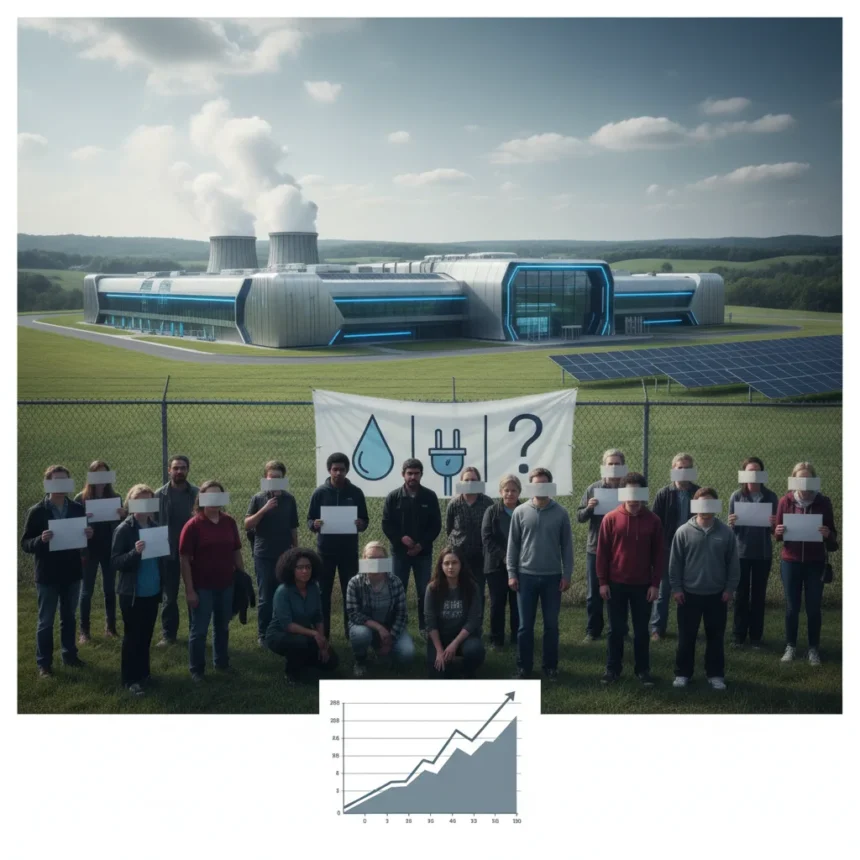
AI data center expansion in Pennsylvania is facing growing grassroots resistance as residents feel excluded from decisions that directly affect their communities. At a recent two-hour online forum, more than 20 speakers voiced concerns to Governor Josh Shapiro’s administration about proposed projects, with about 225 people watching the discussion unfold.
Key Takeaways
- Pennsylvania residents report feeling “bulldozed” by rapid AI data center development decisions made without adequate community input.
- Quinnipiac University polling shows 68% of registered voters would oppose an AI data center in their community.
- Emerson College survey found Pennsylvanians split: 38% support data-center development, 35% oppose it.
- Governor Shapiro proposed standards requiring new data centers to secure their own power or fully fund infrastructure costs.
- Key concerns include rising electricity costs, heavy water consumption, noise pollution, and environmental impacts.
Why Pennsylvania Communities Are Pushing Back on AI Data Center Expansion
The opposition to AI data center expansion stems from a fundamental disconnect between state-level economic incentives and neighborhood-level quality of life. Jennifer Dusart, a small business owner from Mechanicsburg near the state capital, articulated the core grievance: “This is a public trust and transparency issue.” She continued, “Too many Americans are finding out about these projects after decisions have been made. We have been bulldozed over, and when citizens have raised concerns, they are often dismissed as uninformed, emotional or anti-progress.”
The concerns are concrete and measurable. Residents report anxiety about rising electricity prices as data centers draw power from regional grids, heavy water consumption in communities where water availability is already strained, noise pollution from industrial operations, and the transformation of rural areas into industrial zones. Property values and environmental quality are secondary concerns that compound the primary issue: communities feel they have no say in whether these projects arrive at all.
Public opinion data reveals the depth of local opposition. A Quinnipiac University poll of Pennsylvania registered voters found that 68% said they would oppose a data center for AI in their community. This contrasts with broader state-level sentiment captured in an earlier Emerson College survey from November, which showed 38% of Pennsylvanians supported data-center development while 35% opposed it. The gap between abstract support and personal opposition suggests residents approve of development in theory but reject it in practice when it lands in their backyards.


What Governor Shapiro Proposes to Address AI Data Center Expansion Concerns
Rather than halting AI data center expansion, Governor Shapiro’s administration has proposed guardrails designed to protect communities while capturing economic benefits. In his February budget address, Shapiro outlined standards requiring new data centers seeking state support to either provide their own power rather than drawing it from the grid, or fully fund their power needs and the transmission infrastructure required to support them. This approach attempts to shift the burden of energy costs away from existing residents and onto the companies benefiting from the development.
State spokesperson Rosie Lapowsky framed the administration’s position: “If companies want the Commonwealth’s full support — including access to tax credits and faster permitting — they must meet strict expectations around transparency, environmental protection, and community impact.” The condition linking state incentives to transparency and community engagement represents an acknowledgment that the previous development process failed on these fronts.



However, proposed standards differ fundamentally from enacted policy. These measures exist as conditions for state support, meaning companies that decline tax credits and faster permitting face no obligation to meet them. The framework creates incentives for responsible development but does not mandate it for all projects, leaving room for data centers to proceed without state backing and potentially without the same environmental or transparency requirements.
How AI Data Center Expansion Compares to Other Infrastructure Debates
The Pennsylvania conflict reflects a broader national pattern where infrastructure development that generates wealth at the state level creates localized costs for residents. Unlike renewable energy projects that communities sometimes embrace for environmental reasons, or traditional industrial facilities that create immediate jobs, data centers offer abstract economic benefits—tax revenue, some construction jobs, minimal ongoing employment—while imposing tangible daily costs: higher electricity bills, water depletion, noise, and visual industrialization of rural areas.
The transparency issue distinguishes this conflict from many infrastructure debates. Residents are not primarily arguing against data centers as a category; they are arguing for inclusion in decisions that affect them. The repeated assertion that “decisions have been made” before communities learn about projects suggests a procedural failure rather than purely a policy disagreement. This distinction matters because it points toward solutions—better notification, earlier community engagement, genuine input mechanisms—rather than ideological deadlock.
What Happens Next for AI Data Center Expansion in Pennsylvania
The political pressure is mounting. Residents at the forum expressed willingness to vote based on this issue, with some stating they would work to prevent Governor Shapiro’s future political advancement if he continues prioritizing corporate development over community concerns. Whether Shapiro’s proposed standards satisfy this anger remains unclear; they address some concerns but do not grant communities veto power over projects.



The outcome in Pennsylvania will likely influence how other states approach AI data center siting. As artificial intelligence infrastructure becomes essential to economic competitiveness, the question of how to balance state-level growth with local quality of life will intensify. Pennsylvania’s current struggle represents an early test case for whether state governments can thread that needle or whether AI data center expansion will become a flashpoint in every community targeted for development.
Are Pennsylvania residents actually opposed to all data center development?
Not necessarily. The Emerson College survey showed 38% of Pennsylvanians support data-center development, indicating appetite for growth exists. The opposition centers on process—lack of transparency and community input—and on cost-shifting, where existing residents bear the burden of increased electricity costs and environmental impact while companies capture the profit. Better transparency and cost management could shift some opposition.
What power requirements are proposed for new AI data centers in Pennsylvania?
Governor Shapiro’s February proposal requires new data centers seeking state support to either generate their own power independently from the grid or fully fund both their power needs and the transmission infrastructure required to deliver that power. This prevents companies from drawing power from existing grids and passing the cost to local residents through higher electricity rates.
How do Pennsylvania’s proposed data center standards compare to other states?
The research brief does not provide information about data center standards in other states, so a direct comparison cannot be made. Pennsylvania’s approach of conditioning state incentives on transparency and environmental protection represents one model, but whether it is stricter or more lenient than standards elsewhere is not documented in available sources.
The Pennsylvania data center debate is ultimately about power—both electrical and political. Residents want a voice in decisions that reshape their communities, and they are using public forums and electoral pressure to demand it. Whether Governor Shapiro’s proposed standards satisfy that demand, or whether the conflict escalates, will determine whether AI data center expansion in Pennsylvania proceeds smoothly or becomes a cautionary tale about infrastructure development that ignores local concerns.
Edited by the All Things Geek team.
Source: TechRadar