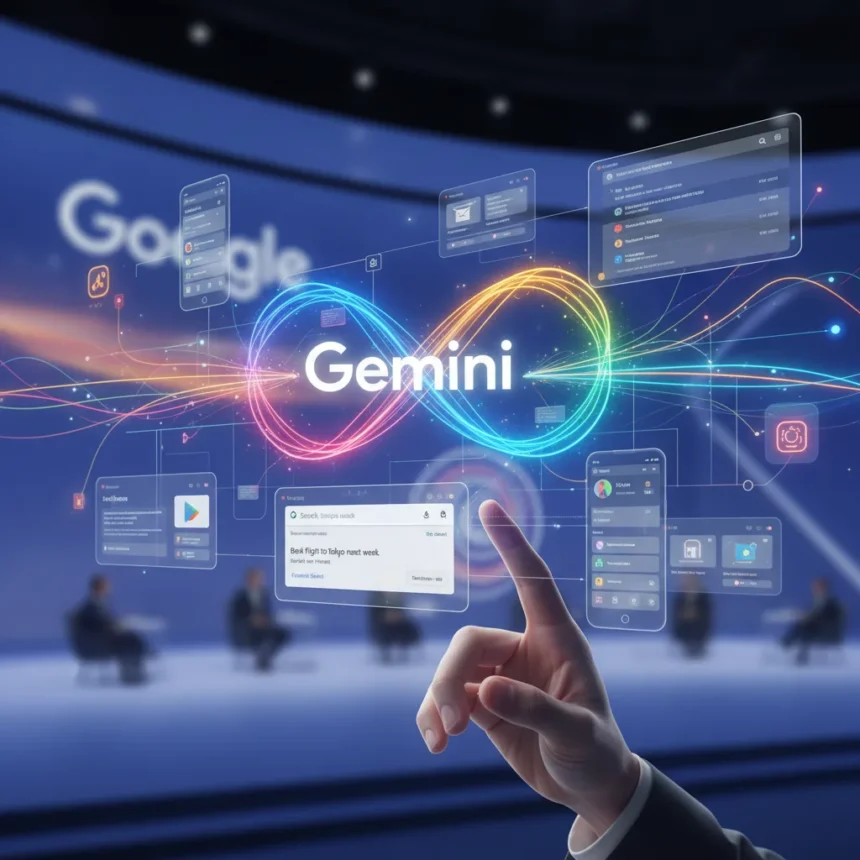
Google’s Gemini updates Google I/O 2026 mark a fundamental shift in how the company sees AI: not as a chatbot you ask questions, but as an agent that strips away repetitive work across your entire digital life. At this year’s conference, Google unveiled five major Gemini integrations designed to automate shopping, search, email, mobile tasks, and desktop workflows. The move signals that Google is betting on AI agents, not conversational assistants, as the future of productivity.
Key Takeaways
- Gemini is shifting from conversational chatbot to system-wide agent that automates repetitive tasks across Google products
- Five major updates span Search, Gmail, Android, Play Store, and desktop workflows with varying rollout timelines
- Daily Brief creates personalized morning digests using Gmail and Calendar data for AI Plus, Pro, and Ultra subscribers
- Gemini Spark automates desktop workflows on macOS with access to local files and apps
- Ask Play and Play Shorts introduce AI-powered app discovery, replacing traditional browsing with agent-driven recommendations
Gemini updates Google I/O 2026 redefine what an AI assistant does
The five Gemini updates Google I/O 2026 announced represent a departure from traditional AI assistants. Instead of waiting for you to ask a question, these updates push Gemini into the background to handle tasks before you even realize you need help. Daily Brief generates personalized morning digests by pulling data from your Gmail inbox and Calendar, delivering a curated summary without you lifting a finger. This compares directly to Samsung’s Now Brief, which offers similar personalized briefings but lacks Gemini’s integration depth across Google’s ecosystem.
The shift matters because it changes the relationship between user and AI. Rather than opening an app and typing a prompt, you wake up to actionable intelligence. For busy professionals juggling email overload and fragmented schedules, this automation removes a genuine friction point. The feature rolls out today for Google AI Plus, Pro, and Ultra subscribers in the U.S., making it immediately available to paid users.
Search gets smarter reasoning with AI Mode
Google’s AI Mode in Search represents a significant evolution in how the search engine handles complex questions. Unlike traditional Search results that return a list of links, AI Mode delivers advanced reasoning, thinking, and multimodal capabilities that synthesize answers across multiple sources in real time. This is not a minor tweak—it is a fundamental reimagining of search as a reasoning engine rather than an indexing system.



The practical impact is substantial. Instead of running five separate searches to answer a complex question—say, comparing neighborhoods for relocation—AI Mode potentially answers it in one interaction. Google One AI Premium subscribers can access this in Labs, though broader rollout timelines remain unclear. Traditional search engines and older AI chatbots lack this integrated reasoning layer, making AI Mode a genuine differentiator in how Google competes with both traditional search and newer AI-first interfaces.
Gmail and desktop automation close the loop
Gemini Spark brings AI automation to macOS, letting the assistant work with local files and desktop applications to automate workflows that previously required manual switching between tools. Early trusted testers are getting access now, with Google AI Ultra subscribers expected to receive beta access starting next week. This is the first major expansion of Gemini beyond Google’s cloud ecosystem into the broader desktop environment.



Meanwhile, Gmail assistance handles the email workflows that consume hours of knowledge worker time each week. Gemini can help draft messages, summarize threads, and organize inboxes—tasks that are repetitive but cognitively demanding. Combined with Spark’s desktop capabilities, these updates position Gemini as a cross-platform agent rather than a mobile-first or web-only tool.
Android and Play Store get agentic AI discovery
Ask Play lets users discover apps through Gemini rather than browsing the Play Store manually, while Play Shorts introduces a TikTok-style feed for app discovery. Both features represent a shift from user-initiated search to agent-driven recommendations. Instead of you deciding what apps to look for, Gemini surfaces options based on your behavior and stated needs.
Android Halo, meanwhile, shows live AI agent activity on your phone without interrupting your workflow—a visual indicator that Gemini is working on your behalf in the background. This addresses a real pain point: users want AI automation but also want visibility into what the system is doing. Halo solves this by making agent activity transparent without requiring you to open an app.
Why Gemini updates Google I/O 2026 matter right now
The timing of these Gemini updates Google I/O 2026 reflects growing competition in AI assistants. Apple’s Siri, Samsung’s Bixby, and standalone tools like ChatGPT all claim to boost productivity, but most remain conversational—you ask, they answer. Google’s agentic approach is fundamentally different: Gemini acts on your behalf across multiple products simultaneously. This architectural advantage is hard to replicate because it requires deep integration across an entire ecosystem, something only Google, Apple, and Microsoft can realistically achieve.


For users, the promise is clear: less busywork, more time for actual thinking. Whether these updates deliver on that promise depends on execution, privacy safeguards, and how smoothly Gemini learns your preferences over time. Early rollouts suggest Google is confident enough to push these features to paying subscribers first, a signal that the company believes they work.
How do Daily Brief and Gemini Spark differ from older AI assistants?
Daily Brief and Gemini Spark represent a move toward proactive AI. Traditional assistants wait for input; these features act without prompting. Daily Brief pulls your Gmail and Calendar data to create a morning digest, while Spark automates desktop tasks by understanding your workflows. Older assistants like Siri or Cortana remain reactive—they answer questions but do not anticipate needs or automate repetitive sequences.
Will these Gemini updates Google I/O 2026 work across non-Google apps?
Gemini Spark’s macOS version can integrate with local files and some desktop applications, but the research brief does not specify which third-party apps are supported or whether deep integrations exist beyond Google‘s ecosystem. Early access is limited to trusted testers, so full capability details remain unclear. Broader third-party integration would significantly expand Gemini’s utility, but that remains to be seen.
When will all five Gemini updates Google I/O 2026 be generally available?
Rollout timelines vary by feature. Daily Brief is available today for paid subscribers in the U.S. Gemini Spark goes to trusted testers now, with Google AI Ultra subscribers getting beta access next week. AI Mode, Ask Play, and Android Halo are rolling out in the U.S. with varying availability windows. Full global availability and free-tier access are not yet confirmed for all features.
Google’s Gemini updates Google I/O 2026 signal a decisive bet on AI agents over chatbots. Whether you see productivity gains depends on how well Gemini learns your workflows and whether you trust the system to act on your behalf. For now, the company is putting these tools in the hands of paying subscribers first—a smart move that lets Google refine the experience before pushing to the broader user base.
Edited by the All Things Geek team.
Source: Android Central