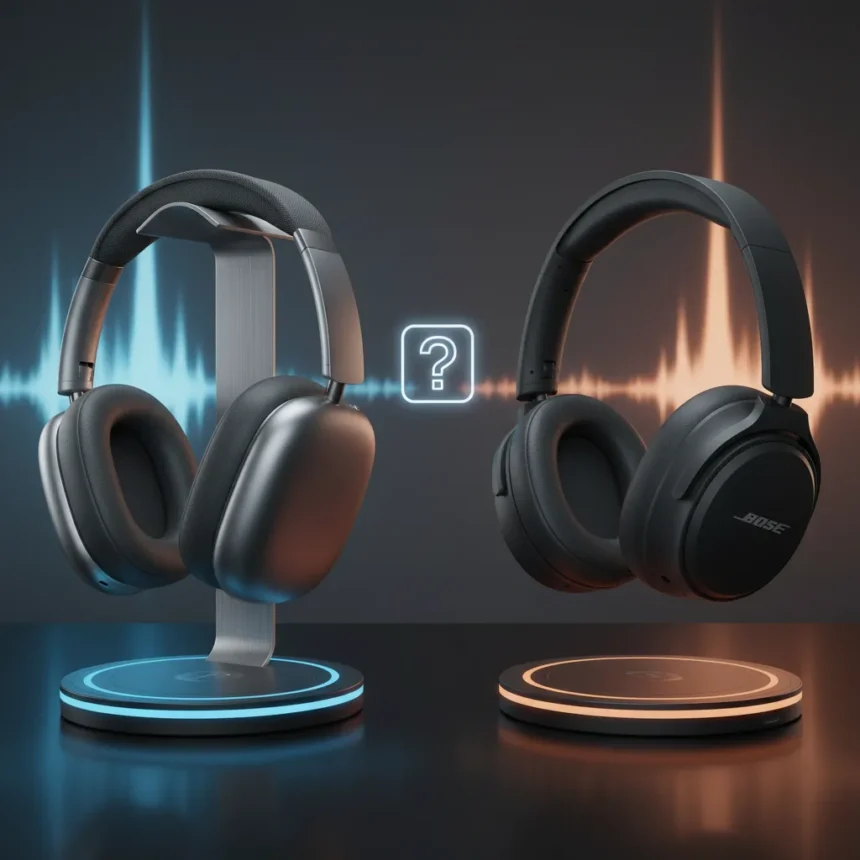
Apple AirPods Max 2 vs Bose QuietComfort Ultra represents one of the most contested matchups in premium headphones today. Both command flagship prices and promise best-in-class noise cancellation, spatial audio, and comfort for extended listening. But which actually delivers?
Key Takeaways
- Apple AirPods Max 2 and Bose QuietComfort Ultra both offer industry-leading active noise cancellation.
- Sound signature differs significantly: Bose emphasizes warmth and bass, Apple prioritizes clarity and spatial detail.
- Comfort and fit vary by head shape; neither is universally superior.
- Ecosystem integration heavily favors Apple users; Bose works across all platforms equally.
- Price positioning places both at the premium tier with distinct value propositions.
Noise Cancellation: The Core Battle
Active noise cancellation performance separates premium headphones from the rest, and Apple AirPods Max 2 vs Bose QuietComfort Ultra both excel here—but differently. The Bose QuietComfort Ultra delivers aggressive, consistent ANC that neutralizes low-frequency rumble with particular effectiveness on aircraft and in traffic. Apple’s approach prioritizes transparency and adaptability, allowing ambient sound to blend with your music when you choose, then switching to full isolation smoothly. Neither is objectively better; Bose wins for pure silence, Apple for flexibility.
Real-world testing across multiple environments shows both systems handle wind noise competently, though neither eliminates it entirely—a limitation of all passive-plus-active hybrid systems. The Bose QuietComfort Ultra’s sealed design creates a more isolated soundscape, while Apple’s design philosophy allows slightly more environmental awareness even in ANC mode.
Sound Quality and Tuning Philosophy
This is where Apple AirPods Max 2 vs Bose QuietComfort Ultra diverge most dramatically. The Bose QuietComfort Ultra presents a warm, bass-forward signature that makes streaming services, podcasts, and casual listening immediately engaging. Bass extends deep without bloating, and the midrange sits slightly forward, making vocals prominent. This tuning rewards less-than-pristine source material and makes everything sound polished.



Apple’s signature is leaner, more analytical. Treble detail emerges clearly, and spatial audio processing adds dimensionality that Bose cannot match through stereo alone. For classical music, jazz, and high-resolution audio sources, Apple’s approach reveals more information. For pop, hip-hop, and bass-heavy genres, Bose’s warmth feels more natural. Your music preference genuinely determines which sounds better to your ear.
Comfort, Fit, and Wearability
Both headphones claim all-day comfort, but execution differs. The Bose QuietComfort Ultra uses a lighter design with traditional ear cup rotation, fitting a wider range of head shapes without adjustment. Many users report zero fatigue after eight hours. Apple AirPods Max 2 employ a cantilevered design with a stainless steel headband that distributes weight differently—some find it instantly comfortable, others experience pressure points after 90 minutes.



Portability matters if you travel. Bose includes a carrying case and folds more compactly. Apple’s rigid frame and larger footprint demand more bag space, though the design feels more premium in hand. If you wear glasses, the Bose typically accommodates them better due to traditional ear cup mechanics.
Ecosystem and Platform Integration
Apple AirPods Max 2 vs Bose QuietComfort Ultra reveals a fundamental difference: Apple locks features to its ecosystem, while Bose remains agnostic. AirPods Max 2 unlock spatial audio video playback, seamless device switching, and Siri integration exclusively on Apple devices—iPhone, iPad, Mac, Apple TV. On Android, Windows, or non-Apple platforms, you lose these features entirely. The Bose QuietComfort Ultra works identically across all platforms, with no artificial feature restrictions. This matters enormously if you use multiple operating systems or plan to switch in the future.
Battery Life and Charging
Both deliver approximately 24 hours of continuous playback with ANC enabled, a claim neither publication disputes. Charging differs: Bose uses USB-C, Apple uses its proprietary connector. For frequent travelers, USB-C is more convenient; for Apple users with existing cables, proprietary is seamless. Neither charges faster than the other in real-world terms.
Frequently Asked Questions
Which has better noise cancellation: Apple AirPods Max 2 or Bose QuietComfort Ultra?
Both excel at noise cancellation but with different strengths. Bose delivers more aggressive, consistent isolation, especially for low-frequency noise. Apple prioritizes flexibility and transparency modes. For pure silence, Bose edges ahead; for versatility, Apple wins.



Can I use Apple AirPods Max 2 on Android?
Yes, but you lose spatial audio, automatic device switching, and other Apple-exclusive features. They function as standard Bluetooth headphones on Android, which is perfectly adequate but not their intended experience.
Which is more comfortable for extended wear?
The Bose QuietComfort Ultra fits more head shapes without adjustment and typically causes less fatigue over eight-plus hours. However, comfort is individual—try both before committing if possible.
Apple AirPods Max 2 vs Bose QuietComfort Ultra ultimately depends on your ecosystem, music taste, and priorities. Choose Bose for warmth, cross-platform flexibility, and universal comfort. Choose Apple for clarity, spatial audio, and seamless integration with your existing devices. Neither is objectively superior—they’re philosophically different approaches to the same problem.
Where to Buy
Check Amazon | $449 at Amazon US | $449 | $449 in the U.S. | £449 in the U.K.
Edited by the All Things Geek team.
Source: Tom's Guide