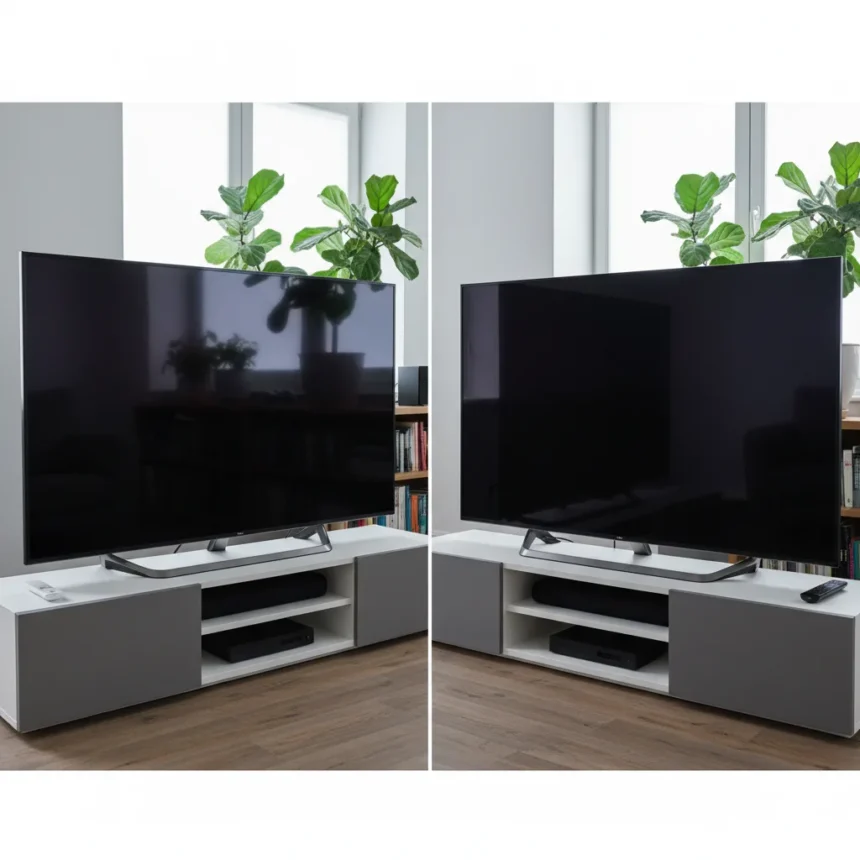
The LG B5 vs B6 OLED decision comes down to a simple question: does LG’s newest entry-level model deliver enough improvement to justify spending more? After comparing the two, the answer for most buyers is no. The LG B5 remains the smarter choice if you want affordable OLED picture quality without paying for features you won’t use.
Key Takeaways
- LG B5 is the current entry-level OLED with peak brightness around 650 nits and Delta-E of 1.7
- B5 supports 4K/120Hz gaming with four HDMI 2.1 ports, VRR, and FreeSync
- B5 delivers core OLED benefits: perfect blacks, ultra-wide viewing angles, and pixel-level dimming
- 48-inch B5 dropped to $599 during promotional pricing at Best Buy
- Main B5 compromise is contrast handling in dark and shadowy content
What Makes the LG B5 the Entry-Level OLED Standard
The LG B5 is the most affordable LG OLED TV currently available, and it proves you don’t need to spend flagship money to get true OLED picture quality. This non-evo entry-level model delivers the fundamental OLED advantage: perfect black levels achieved through pixel-level dimming, combined with ultra-wide viewing angles that keep the picture consistent from extreme positions. For a TV that costs less than many mid-range LED models, that’s genuinely impressive.
Where the B5 shows its budget positioning is brightness. Tom’s Guide measured peak brightness at approximately 650 nits in HDR content, with a Delta-E of 1.7 and Rec. 2020 color gamut coverage of 76.59%. Those numbers pale next to the LG C5’s 1,165 nits or the flagship G5’s 2,296 nits, but they’re sufficient for most living rooms. The real compromise isn’t brightness—it’s contrast handling in dark and shadowy scenes, where the B5 struggles compared to higher-end OLEDs.
Gaming is where the B5 punches above its price. The TV includes four HDMI 2.1 ports supporting 4K/120Hz gaming, plus VRR, FreeSync, and G-Sync compatibility. This puts it on equal footing with much pricier models for console and PC gaming. Streaming apps, Google Cast, Apple AirPlay 2, Dolby Vision, and webOS round out a feature set that feels complete for the price.



LG B5 vs B6 OLED: Where the Upgrade Falls Short
The LG B5 vs B6 comparison reveals minimal meaningful differences. Both occupy the non-evo entry-level tier, meaning they share the same core architecture and compromise on brightness compared to higher-end LG OLEDs. Without access to full B6 specifications in available reviews, the upgrade path appears incremental at best—the kind of generational refresh that improves a few metrics by single-digit percentages while keeping the core weaknesses intact.
The real question isn’t whether the B6 is better. It probably is, marginally. The question is whether those improvements justify paying more when the B5 already delivers OLED’s most valuable trait: perfect blacks and infinite contrast in bright rooms. For gaming, the B5’s four HDMI 2.1 ports and 4K/120Hz support remain competitive even against newer models. For movies and TV, the B5’s color accuracy (Delta-E 1.7) is solid, and the contrast limitation affects only a narrow slice of content—mostly dark cinematography and shadowy game scenes.



B5 Pricing Makes the B6 Harder to Justify
The LG B5 has been aggressive on price. The 48-inch model dropped to $599 during promotional periods at Best Buy, the 55-inch hit $799 to $896 at Amazon depending on timing, and even the 65-inch fell below $1,000. At these price points, the B5 becomes genuinely disruptive—it’s the entry point where OLED stops being a luxury and starts being an option for budget-conscious buyers.
For context, the 55-inch LG C5 carries a $200 premium over the B5 and adds 4K/144Hz gaming support and significantly higher brightness. That’s a clearer upgrade path for gamers or brightness-sensitive rooms. The B6, positioned between the B5 and whatever comes next in LG’s lineup, has to justify its price against an entry-level model that’s already remarkably cheap and feature-complete. Unless the B6 brings substantial brightness improvements or novel features, it’s a harder sell.
Should You Buy the LG B5 or Wait for the B6?
Buy the B5 now if you find it at a promotional price—particularly the 48-inch at $599 or the 55-inch under $850. OLED technology doesn’t depreciate slowly; a B5 at that price is a genuine bargain that will hold its value and performance for years. The B5 delivers OLED’s core benefits without requiring you to spend flagship money, and its gaming features remain competitive.
Wait for the B6 only if you specifically need higher brightness for a very bright room or if you’re willing to spend noticeably more for incremental improvements. The B5’s contrast limitation in dark content is real but affects a minority of viewing scenarios. For most buyers—gamers, streamers, movie fans in typical living rooms—the B5 remains the smarter entry-level OLED choice.



How does the LG B5 compare to the C5 for gaming?
Both support four HDMI 2.1 ports and 4K/120Hz gaming with VRR and FreeSync. The C5 adds 4K/144Hz support and reaches 1,165 nits brightness versus the B5’s 650 nits. For 120Hz console gaming, they’re equivalent; for PC gaming at 144Hz or very bright rooms, the C5 justifies its $200 premium.
What’s the main picture quality weakness of the LG B5?
The B5 struggles with contrast in dark and shadowy content, where higher-end OLEDs maintain better separation between dark tones. Bright rooms and well-lit content show no meaningful difference compared to pricier models.
Is the LG B5 worth buying in 2025?
Yes, especially at promotional prices under $650 for the 48-inch or under $850 for the 55-inch. The B5 delivers authentic OLED performance—perfect blacks, infinite contrast, wide viewing angles—without the flagship price tag. Its gaming features remain competitive, and its color accuracy is solid. The B6 may improve marginally on paper, but the B5 already solves the core problem: making OLED affordable.
Where to Buy
Check Amazon | $799.99 at Amazon
Edited by the All Things Geek team.
Source: Tom's Guide